Dutch Christians face opposition over statement on biblical sexuality
Christian leaders in the Netherlands are facing backlash over a statement affirming biblical sexuality, Baptist Press reported late last week. The Nashville Statement, released in 2017 by U.S. evangelicals including the Southern Baptist Ethics and Religious Liberty Commission, in part affirms “that it is sinful to approve of homosexual immorality or transgenderism and that such approval constitutes an essential departure from Christian faithfulness and witness.”

In the Netherlands, where same-sex marriage was legalized in 2001, signers of the statement have been threatened with criminal prosecution, BP reported.

Harvest Church to drop lawsuit
Harvest Bible Chapel announced plans to drop a lawsuit against a reporter and a group of bloggers who released reports of mismanagement and poor leadership at the Chicagoland megachurch. Harvest and Pastor James MacDonald claimed defamation when they sued reporter Julie Roys and the team behind “The Elephant’s Debt” last October. Earlier this month, a judge denied the church’s attempt to keep subpoenaed documents private, Christianity Today reported.

MacDonald was scheduled to preach at the 2019 SBC Pastors’ Conference this June, but withdrew in December.

Dockery to lead Missouri university’s theology evaluation
A Southern Baptist university in Missouri will undergo an evaluation to ensure its “theological integrity is intact,” The Christian Post reported Jan. 11. Students at Southwest Baptist University in Bolivar have protested the dismissal of Professor Clint Bass, who was fired after expressing concern over some faculty members’ theological views. SBU told The Christian Post it had intended to have conversations on theology in fall of 2019, but Bass’s dismissal and the public fallout moved up the timeline.

The theology review at the university, which is affiliated with the Missouri Baptist Convention, will be led by David Dockery, president of Trinity International University in Deerfield, Ill.

Hurricane relief continues in new year
Disaster Relief efforts in Florida and North Carolina are ongoing, Baptist Press reported Jan. 8, in response to 2018’s Hurricanes Michael and Florence. Teams are continuing to serve in affected areas, and plans are underway for college students to join the response during spring break. More information is available at SendRelief.org/GenSend.

Barna releases new insights on pastors and their work
Almost three-fourths of pastors feel content with their role, Barna reports, but more than half had another career before going into ministry. And a quarter another job in addition to their work as a pastor.

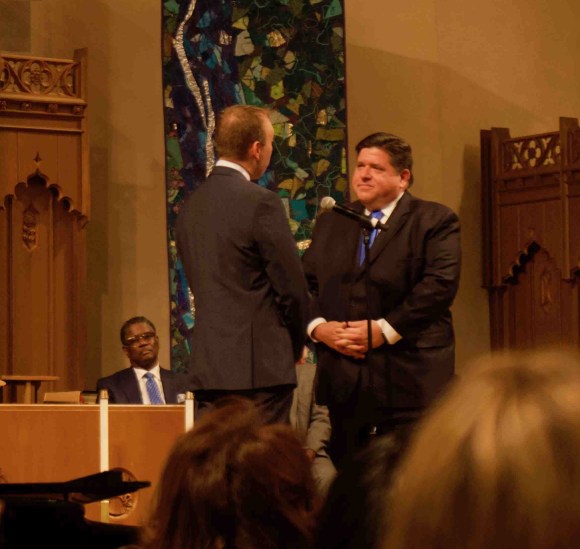
Governor J.B. Pritzker and a slate of other leaders were sworn in today in Springfield, signaling what many supporters have called “a new day” for Illinois. At a prayer service at historic First Presbyterian Church in Springfield, where Abraham Lincoln and his family once worshiped, Pritzker and five other constitutional officers were prayed over by their own spiritual leaders to start their terms of service in Illinois.

Under the church’s towering stained glass windows, faith leaders also read passages from the Bible and the Quran, and talked about the principles held closest by people who practice their faith traditions. They spoke of justice and mercy, ideals Pritzker talked about when discussing his own Jewish faith and upbringing in an interview last summer.

pritzker_prayer_web

Rabbi Seth M. Limmer prays for Gov. J.B. Pritzker (right) at a service prior to his inauguration.

They celebrated the leaders who were elected in November, and spoke hopefully of how their service will benefit the people of Illinois. The crowd packed into wooden pews cheered Springfield pastor T. Ray McJunkins’ optimistic message with its refrain of “the best is yet to come.” The prayer service was a good way to start inauguration day, many would say later.

As I sat in the sanctuary, my thoughts turned to people of faith who weren’t represented on the platform. How should members of our Illinois Baptist churches engage with an administration whose views on many issues undoubtedly run counter to their own? We’ll cover that topic in a longer story in the Jan. 21 issue of the Illinois Baptist, but for now, I can say I left the prayer meeting hopeful.

My hope isn’t based on political agendas or the current administration’s position on specific issues—indeed, I disagree with more than I agree with in those areas. Rather, my hope stems from wisdom I heard while reporting on Gov. Pritzker’s inauguration: Real victory doesn’t rely on political victory. As Southeastern Seminary’s Bruce Ashford told me, “We do what we do out of witness and obedience, and not because we have to win.”

pritzker_inauguration_web

Gov. Pritzker and his family are introduced at the inauguration ceremony in Springfield.

Lieutenant Gov. Juliana Stratton said something similar after her swearing-in today. Community building is done when we put our own self-interests on hold, she said, and commit to working side-by-side. Even when it’s hard.

While I wasn’t necessarily represented on the platform today, I did hear the call to engage the process even when my side isn’t winning. That reminder was a good way to start inauguration day.

Meredith Flynn is managing editor of the Illinois Baptist newspaper.


To save a life

Lisa Misner —  January 14, 2019

A Michigan church is fighting to prevent abortions, and build lasting relationships with families.

By Grace Thornton

Justin Phillips.jpg

Justin Phillips holds a baby saved from abortion.

Editor’s note: January 20 is Sanctity of Human Life Sunday.

Justin Phillips said it’s the best and worst thing he’s ever done with his life. Every day, he stands across the strip mall parking lot from a door marked simply G-3422. It’s sandwiched between two dollar stores.

Every week, 20 to 30 babies are aborted there.

“We’re out there pleading with moms and dads to have mercy on their child, and we’ll help,” said Phillips, a full-time missionary with ONElife for Life, a ministry of ONElife Church in Flint, Mich.

Since ONElife for Life began in May 2016, dozens of babies that they know of have been saved out of G-3422. And the ministry has grown, said Eric Stewart, pastor of ONElife Church and president of ONElife for Life. They’ve acquired a building next to the strip mall that will be a pregnancy resource center and they’ve been given a bus that will be used as a mobile ultrasound.

They’ve also expanded their reach to conversations outside a second abortion clinic in town.

It’s been slow growth. Stewart’s big-picture goal is for Christians to have a presence outside each of the nation’s 720 abortion clinics. Right now, ONElife for Life is covering two.

Stewart and Phillips have been speaking in churches in recent months trying to awaken a desire to pick up the mantle. When he speaks, Stewart said the first thing he does is ask the church he’s visiting to repent with him.

“For years, I did nothing, but if it’s really murder, then we have to face that reality,” Stewart said. “If someone drove into our town and wiped out an entire kindergarten class every week, we wouldn’t sit idly by and say, ‘It’s not affecting me.’”

The story of the Good Samaritan demands the liability of the bystander, he said.

Stewart said he thinks about it all the time, ever since he heard a story about how one particular church in Nazi Germany would sing louder on Sundays so they wouldn’t have to hear the trains chugging by on the way to the concentration camps.

“We hear that story, and do we not wish that there would have been Christians who went to the point of injustice and said, ‘No, we can’t let this happen,’” Stewart said. “We have our opportunity now. We are living in the American holocaust and we have the opportunity to [speak] in Christ’s name.”

For churches interested in being involved, Stewart and Phillips can provide training in how to start a ministry like ONElife for Life and have conversations with people outside abortion clinics. They aren’t there to protest, Stewart said. They’re simply there to show love and offer mothers the help they need to bring a baby full term.

“We want to equip the church. We’ve learned how to train people to do this kind of ministry—we’ve learned from our own mistakes and would love to pass that along so that people don’t have to reinvent the wheel,” Stewart said. “We’ve thrown our lives into this, and we would love to duplicate it all over the place. We need gospel-saturated missionaries to confront the darkness and abolish the evil of abortion. It really is a life-or-death situation.”

There’s an emotional toll to the ministry of standing at a “modern-day concentration camp,” Stewart said. There at their tent across the parking lot, Phillips and volunteers from the church have conversations with anyone who will talk to them. They offer to adopt the baby or cover any financial needs the parents might have for the baby’s first three years of life. They remind each mother that God knows the baby in her womb.
Sometimes those babies are still aborted.

“But we’re compelled to go because we’re told to go to orphans in their distress, and these children have been disowned by their parents,” Phillips said.

And at least 85 have been saved. It could be more. They only know about it if a tearful mother meets them there on the edge of the parking lot and tells them she’s decided not to go through with it, or if the parents later choose to swing back by and let them meet the baby.

“Every month we have people who come back and say, ‘Hey, I never said anything, but here’s my baby,’” Stewart said. “So we know there’s probably more.”

God is at work there, shining light into the darkest of places, Phillips said. “We just stand there and watch him move. It’s all him. He brings people to us and saves babies all the time.”

One woman told Phillips that she didn’t want to talk to him, but her legs just walked her over there. After talking with him, she chose not to go through with it.

“It’s a battlefield all the time, and it’s an honor to stand there proclaiming a message of hope,” Phillips said. “We do that, and God does the rest. We can’t change hearts, but he can.”

It hasn’t been without pushback. Sometimes the clinic will have people posted in the parking lot to “shepherd” women into the building so they won’t have conversations with Phillips. Other times people have approached him with threats.

But in Christ, Phillips said he knows he goes out victorious already.

“It’s a horrible ministry, horrible to watch it every day,” he said. “But at the same time, to be able to lay down our lives in that way on behalf of Christ and his love for these babies is incredible.”

For more information about ONElife for Life, visit onelifeforlife.org.

Grace Thornton is a writer in Birmingham, Ala. This article is originally from Baptist Press, online at BPNews.net.

What’s trending in 2019

Lisa Misner —  January 10, 2019

Key issues in politics

IB Media Team Report

Will the church embrace immigrants?
After illegal border crossings declined in 2017 to a more than 40-year low, the numbers began climbing again in 2018. This included a record-setting number of people from Honduras, Guatemala, and Mexico traveling in September in a caravan toward the border.

Earlier in 2018, when the Trump administration attempted to deter immigration, migration declined. The government’s zero-tolerance policy ramped up criminal prosecution of anyone entering the United States illegally. But when 3,000 children were separated from their arrested parents, the policy came under attack, including a public letter of protest written to the administration by evangelical leaders.

“As Christians, we should share the heart of Jesus for refugees and others imperiled,” said Russell Moore, president of the Ethics and Religious Liberty Commission. “Those escaping violence and persecution in Honduras and elsewhere bear the image of God and should be treated with dignity and compassion.”

An executive order officially halted family separations in June, but immigration policy is still in limbo, a fact highlighted by a December court decision that grants those crossing the border illegally the right to seek asylum in the U.S. With its current trajectory, migration is expected to grow in 2019—increasing the challenge for the church to offer a biblical response to an increasingly volatile problem.

Is Pence courting evangelicals?
With the first Trump term at its midpoint, several questions face evangelicals: How do they view the president now, in light of increasing scrutiny over his ethical and legal behaviors and the pending special counsel’s report? And, in contrast to Trump, how do evangelicals feel about Vice President Mike Pence?

Self-described as both evangelical and Catholic, Pence has managed to stay above the fray mostly, while appealing to Republicans’ traditional faith-base. “We know that what you do in the ministries of your churches make an extraordinary difference in the life of our nation…” Pence told Southern Baptists in June. “You’re the cornerstone, not just of your communities but, in so many ways, of our country.”

Some wonder if Pence has his own presidential ambitions. In May, the New York Times reported while “[the President is] mostly uninterested in the mechanics of managing a political party” his “supremely disciplined running mate has stepped into the void.”

The Times also noted that while the two previous Vice Presidents “have played important roles maintaining the political coalitions of their ticket-mates, neither man wielded Mr. Pence’s independent influence over an administration’s political network and agenda,” referring in part to his networking with evangelicals on Trump’s behalf—and perhaps his own.

New justices differ on key issues
In a year that saw a vicious, partisan fight over a U.S. Supreme Court nominee with a pro-life record, many were surprised by that new justice’s decision in a life-related case.

The Court announced Dec. 10 it would not review decisions by lower courts in Kansas and Louisiana that require Medicare to remove Planned Parenthood as a patient provider. Controversial new Associate Justice Brett Kavanaugh joined more moderately conservative Chief Justice John Roberts and liberal justices in refusing to consider the lower court rulings.

Associate Justice Neil Gorsuch, Trump’s previous Court pick, joined conservative Justices Clarence Thomas and Samuel Alito in filing written dissents of the High Court’s decision. Kavanaugh’s move has caused many to speculate that he may be a more moderate influence on the Court than originally thought.

In the nearly three months since Kavanaugh joined the Court, he and Gorsuch have differed on rulings concerning abortion, immigration, and the environment, USA Today reported. “There’s a pattern here that you can’t ignore,” Curt Levey, president of the conservative Committee for Justice, told the newspaper. “It corresponds with our prediction for Kavanaugh, which is that he would be more like Roberts.”

Written by the IB Media Team for the 1/1/19 issue of the Illinois Baptist.

Gallup poll finds low expectations for global peace
70% of Americans expect 2019 to be “a troubled year with much international discord,” according to Gallup data collected in December. Hopes are higher for economic prosperity and employment, but the nation’s political system received a gloomy forecast from many respondents. 89% predicted a year of conflict, while only 11% foresaw a year of cooperation.

Bible app gets 1 million subscriptions on New Year’s Day
The YouVersion Bible app’s Bible-reading plans got more than one million new subscriptions to start the new year, The Christian Post reported. The app offers more than 13,000 reading plans, including some offered in 1,000 languages other than English.

Greear launches evangelism emphasis with local associations
Southern Baptist Convention President J.D. Greear will work with local associations of Southern Baptist churches to implement a focus on personal evangelism in 2019. “Who’s Your One?” is an initiative to encourage every Southern Baptist to share the gospel with one person this year. Greear will introduce the emphasis to his own local association—Yates Baptist Association—at a Jan. 31 simulcast available to associations across the country. More information is forthcoming at sbcassociations.org.

Third gender option legal in New York City, California
The nation’s most populous city and state now allow people to choose a “third gender,” often designated by X on legal documents. New York City and California join Arkansas, Colorado, Maine, Minnesota, Oregon, Washington State, and Washington, D.C., as places that allow a non-binary gender option for people who believe they are neither male nor female.

Passion attenders raise money for deaf Bible translations
Young people at this year’s Passion conference gave $450,000 toward translating New Testament stories in sign languages used in 16 countries. The Deaf Bible Society reports only 2% of deaf people around the world have been introduced to the gospel, and that there is no Bible translation for at least 95% of more than 400 unique sign languages used globally.

What’s trending in 2019

Lisa Misner —  January 7, 2019

Key issues for the Southern Baptist Convention

IB Media Team Report

A season for reinvention
There’s no time in living memory when there have been so many vacancies at the top of key SBC entities. The election of Paul Chitwood to the presidency of the International Mission Board in November fills but one of five vacant posts. Two seminaries (New Orleans and Southwestern), the Executive Committee, and LifeWay Christian Resources are all engaged in president searches right now.

There was a period of turnover after World War II that stretched over several years, and, of course, the Conservative Resurgence that swapped out leaders and philosophies of SBC entities over more than a decade. But this shifting of leadership gears represents the greatest change in the shortest time in living memory.

What is the effect of all that change in executive leadership?

In any organization, changes at the top mean changes in philosophy and style, the departure of some second-tier leaders and rearrangement of others, and—in general—a season of optimistic uncertainty.

People are glad there’s a new leader but unsure where that leaves them, and they are wondering about the new direction of the organization.

Multiply that times five, and the ripple effect is felt across the Convention.

If we consider the last round of changes at the top of the International Mission Board, the North American Mission Board, and LifeWay—and how long it took for the new leaders and their new plans to settle in—the SBC as a whole may be looking at two or three years of choppy water.

Making room at the table
Questions surrounding women in the church came into sharp relief in 2018 on the heels of #Metoo. Southern Baptists struggled through their own version of the movement, resulting in the termination of a seminary president and public investigations of pastors and missionaries accused of sexual abuse. Amid the scandals, women leaders denounced abuse and also prescribed preventive measures for churches and pastors.

In “A Letter to My Brothers” in May, Bible teacher Beth Moore called out misogyny of any kind among believers in Christ. “One of the most demoralizing realizations of my adult life,” Moore wrote, is “Scripture was not the reason for the colossal disregard and disrespect of women” among some key Christian leaders. “It was only the excuse. Sin was the reason. Ungodliness.”

Moore and others, including Texas Bible teacher Jen Wilkin, have called both men and women to more fervent Bible literacy, and to a reexamination of how men and women are called to build the church—together.

“The women e-mailing me regularly are not worried about winning the pulpit,” Wilkin wrote in 2015. “They are looking for leadership trajectories for women in the local church and finding virtually nothing. They watch their brothers receive advocacy and wonder who will invite them and equip them to lead well.”

As the dust settles on an unsettling movement, Baptists and other evangelicals still have questions to answer about what it really means for men and women to be made in the image of God, and treat each other as such.

The Greear Effect
The election of David Platt, then 35, to head the International Mission Board in 2014 prompted this question, but his departure this year means we have to ask it of another young leader, J.D. Greear, instead: What will be the impact of this young pastor on senior leadership in the SBC?

It’s probably too early to talk about his legacy, since he’s only six months into his first term as SBC president. It won’t be until the nominations for denomination committees are made in June that the presumed influence of Greear’s Reformed theology—as implemented by his likeminded peers—will be known. And we can only assume, based on a few comments he’s made, that his reluctance to embrace populist U.S. politics will mean an annual meeting with less public support for the Trump administration.

So far, we have only seen some public statements in support of Cooperative Program, and in November, a challenge to raise giving to the Lottie Moon Christmas Offering for International Missions by $10 million, surpassing IMB’s goal of $160 million. If giving reaches $170 million, Greear has pledged to engage in some kind of stunt in celebration.

The nature of the stunt is unknown, but Baptist Press reports, “suggested stunts include singing a duet with newly elected IMB President Paul Chitwood, arm wrestling Chitwood, performing a Broadway number, taking a pie in the face, and sporting a mullet at the SBC annual meeting.”

Signs are the Greear Effect seems, at this point, more youth-ministry than missional in nature. With four SBC entities still seeking head leadership (LifeWay, Executive Committee, and Southwestern and New Orleans seminaries), perhaps it will be in his second one-year term (if reelected) that Greear really makes his mark on behalf of a younger generation.

Written by the IB Media Team for the 1/1/19 issue of the Illinois Baptist.

Two watches

Lisa Misner —  January 3, 2019

WatchesBy Nate Adams

This past year, my sons convinced my wife that I needed a new watch. Frankly, that idea hadn’t occurred to me, because I already have a nice watch, one that has worked well for over 20 years. It’s also meaningful to me because it was a parting gift from friends at one of my previous employers.

In fact, to be honest, I really like my old watch. It’s wound by pendulum action, so it doesn’t need a battery. It has an easy-to-read face, allowing me to glance at it quickly during meetings, or sermons, which most people seem to appreciate. And it has the date right on it. What else would you want from a watch?

What else indeed! My new Apple watch does so much more than tell me the time and date. It reports how many calories I’ve burned that day, how many minutes I’ve exercised, even how many times I’ve stood up. It precisely describes the current weather conditions, and forecasts them for the future, wherever I am. It knows the time the sun will rise and set each day, and all about the latest news events. It displays my favorite photos, and with the press of a button it makes available dozens of other apps connected to my phone or computer.

When I set exercise goals or appointments or reminders, my watch vibrates or beeps and tells me what to do. Sometimes while I am sitting in a meeting it tells me I’ve been sitting too long and should stand up. So I do. When people ask me why, I now just say, “Because I work for my watch.”

These gifts are teaching me to appreciate the past and the present.

My new watch has also presented me with a challenge, however. After replacing my pendulum watch with my fancy new watch for a few days, I discovered that my old watch had stopped, and I couldn’t get it started again. The jeweler who repaired it told me that he couldn’t promise it would keep running, if I kept letting it wind down.

Some people would probably solve that problem by putting the old watch in a drawer and letting it become a relic, a memento of times past. But I’m not ready for my old watch to stop serving me, or reminding me of the people who gave it to me. So now, not every day, but every couple of days or in the evenings, I wear two watches, one on my left wrist and one on my right. It’s become kind of a conversation starter.

Since beginning that routine, I have started to ponder how much my dual watch situation represents an important reality in today’s churches. In practically every church, there is an older generation of leaders who have served well, and who can continue to serve well. And often, though not always, there is also a new generation of leaders with the same core beliefs and dedication to the church, but with new tastes in music, new needs and preferences, new skills in technology, and new ideas about reaching their generation with the gospel.

Wise pastors and mature church leaders learn to value both generations, and all they have to offer today’s churches. They don’t scorn new ideas and methods simply because the old ones still work just fine. But neither do they discard the old ways simply because some new style or preference comes along.

Sadly, that’s not always the case. It seems more churches are unwilling to learn the new than are discarding or devaluing the old. But a healthy church with a bright future will learn to value and utilize both generations, side by side, as I have my two watches.

Nate Adams is executive director of the Illinois Baptist State Association. Respond at IllinoisBaptist@IBSA.org.

In all circumstances

Lisa Misner —  December 27, 2018

By Adron Robinson

“Rejoice always, pray without ceasing, give thanks in all circumstances; for this is the will of God in Christ Jesus for you” (1 Thessalonians 5:16–18, ESV).

We cannot control what happens to us in life, but we can control how we respond to what happens to us. The Apostle Paul knew this to be true, so he gives us three ways to live a thankful life.

First, be joyful. The apostles did not encourage believers to live in denial. We are never to deny the fact that trials, tribulations, and adversities bring us pain and grief, but the child of God must recognize that in the midst of trials, tribulations, and adversities, the presence of God through the power of the Holy Spirit gives us reason for joy.

We can rejoice despite our circumstances because God is in control!

Second, be prayerful. The second command to pray is the foundation for the first command of joy and the last command to be thankful. Paul knows that in order to obey either we have to be praying people. Oftentimes our circumstances can cause us to abandon prayer, but if you don’t feel joy, pray! If you don’t see anything to be thankful about, pray! Let nothing stop you from praying!

Finally, Paul tells us to be thankful. It is the will of God that Christians be thankful, but we aren’t commanded to be thankful for everything, we are commanded to give thanks in everything. We cannot control our circumstances, but whatever the circumstance, we have reasons to thank God.

PRAYER PROMPT: Father, we thank you for your promise never to leave us or forsake us. And because of your presence we can be thankful in all things. Thank you for salvation, thank you for life eternal, and thank you for the gift of today. Help us, Lord, to live thankful lives, being grateful for all that you have given us through faith in Jesus Christ our Lord.

Adron Robinson is pastor of Hillcrest Baptist Church in Country Club Hills and president of the Illinois Baptist State Association.

The gift of presence

Lisa Misner —  December 24, 2018

By Nate Adams

Not long ago, my wife, Beth, and I were discussing whether or not to try and attend a wedding to which we had been invited. It was a considerable distance from our home and required a couple of nights in a hotel, driving and meal expenses, and at least one vacation day.

Though we both wanted to go, and felt we should, I found myself asking, “I wonder if the couple would rather have the money that we would spend on travel as a wedding gift?”

It’s not the first time I’ve asked that kind of question, and it probably won’t be the last. I remember international missionaries once telling me that a church had spent $50,000 to send a large mission team halfway around the world to serve with them for a few days.

They were grateful for the help and encouraged by the fellowship. But they also shared with me candidly, “We couldn’t help but think how much more we could have accomplished here with $50,000 if they had stayed home and just sent the money.”
Experiences like these underscore the sometimes difficult question, “How much is someone’s physical presence worth?” Or, to state it more casually and commonly, “Shall I go, or just send something?”

And of course, when the question presents itself at the time of someone’s death, it often has the additional pressure of urgency, since there is often little advance notice and little time to make a good decision about going. I still remember fondly and with great appreciation the people who traveled distances to attend my dad’s funeral. And I remember a funeral from almost 40 years ago that I still regret missing today.

How much is someone’s physical presence worth? It’s an excellent, spiritual question to ponder during this Advent season. Could Jesus have just “sent” the gift of salvation, without coming personally? Could he have dispatched someone else to the cross, or was it supremely, eternally important that he be there himself?

I think we miss something incredibly important if we celebrate salvation without celebrating incarnation. On that holy night when the Word became flesh and dwelt among us, he chose not just to be present with us, but to become one of us. Through Jesus, God entered in to our condition not just with sympathy, but with immeasurable sacrifice.

At Christmas, we celebrate God’s love and amazing grace in choosing to become human, in choosing to embrace mortality for the sake of our immortality. How much was the physical presence of Jesus worth? It was worth everything. It was worth our eternal lives.

By the way, eventually my wife and I did decide to attend that distant wedding. We decided to do so after remembering some of the older adults that traveled distances to attend our own wedding. We remembered wondering, at the time, why they went to such trouble. But now, decades later, we remember very few of their wedding gifts. But we still remember their presence.

There’s a worship song that says, in part, “I’ll never know how much it cost, to see my sins upon that cross.” That’s certainly true. And yet I wonder if we don’t reflect more on the gift of salvation than we do the very presence of “God with us” in the incarnation.

As great as the gift of salvation is, that gift is simply an expression of how much God loves us and is willing to sacrifice to be with us, both now on earth and throughout eternity in heaven. The value of his very presence eclipses even the value of his wonderful gift.

Nate Adams is executive director of the Illinois Baptist State Association. Respond at IllinoisBaptist@IBSA.org.

By J.D. Greear

What do we mean when we talk about the “favor of God”?

The house you’ve always wanted goes into foreclosure and you buy it for a steal. Your kids bring their report cards home and it’s straight A’s. You find out that a long lost relative left you a tidy sum of money.

Many people may think that God’s favor is something like that. When life seems to break your way, it’s easy to think, “God is really smiling down on me now. He must really love me.”

When we turn to the New Testament, though, we get a splash of cold water. The favor of God doesn’t always line up with great circumstances. Case in point: Mary.

When the angel Gabriel shows up to announce the first Christmas to Mary in Luke 1, he tells her twice that she has God’s favor. But her situation sure doesn’t look like it.

Gabriel has just told her she is going to be pregnant out of wedlock in a culture where this isn’t just frowned upon but could have been punishable by death. The man she loves, Joseph, is probably not going to understand the situation or believe her bizarre explanation and might leave her. She’s already poor, and if Joseph rejects her, she’ll be destitute. She might have to beg for a living.

So here’s Mary — financially insolvent, with a ruined reputation, her most important relationship in tatters.

Maybe you can relate if you sense no joy or good cheer this Christmas season, but dread. Your life doesn’t look like one “blessed and highly favored.” For you, Christmas only reminds you of all the good you don’t have in your life.

If that’s you, then Mary’s circumstances are particularly relevant, because she supposedly has the favor of God in the midst of all her mess. How?

Because a Son is being born to her — a Son, the angel says, whose name will be “Jesus,” meaning that He will save His people from their sins. Like all of us, Mary’s main problem was a severed relationship with God. Jesus was coming to restore that.

But Jesus was coming to do more than merely save from sin. Gabriel points out that He’ll also rule from the throne of David (Luke 1:32). It’s easy to miss how big that promise is. David’s throne symbolized the restoration of worldwide peace and blessing — a condition called shalom.

Think of the promise in Joel where the prophet says, “I will restore the years that the swarming locusts have eaten.” Not just forgive, but restore. Bodies destroyed by disease will leap and run in perfect health. Reputations that have been ruined will be exonerated. Relationships torn apart by death will be mended, as we see, in Tolkien’s words, “all the sad things come untrue.”

We know that God will do this because He did this with Jesus. At the cross, Jesus went through pain that looked like a defeat. But the Father used that pain for our good. He reversed it and turned the devil’s strongest attack into an opportunity to redeem us and restore the world.

Mary isn’t the only one with a miraculous birth in Luke 1. Her relative Elizabeth also gets a visit from Gabriel, and even though she’s barren, she is promised a child. Barrenness has never been easy, but in those days it would have been devastating, the biggest disappointment a woman could imagine. The lead-up to Jesus’ birth includes an elderly, barren woman getting pregnant because the birth of Jesus is God’s promise to erase our deepest disappointments.

What that means is we don’t have to be frantic if we don’t get to everything on our “bucket list.” Many of us live with such an urgency to experience everything that life becomes worthless if we don’t. It’s not the glib stuff, like not seeing the Grand Canyon, that really leads us to disappointment. It’s not getting married, or having children, or being financially comfortable, or overcoming an illness. What we need to see is that in the resurrection, under the reign of the Son of David, every disappointment will be fulfilled.

We have pain; He will reverse it. We have disappointment; He will erase it. We yearn for justice; He will restore it. When we go through seasons of racial strife in our country, many people start to ask, “Will there ever be justice?” Or maybe the yearning for justice is more personal: You’ve been wronged and just can’t get past it. You want to cry out like the psalmist, “Will the wicked go unpunished?”

Unless we look to God’s perfect justice — instead of our judicial system or our own efforts — we’ll always be bitter. Perfect justice will be restored but only when Jesus rules from David’s throne. That truth gives us the hope to continue working for justice now while enduring the injustice in the world.

In the end, that’s what God’s favor is all about. It’s what Christmas is all about — hope. God’s favor isn’t always easy. Sometimes, as with Mary, it brings with it a lot of difficulties. But it’s always good because it brings us a hope in God’s promises and an assurance that His presence will be with us.

J.D. Greear is president of the Southern Baptist Convention and pastor of The Summit Church in Raleigh-Durham, N.C.