pull quote_WARNOCKCOMMENTARY | Mark Warnock

At first glance, the fight about same-sex marriage appears to be over whether to “normalize” homosexuality. But there is a more chilling danger lurking unseen: legalizing same-sex marriage will change the government’s posture toward religion from neutral to antagonistic.

Marriage is a universal, God-given institution, which is set up to provide the best environment for the nurturing of children. Marriage fuses the private interests of romance and sex with the public interest of seeing that children are cared for.

Marriage was not created by either the state or the organized church, but both administer it.  More importantly, both have long agreed on its definition: a permanent joining of a man and woman, which authorizes their sexual congress and makes them responsible to parent any children they might have.

Now, however, our government wants to usurp marriage for its own, and change it to include homosexual couples.

Many Christian churches, including Baptists, are bound by Scripture and doctrines to the original, time-honored understanding of marriage. They simply cannot recognize same-sex marriage as legitimate. Redefining marriage will put government and religion on opposite sides of an unfriendly divide.

The state will soon find it necessary to enforce its new definition of marriage, and to protect those marriages from discrimination. Churches and synagogues that refuse to recognize same-sex marriages will risk the state’s wrath. Imagine if a church secretary enters a same sex marriage and wants to add her partner to her church-funded medical coverage. Or what if a gay couple wanted to rent the facilities for their ceremony? Would the law allow a church to say yes to some non-members, but no to others?

We have already seen the government force individuals and their businesses to recognize same-sex marriage in violation of their own religious convictions. All assurances that religious people have nothing to fear are coming from advocates of same-sex marriage, who view religion as an essentially private matter. The “assurance” they offer is that religious people can think whatever they want about same-sex marriages, but will still be forced in practice to acknowledge and accommodate them.

In this contest, the state has all the power. It can legislate, fine, remove tax exemption, and seize property. If same-sex marriage becomes law, religious people and institutions will find themselves no longer in a neutral, free, protected place in our society.

This may in fact be the sinister goal of same-sex marriage legislation. Under Illinois civil union law, homosexual couples already have all the rights that marriage would confer. The only meaningful difference is that legalizing same-sex marriage will increase the government’s power over religion.

The first American freedom may be about to fade away.

Mark Warnock is associate pastor at First Baptist Church of Columbia, Ill., and is studying for his Ph.D in Christian Philosophy at The Southern Baptist Theological Seminary in Louisville, Ky.


THE BRIEFING | Meredith Flynn

The number of non-Anglo congregations in the Southern Baptist Convention has increased by more than 66 percent since 1998, according to data from the convention’s agencies. Of the SBC’s 50,768 congregations, just over 10,000 identified themselves by an ethnicity other than Anglo in 2011, up from 6,044 in 1998.

SBC President Fred Luter, elected last year as the convention’s first African American president, rejoiced over the shift.

“I remember at one time I was the only [African American pastor] in my city who was Southern Baptist,” Luter said. “I caught a lot of flack as a result of that. Thank God I’m able to see some of the fruit of my labor – not only at my particular church but in the associations and conventions across the country.”

In Illinois, one-fourth of Southern Baptist churches, missions and church plants identify either as an ethnicity other than Anglo, or as a multi-ethnic church.

“Having been Southern Baptist since 1969, and to see the changes and see the increase, it’s simply exciting to me,” said Don Sharp, pastor of Faith Tabernacle Baptist Church in Chicago. “I really get a good handle on it when I go to Black Church Week at Ridgecrest, N.C., and see the gathering of close to 2,000 who come there who are Southern Baptist.

“I remember some years ago when we went there, and there weren’t enough of us to fill up one little room.”

The largest jump in non-Anglo congregations within the SBC has predominantly come from an 82.7 percent increase in the number of African American congregations, but Hispanic congregations also have seen a significant increase over the same span – nearly 63 percent. And the number of Asian congregations affiliated with the SBC has grown by 55 percent. Read more at BPNews.net.

-From Baptist Press, with additional reporting by Meredith Flynn

Other news

Richard Blackaby says prayer is hard workWhile in Springfield to speak to directors of missions and associational leaders, author Richard Blackaby sat down with the Illinois Baptist for a Q&A on prayer and character development. Blackaby, who comes from a famously prayerful family (his father Henry co-authored “Experiencing God), said prayer is hard work.

“It must be, because so many Christians struggle with it. I mean, it’s not really hard to do, but it is a discipline because you’re talking to someone that’s invisible. You don’t hear His voice, and you’re busy, and you start thinking of all the other stuff you should be doing.”

The solution? Carving out unhurried time with God, to start with, Blackaby said. He also suggested writing out your prayers. “Not my prayer requests…but actually writing out in sentence form what I was asking God to do.

“I’d get my hands on it better when it was written out.”

For more of the IB‘s interview with Richard Blackaby, see the next issue of the Illinois Baptist, online Feb. 8 here.

Stanford opens religious liberty clinic
One of the country’s most prestigious law schools has opened the first legal clinic exclusively for religious freedom cases, Baptist Press reports. “It’s not needed because the U.S. is uniquely persecuting – it’s not,” said Stanford Law professor Michael McConnell. “I believe we are the freest and most welcoming country in the world … But we still be to fight and to think and to litigate and protect.” The clinic works like a small law firm, where students handle real cases under the supervision of a professor. Read full story at BPNews.net.

Help from above?
A survey by the Public Religion Research Institute found 27% of Americans believe God “plays a role in determining which team wins” in sporting events. And 53% believe God “rewards athletes who have faith with good health and success.” Institute CEO Robert P. Jones told CNN that many Christians believe in “a God that is very active in their daily lives and very concerned about the things that matter to them. So far as sports are one of the things that matter, it stands to reason that God is playing an important role.” Read more on CNN’s Belief blog.

SPE_034HEARTLAND | Nate Adams

Recently our neighbors invited us to a Super Bowl Party at their home. This isn’t the first year they have invited us, but it is the first time we said yes. I have to admit, though, that there were several reasons I wanted to say no.

First, of course it was on a Sunday. The afternoon game time meant I could easily get home from the church where I was speaking. But Sunday afternoon is usually a time when I can relax a little, have some personal time, and maybe even take a nap. I kind of wanted the option of falling asleep in front of the game, rather than socializing through it.

Second, the people that were inviting us aren’t very much like us, and we both knew that. Before offering the invitation, our neighbor asked, “Do you mind being around people who are drinking?” The invitation itself then came with assurances that there would be soft drinks available as well. I guess we’re known as “the Baptists on the block,” and most of our neighbors know I’m in full-time ministry.

Third, I wasn’t sure exactly what kind of position we might find ourselves in at this party. Who else would be there? Would we even find we had much in common to talk about? Would others wonder why we were there, especially after not coming in previous years, and would they be watching us for ways we might not fit in?

Finally, I wondered what kinds of other commitments might be asked of us as a result of this party. Did they need new workers for the neighborhood workday or workday? Would we now be asked to buy more wrapping paper or Girl Scout cookies from their kids?

I know, all those suspicions and phobias don’t sound very trusting, or even mature, do they? And yet as I reflected on all the reasons I wanted to tell our neighbors no once again, I realized that many of those same thoughts probably run through the mind of anyone who is invited to church by his or her neighbor.

When we invite our neighbors to church, we may feel like we are inviting them to a wonderful place where we have the richest worship experiences and deepest friendships of our lives. But in their minds we may be asking them to take a big slice of their most personal time and spend it with people they suspect are not very much like them, and who may press them for changes they’re not ready to make.

So instead of saying no to the Super Bowl party this year, we said yes. It wasn’t just because we empathized with how hard it is to invite someone to something. It was because our neighbor taught us something about the art of a sincere invitation.

First, she has gradually but consistently built a closer and more trusting relationship with us. I now believe she wouldn’t intentionally put us in an awkward or compromising position. She obviously knows we’re different than many of those who will be at the party, but she respects our values and looks for ways to accommodate them. She seems interested in us personally, and not with whether we will conform to others. And she has persistently and warmly invited us, even when we’ve always said no. Her invitation came from her heart.

There was one more thing. In saying yes this time, we also knew there would be at least three couples present for whom we’ve been praying, and looking for opportunities to share Christ. In fact one of those couples is our host. And in an ironic way, God has used the very neighbors for whom we’ve been praying to show us the art, and the heart, of a good invitation.

pull quote_ROACHCOMMENTARY (From Baptist Press) | David Roach

It’s that brief season of the year when most people are still on track with their resolutions to eat more healthfully and lose weight. In pursuit of that goal, millions have consulted Weight Watchers, Jenny Craig, online diet plans, calorie-counting apps and a host of other nutritional guides – most of which have great value.

But what about the Bible? Does it have anything to say about our eating habits?

Certainly it does. Incorporating Scripture’s wisdom into our New Year’s resolutions could mean the difference between success and failure.

First of all, we should make a distinction between healthy eating and fasting. The Bible says a great deal about fasting, but that’s abstaining from food for a purely spiritual purpose.

Healthy eating habits are a different matter, which the Bible also addresses. For one, the apostle Paul calls the body “a temple of the Holy Spirit” and urges, “You are not your own … glorify God in your body” (1 Corinthians 6:19-20). The context is an exhortation to flee sexual immorality and not profane the body that was created to honor God, but there’s an application to diet as well. Honoring our bodies as sacred temples certainly includes eating healthy foods that keep them functioning well.

The Old Testament, in fact, includes an example of God’s blessing people who eat healthy food. When Daniel and his three friends resolved not to eat the rich food of Babylon but instead make their diet vegetables and water, “they looked healthier and better nourished than any of the young men who ate the royal food” (Daniel 1:15 NIV). Of course, health was not the reason for Daniel’s food choice. It had to do with ritual purity and being set apart from the pagan culture of Babylon, and God honored his obedience.

Nevertheless, it was also an occasion when God brought positive consequences from healthy eating. (It’s worth noting that the Old Testament ceremonial laws on diet are no longer in force under the New Covenant, though moral principles related to food still hold. See Acts 10:9-16.) Add Proverbs’ warning about the ruinous effects of gluttony (Proverbs 23:20-21), and this is enough to assure us that God cares about our caloric intake.

Thankfully, though, that’s not all the Bible has to say about eating. Paul says that God “richly provides us with everything to enjoy” (1 Timothy 6:17). The writer of Ecclesiastes makes the connection to eating explicit, telling us that we should enjoy food as a gift from God (Ecclesiastes 3:13). Perhaps that is part of the reason why the Old Testament law required Jews to participate in a series of feasts every year and why scriptural examples of godly hospitality commonly include large quantities of food (see, for example, Genesis 18:6-8; Judges 6:19; 2 Samuel 9:10-13; Luke 15:23).

Jesus Himself instituted the New Covenant at a feast, the Passover meal. And when God wanted to picture for the apostle John the joy that will occur in heaven at Christ’s second coming, He showed him a vision of the Marriage Supper of the Lamb (Revelation 19:6-10) – another meal. God not only cares about healthy eating, there’s also a place for feasting in His economy.

So what does all this mean for dieters? While the Bible doesn’t prescribe any specific diet plan, it does highlight the principle of balance – between healthy restraint and enjoyment of rich foods. In other words, make a habit of disciplined, healthy eating, but on occasion let yourself enjoy a feast of God’s good gifts. Looking forward to the feasts will help keep you going during the seasons of restraint. Interestingly, that distillation of the Bible’s wisdom on eating is the same conclusion that dieticians have reached after thousands of years of scientific research. In Scripture God truly does provide “all things that pertain to life and godliness” (2 Peter 1:3).

David Roach is a writer in Shelbyville, Ky. This article first appeared at Bible Mesh (www.biblemesh.com), an online discipleship resource to help people from all backgrounds grow in their knowledge of the Bible and how it applies to all of life.

bar_chart_BarnaTHE BRIEFING | Meredith Flynn

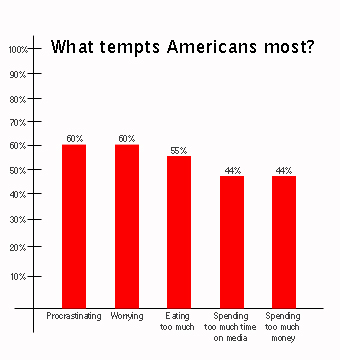
Temptation is an age-old problem. But even it isn’t immune to new challenges posed by the digital age. A new study by Barna Research found 44% Americans admit to being tempted by the decidedly “digital” sin of spending too much time on media, like the Internet, video games and television.

Other technological temptations also beckoned respondents, including viewing pornography or sexually inappropriate content (18%), and reacting angrily via text message or e-mail (11%).

The study, done in conjunction with publisher Thomas Nelson for the new book “Our Favorite Sins,” asked more than 1,000 online respondents about which sins tempt them. Barna then grouped their answers into categories like “new temptations,” “old temptations,” and “particularly Western temptations,” which includes the sins of procrastinating, worrying, and being lazy.

Only the temptations to procrastinate (60%), worry (60%), or eat too much (55%) were more prevalent than spending too much time on media distractions. Spending too much money was also a temptation for 44% of respondents.

Go to Barna.org for more.

Other news:

Stanley responds to inauguration sermon criticism
Megachurch pastor Andy Stanley drew fire when he called President Obama the “pastor in chief” during a pre-inauguration sermon for the President, his family and advisors. But the title came as a result of the President’s actions following the tragic shootings in Newtown, Stanley told Christianity Today.

Chicagoland pastor will run coast to coast for clean water
Steve Spear, a regional campus pastor for Willow Creek Community Church in South Barrington, Ill., quit his job earlier this year to get a running start on a project that will provide a lifetime of clean drinking water for 30,000 Kenyans. Beginning in April, Spear will run the 3,000-mile span between the U.S. east and west coasts in a fundraising endeavor sponsored by World Vision. Read more at christianpost.com.

NewYork_DR_page4_0128Illinois students help Staten Islanders start fresh after Hurricane Sandy
Collegiate volunteers spent part of their winter break on a whirlwind trip to New York, where residents are still deep in recovery mode after last fall’s super storm. Read the full story in the January 28 issue of the Illinois Baptist.

HEARTLAND (From Baptist Press) | Murders had become too frequent in the south St. Louis neighborhood where August Gate church meets.

Neighbors were fed up – including a few August Gate members who were leading a small group in the church’s Tower Grove East neighborhood. When they called to ask the three-year-old Southern Baptist church plant for help, August Gate community pastor Todd Genteman urged the young adults to get involved.

“You’re the Gospel Community in the neighborhood,” Genteman said, referencing the name by which the small group is known. “You should do something.”

So they did. The Gospel Community group organized a pancake breakfast at the church, bringing in community leaders, business leaders and residents to start a conversation about change. Organizers thought 10 to 20 people might show up, but more than 100 did.

The outreach echoed what the church plant’s lead pastor, Noah Oldham, has been teaching to the church which draws its name, figuratively meaning “harvest the city,” from the 10th chapter of the Gospel of Luke. For August Gate members, Gospel Community groups play a critical role in living out the teaching that every member is a missionary. These neighborhood-based small groups commit to learning the Bible, being a family and living on mission together.

“We want the vast majority of our congregation to be living on mission,” said Oldham, who also serves as the North American Mission Board city coordinator for Send North America: St. Louis. “God calls us to be missionaries in particular places.”

Click on the video below for more about August Gate, or go to BPNews.net for the full story.

<p><a href=”http://vimeo.com/57384208″>Noah Oldham: Empty on the Inside</a> from <a href=”http://vimeo.com/namb”>North American Mission Board</a> on <a href=”http://vimeo.com”>Vimeo</a&gt;.</p>

pull quote_ADAMS_jan24COMMENTARY | Nate Adams

A few days ago I had the privilege of performing the wedding ceremony for our son Caleb and his now wife Laura. As is true for most young couples, it was arguably the biggest moment of their lives. So I was very pleased when, together, they told me their desire was for the ceremony to honor God. But I was especially moved when they went a step further, and asked me to make sure the Gospel was clearly presented.

You pastors that are reading this know what a welcome and freeing experience that is. We long, most of us, for opportunities to share Christ openly. But we also need to be sensitive to the couple’s or family’s wishes at times like weddings, anniversaries, or funerals.

And not everyone wants to give the big moments of their lives to the Lord. Even devoted Christians often expect the bride to be the primary focus of a wedding day, and that’s understandable. But I think you can focus on the bride, honor the Lord, and share the Gospel without diminishing any of the three. Let me share briefly here the few words I included in Caleb’s and Laura’s ceremony:

“Now let me pause here and say something to the rest of the congregation. When Caleb and Laura and I were planning this ceremony, I asked them, what would you like the central message of your wedding ceremony to be? What would you like the people gathered there on that special day to know above all else?

“Here’s what they said. ‘The most important thing about us and our story is that we would not be together except for the way God has worked in our lives. We want others to see His story in our story. We didn’t really know how to love each other until Christ became the center of our relationship. We would love everyone there to know what it means to have God at the center of their lives and their relationships.’

“You see, the way this young couple came to know and love each other is the way many people come to know and love God. It may begin with just a casual acquaintance, an occasional prayer, maybe even periods of disinterest and distance. And then one day, your realization that God loves you unconditionally comes alive, perhaps through the joyful expression and heartfelt testimony of someone who really knows Him. You realize the void in your life, and that God has been there all along, loving you and reaching out to you. Nothing would please Caleb and Laura more, and nothing would honor their wedding day more, than for you to turn to God as they have, and to surrender your life to Him.  Caleb and Laura want you to know that, with the certainty they do.”

Words along those lines can give wedding guests something to talk about at the reception. More importantly, they can give lost friends and family something to talk about on the drive home, or with the couple after they return from the honeymoon.

The biggest wedding day of all will be when the risen and victorious Lord Jesus returns to earth as a Groom coming for his bride, the Church. That day will certainly focus on the Bride, but it will also glorify God and lead every knee to bow at the truth of the Gospel. It will be a day when we will all be glad for the big moments of our lives that we gave to the Lord, especially if He uses them as opportunities to draw our loved ones to Himself for eternity.

Nate Adams is executive director of the Illinois Baptist State Association.

THE BRIEFING | Meredith Flynn

The craft retailer has shifted the plan year for its employee health insurance, thereby avoiding for several months up to $1.3 million a day in federal fines. Hobby Lobby is being penalized for refusing to cover abortion-inducing drugs in its employee health care plans. “Hobby Lobby will continue to vigorously defend its religious liberty and oppose the mandate and any penalties,” said attorney Peter Dobelbower. Full story at BPNews.net.

Weddings are Cathedral’s ‘next step’
Leaders of Washington’s National Cathedral announced this month the church will begin hosting same-sex weddings using a marriage rite developed by the Episcopal Church for same-sex couples. Rev. Gary Hall, dean of the Cathedral, said offering the weddings is the “next logical step” in the church’s evolving teaching on marriage. Full story at CNN’s Belief blog.

Is homosexuality a sin?
That’s the question measured in a new survey by LifeWay Research, which found that fewer Americans now believe homosexual behavior is a sin that in 2011. The study found 37% of U.S. adults answered “yes,” down from 44% the previous year. LifeWay Research President Ed Stetzer said the shift could be attributed to President Obama’s support of same-sex marriage. “The president’s evolution on homosexuality probably impacted the evolution of cultural values – there is a real and substantive shift, surprisingly large for a one-year timeframe – though this was hardly a normal year on this issue.” Read more about the survey at LifeWayResearch.com.

Warren tells ‘Oprah’ watchers: Read John
The Gospel of John got an unusual TV shout-out recently from Pastor Rick Warren. Appearing on Oprah Winfrey’s “Lifeclass,” Warren urged the audience to read the Bible book and also encouraged them to listen to God, instead of the world. “God says you’re valuable, you’re capable, you’re forgivable, you’re usable. You listen to the right thing, not the wrong thing.” Full story at ChristianPost.com.

CP up 1.7% in 2012
Giving through the Southern Baptist Cooperative Program in 2012 was 1.7% above the previous year. As of December 31, 2012, contributions to SBC national and international ministries and missions totaled $45,019,759. “After several years of serious financial difficulties, I am guardedly optimistic that the economic prospects of our people have begun to stabilize, said SBC Executive Committee President Frank Page. Full story at BPNews.net.

God’s world in pictures

Meredith Flynn —  January 21, 2013

HEARTLAND | International Mission Board photographers share their pictures of the year for 2012, images that showcase God’s grace and mercy, and the great needs of people around the globe. View the full gallery.

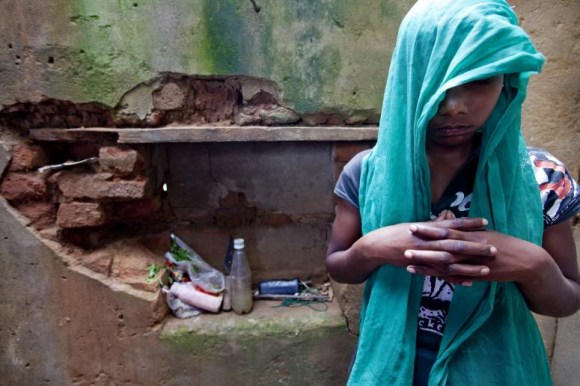
A South Asian teenager has seen her home burned four times because she and her family are Christians. Attackers even took hammers and machetes to shatter the bricks. Despite this persecution, the family remains in their village — the sole followers of Jesus Christ. The young girl lives a lonely life because of her faith.

A South Asian teenager has seen her home burned four times because she and her family are Christians. Attackers even took hammers and machetes to shatter the bricks. Despite this persecution, the family remains in their village — the sole followers of Jesus Christ. The young girl lives a lonely life because of her faith. Photo by Susie Rain

Edison Romero, 72, kneels in prayer while attending a missions training session at the School of Cross-cultural Missions near Iquitos, Peru, in the Amazon jungle. As he prays, the child of a fellow student sleeps on a nearby bench. Romero’s wife of 44 years died just three days before the training began, but he still traveled 12 hours by boat from his village to attend. Romero said he “just couldn’t miss it.” Photo by Rebecca Springer

Edison Romero, 72, kneels in prayer while attending a missions training session at the School of Cross-cultural Missions near Iquitos, Peru, in the Amazon jungle. As he prays, the child of a fellow student sleeps on a nearby bench. Romero’s wife of 44 years died just three days before the training began, but he still traveled 12 hours by boat from his village to attend. Romero said he “just couldn’t miss it.” Photo by Rebecca Springer

Boys play in their dorm room at a Christian children’s home in Choibalsan, Mongolia. The home was set up to provide a stable life for Mongolia’s street children. Its founder, a Mongolian follower of Christ, has had a long friendship and ministry partnership with IMB workers in Mongolia. Photo by Hugh Johnson

Boys play in their dorm room at a Christian children’s home in Choibalsan, Mongolia. The home was set up to provide a stable life for Mongolia’s street children. Its founder, a Mongolian follower of Christ, has had a long friendship and ministry partnership with IMB workers in Mongolia. Photo by Hugh Johnson

pull quote_STETZERCOMMENTARY | Ed Stetzer

(From Baptist Press) Louie Giglio withdrew from the program at President Obama’s inauguration in the face of criticism over a 15-year-old sermon referencing homosexuality as a sin. Many will want to debate and desire to nuance the specific wording he used in the sermon, but his points are largely mainstream evangelical beliefs.

This Louie Giglio moment, and the Chick-fil-A moment that preceded it, and the Rick Warren moment which preceded that, raise the question: Where do people of faith with long-standing traditional religious/scriptural convictions go from here?

For those of us who know Louie, this is a strange moment indeed — but also illustrative of how our culture has turned. Louie has dedicated his life to helping others — the poor, the enslaved, those trapped in sexual trafficking. Yet, I do not recognize the person I see portrayed on the news — a bigoted homophobe driven by his hatred for gays. You can be certain that is not Louie Giglio — even though some prefer to believe that any opposition to homosexual practice, and people who hold that view, must apparently be silenced for the common good.

In a recent LifeWay Research study, 37 percent of American adults agreed that homosexuality is a sin. That number is declining (down from 44 percent according to a 2011 survey), but it is still a substantial minority. Yet, such views (which were mainstream just a few decades ago) are indeed now a minority position — and viewed as unacceptable by many in society.

So, what does this mean for Catholics, Mormons, Muslims, Orthodox Jews and others who believe that their authoritative religious texts teach something the prevailing culture finds so unacceptable that they are no longer welcome in the public square? Must they jettison their sacred texts and adopt new views to be accepted as part of society? If they do not, will they be marginalized and demonized even as they serve the poor, care for the orphan or speak against injustice?

Or, instead, can we recognize that a substantial minority in our culture hold views they see as rooted in their scriptures and part of their faith, even though those views may not always be popularly accepted?

Yes, the First Amendment protects these views. But we also have to decide if the people who hold such views can be protected by our self-identified tolerant culture as they seek not just to hold those beliefs in secret, but also dare to utter them in public — even on a sermon tape 15 years ago.

Ed Stetzer is president of LifeWay Research. This column first appeared at USATODAY.com.