Archives For November 30, 1999

Haiti, at last

Meredith Flynn —  April 24, 2015

Texas youngster visits the school she —and Illinois mission teams—helped build

After four years of prayer and giving, it was all hugs and smiles as Mackenzie (right) visited a community school in Bigarade that her missions giving helped build.

After four years of prayer and giving, it was all hugs and smiles as Mackenzie (right) visited a community school in Bigarade that her missions giving helped build. Photo by Bob Elmore

Bigarade, Haiti | Several years ago, this community in Port-au-Prince was just a flood plain. Now, more than a hundred
homes dot the landscape, and children run down the dirt roads to their very own school.

Recently, there was a new face at the school, though one who’s very familiar with its story. At nine years old, Mackenzie Howell has been working to renew hope in Haiti since 2011, when she saw a documentary about the devastating earthquake that rocked the country the previous year.

Four years after she started raising money to help kids and families there, Mackenzie visited Bigarade and the school she helped build. “Seeing the kids” was what she looked forward to most before the trip, and was also her favorite part of being in Haiti, she told the Illinois Baptist.

“She really does care about this,” said Mackenzie’s mom, Alison, who also went along on the trip led by IBSA’s Bob Elmore. The Howells, who are from Nederland, Texas, met Elmore through International Mission Board missionaries working in Haiti
after the earthquake. Mackenzie sent her first donation—$1,400 raised through a coin drive at her preschool and a bake sale at church—to the missionaries to help with construction projects. They connected her with Elmore, who facilitates IBSA’s short-term mission teams in Haiti.

First she had a bake sale. Then, in 2013, the Texas girl wrote a book to help children in Haiti. File photo

In 2013, Mackenzie wrote a book to help children in Haiti. File photo

Since her first project, Mackenzie has raised more money with several other initiatives, including sales of “Leila’s Big Difference,” the book she wrote and published in 2013. Elmore, several teams of volunteers, and Haitian workers have turned Mackenzie’s gifts, along with other donations and resources, into a school for more than 100 children in Bigarade.

Instant community
The school property was vacant in November of 2011, when Elmore first saw it. “It was a goat field then…we just kind of wrote it off,” he said.

When he returned the next spring, a local Christian man named Thomas had gotten permission to put up a tarp and bamboo school on the site. People on Elmore’s mission team were asking, “What can we do?”

That fall, after receiving an anonymous donation to purchase the land, Elmore took a team to Bigarade to start construction on the school. At least eight Illinois churches and associations helped with the project. The facility now doubles as Gosen Church.

Bigarade is an “instant community,” Elmore said, a product of the earthquake that drove people from where they were and forced them into new living situations. Before the school was built, kids were either walking to another community or not going to school at all.

Mackenzie's mission team prepared lunch for kids at the school in Bigarade.

Mackenzie’s mission team prepared lunch for kids at the school in Bigarade.

Working in the school was one of the main objectives for Mackenzie and her team. They came prepared to do a two-hour
lesson each day with crafts, and to provide lunch for the kids on three days.

“Our ultimate goal is to start a feeding program where the kids can have lunch every day,” Alison said a few days before her
team left for Haiti. It just seems like something God would want them to do, she said, to feed his children. The team took with them enough money to start construction on a kitchen for the school, and also a classroom for the youngest students.

Thomas, who put the early school on the property, is now headmaster, and students arrive every morning in blue and white uniforms. Once a goat pasture, the school now employs seven teachers, and has 114 students. The feeding program will employ two or three cooks and purchase food from local sources, Elmore said.
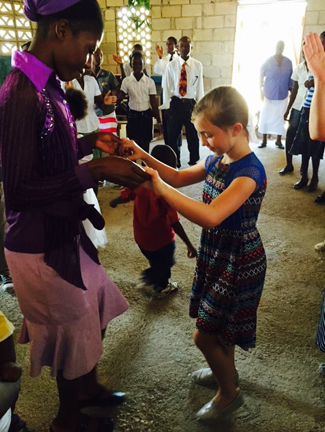
On a recent mission trip to Haiti, Mackenzie Howell, 9, worshiped in the church she helped build after a massive earthquake.

On a recent mission trip to Haiti, Mackenzie Howell, 9, worshiped in the church she helped build after a massive earthquake. Photo by Mary Russell

Complete God
“Why don’t we dance at church, Mom?” That was Mackenzie’s question after her first Haitian church service, where lively singing and dancing was a big part of the worship experience. (Alison’s response: “I don’t know; why don’t you talk to the pastor about that one?”)

“…It was such a blessing to watch her,” Alison said of her daughter during the trip. “She really grew throughout the week.” And Mackenzie’s not finished with Haiti, not by a long shot. She wants to go back—soon. And she’s planning a second book.

“It’s going to be about Leila [meeting] a white girl that came from the U.S. to visit her school and help out with the school and do crafts and stuff, kind of like how I did.”

Recently, she shared about Haiti with kids in her church’s Awana program. Mackenzie’s grandmother, who also was part of the March trip, came out of the room crying, Alison remembered.

“Whatever you do, don’t practice with her,” was the grandmother’s advice for Mackenzie’s future speaking engagements. “…She had them laughing and crying,” Alison said. “It’s because it really does come from her heart.”

In Haiti, Mackenzie taught her new friends a dance she had choreographed in honor of their country to a song with special meaning there, “I Am Not Forgotten.” Watching, Alison said, “It was just such a beautiful picture of how complete God is.”

“So many times, we give to missions or do this and that…but we don’t always get to see the fruits. I just continuously thank God that’s he’s allowed us to see so much of the fruit of his work.”

Reported by Meredith Flynn for the Illinois Baptist newspaper, online at http://ibonline.IBSA.org

Click through the slideshow below for more photos from Mackenzie’s trip to Haiti. Photos are by Bob Elmore and Mary Russell, Mackenzie’s grandmother.

This slideshow requires JavaScript.

Illinois_map_AprilCOMMENTARY | Lisa Sergent

Just outside my office door, there is a large map of Illinois with each county outlined and labeled. Every county has been shaded in to represent the percentage of the population who are Southern Baptist.

When I heard about the April 9 tornado outbreak and where it occurred, my thoughts immediately went to the map. The northern part—the region most affected by the storms—has counties in white (no IBSA churches), dark green (one IBSA church), and a particular shade of orange denoting that just 0.5 to 0.99% of the population belongs to an IBSA church.

Disaster Relief spring callouts like the one in northern Illinois after the tornadoes are nothing unusual. In April 2013, chaplains and mudout teams responded to the Peoria area after widespread flooding. March 2012 saw a tornado strike Harrisburg, destroying homes and businesses. Chaplains and chainsaw teams were called in to comfort and to clear debris.

But this ministry opportunity is different. The previous spring callouts in our state have served areas with a much higher ratio of IBSA churches. These most recent tornadoes touched the northern part of Illinois, the part with little Southern Baptist or other evangelical presence.

In Ogle County, where the town of Rochelle is located, there is just one IBSA church to serve the county’s 52,000 people. In DeKalb County, home to the Fairdale community that was devastated April 9, there are just three IBSA churches with fewer than 300 resident members. DeKalb’s total population is 105,000.

Illinois Baptists now have an opportunity to reach out to the unreached in new ways. Chainsaw teams from four associations of churches—Fox Valley, Quad Cities, Sinnissippi, and Three Rivers—worked in Rochelle the weekend after the storms. Disaster Relief coordinators monitored the situation in Fairdale, but found it was completely destroyed, leaving nothing large enough for chainsaw crews to remove.

Not only were IBSA Disaster Relief teams at work, but teams from other evangelical denominations also were on the scene. Their presence is something new for an area that consists mainly of Catholic and mainline Protestant churches.

Illinois Baptists have a unique opportunity to share Christ’s love in a unique time of need. My prayer is that we take this opportunity to minister to the peoples in these and surrounding communities, sharing Christ—perhaps, as never before—in this region of our state.

Lisa Sergent is director of communications for the Illinois Baptist State Association and contributing editor of the Illinois Baptist newspaper.

THE BRIEFING | Meredith Flynn

People with gay or lesbian friends are almost twice as likely to say same-sex marriage should be legal, according to a survey by LifeWay Research. Half of all Americans overall believe gay marriage should be legalized, but the percentage jumps to 60% for people who have gay or lesbian friends (and decreases to 33% for those who don’t).

From LifeWayResearch.com

From LifeWayResearch.com

An additional LifeWay survey found 30% of Americans believe homosexual behavior is a sin, down from 44% in 2011.

On April 28, the U.S. Supreme Court is scheduled to hear oral arguments in several same-sex marriage cases.


Thirty Ethiopian Christians were killed in two attacks by ISIS in Libya, according to a video released by the terrorist group April 19. “That these terrorists killed these men solely because of their faith lays bare the terrorists’ vicious, senseless brutality,” said U.S. National Security Council spokesperson Bernadette Meehan.

Back in February, Ethics and Religious Liberty Commission President Russell Moore asked in a blog post, “Should we pray for the defeat of ISIS, of their conversion?”


Southern Baptist Convention President Ronnie Floyd has designated the Tuesday evening session of this summer’s SBC Annual Meeting as a “National Call for Prayer.” Floyd has recruited 11 pastors to help lead the prayer meeting, including Paul Kim, pastor emeritus of Antioch Baptist in Cambridge, Mass., K. Marshall Williams, president of the National African American Fellowship, and Timmy Chavis, chairman of the SBC Multi-Ethnic Advisory Council.

“One of the unique moments of the evening will be when we embrace and celebrate our ethnic diversity, which may also involve moments of repentance and reconciliation,” Floyd said in a blog post about the service.


Baptist pastors and leaders will share the stage with a potential presidential candidate at the 2015 SBC Pastors’ Conference in Columbus, Ohio, June 14-15. Dr. Ben Carson, a neurosurgeon and author, will speak during the Sunday evening session. Earlier this month, he said on his Facebook page that on May 4, he will announce whether or not he will run for President.


Which missions job is right for you? Take this interactive quiz from the International Mission Board.

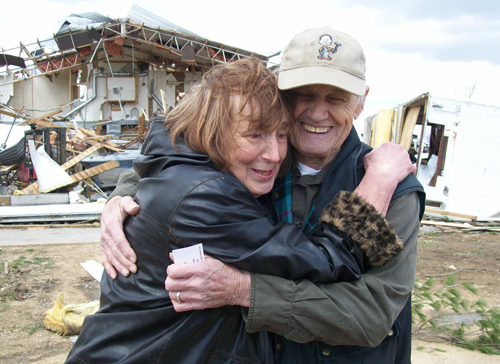
Raymond and Betty Kramer hug each other after being interviewed by the media about their experience in a Rochelle, IL restaurant's storm cellar while a tornado was on the ground above them. This photo was taken during and interview  in the town of Fairdale, IL, which was completely destroyed by tornado April 9.

Raymond and Betty Kramer hug each other after being interviewed by the media about their experience in a Rochelle, IL restaurant’s storm cellar while a tornado was on the ground above them. This photo was taken n the town of Fairdale, IL, which was completely destroyed by tornado April 9.

HEARTLAND | Lisa Sergent

Raymond Kramer and his wife, Betty, were driving home from Rockford, Ill.,

when it started to hail. As the icy stones got larger and came down harder, they started to look for shelter. Then, to his west, Kramer saw a funnel cloud on the ground.

The funnel cloud was part of a tornado outbreak that hit northern Illinois April 9. It caused destruction in town of Rochelle and completely destroyed the small community of Fairdale, where two people died.

The Kramers, members of Grace Fellowship in Ashton, took shelter in Grubsteakers Restaurant, where “the owner herded us through the kitchen, out the door, and we made a u-turn down into a good old-fashioned storm cellar,” Kramer told the Illinois Baptist.

When the tornado had passed, they tried to open the cellar doors, but found them blocked by debris. The back dining room and pantry walls had fallen on top of the doors. And the restaurant owner’s SUV had been lifted up by the tornado and was sitting on top of the walls.

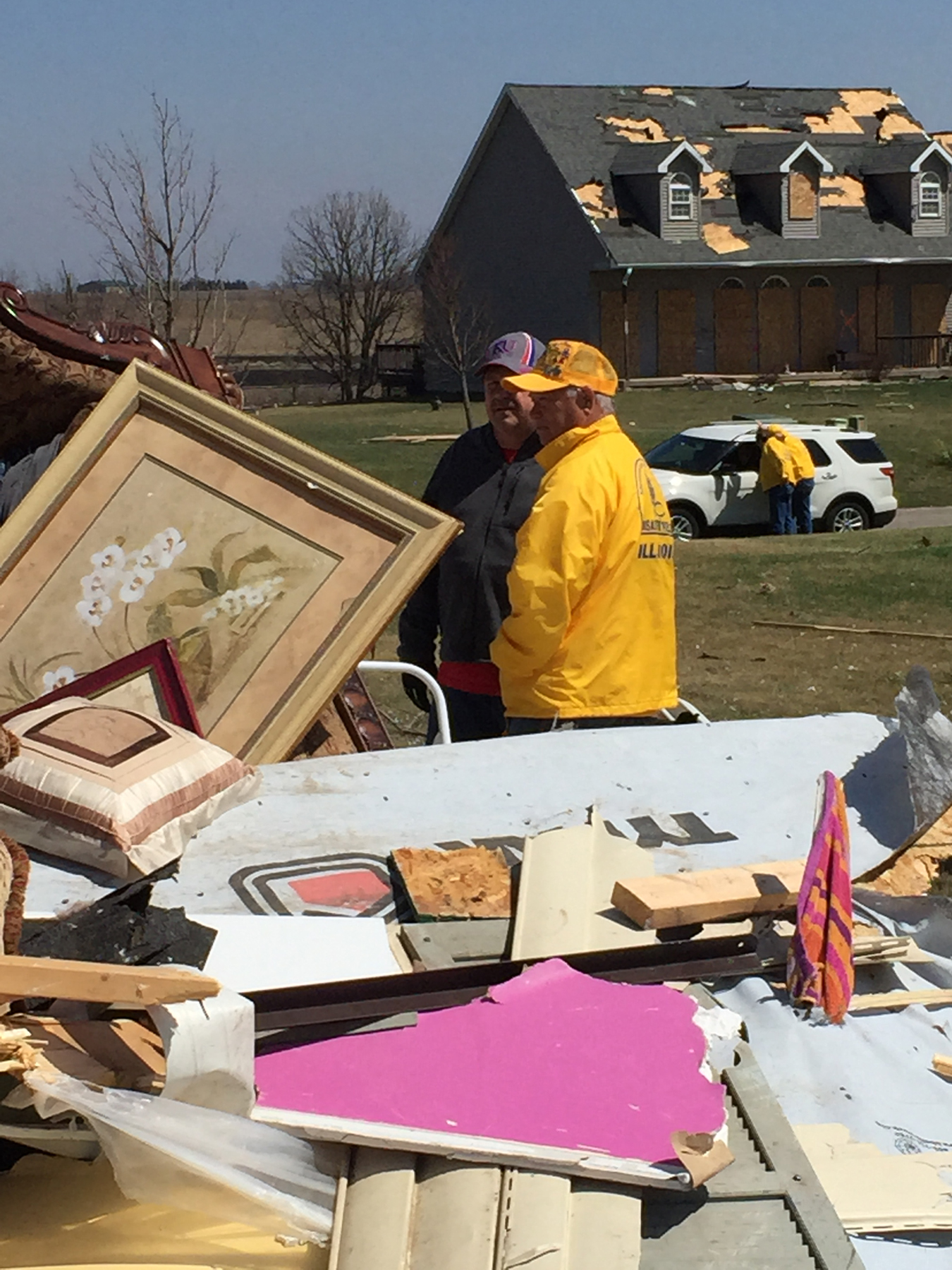
Illinois Baptist Disaster Relief workers survey damage after a tornado outbreak in northern Illinois April 9.

Illinois Baptist Disaster Relief chainsaw teams were on the scene two days after a tornado outbreak in northern Illinois April 9.

The Kramers prayed with 10 fellow survivors as they waited for first responders to arrive, which they did in 30 minutes. However, it took two hours for responders to free them. Sitting in the dark with only cellphone flash lights and, later, a light passed down by the responders, the Kramers prayed with the group.

One woman was crying, and as his wife comforted her, Kramer prayed. “I pray aloud in situations like this,” he said.

To help everyone relax, Kramer said he started singing, “’I’ll be there to pick you up in the wheel barrow honey, after about a quarter past eight….’ Then, I sang, ‘Que Sera, Sera, whatever will be will be…’”

Since the tornado, Kramer has been interviewed by local and national media who have called the 81-year-old and his wife heroes. “We’re not heroes,” he said. “We’re just servants of the Lord Jesus Christ…I had the joy of the Lord down there. I prayed to my God and I knew He would protect us.”

IBSA Disaster Relief participated in clean-up efforts after the tornado outbreak. Chainsaw teams from four associations of churches—Fox Valley, Quad Cities, Sinnissippi, and Three Rivers—worked at three homes in Rochelle.

Rex Alexander, Disaster Relief Coordinator said the callout “was a good opportunity for northern teams to work in their own backyard.”

To learn more about Disaster Relief ministry, go to www.IBSA.org/dr or call (217) 391-3142.

Editor’s note: The following Trevin Wax column from BPNews.net first appeared on his Kingdom People blog, hosted at thegospelcoalition.org.

COMMENTARY | Trevin Wax

Summer is for vacations and, for many pastors, denominational gatherings. The Southern Baptist Convention is no exception. This year, we’re meeting in Columbus, Ohio, the 15th largest city in the U.S., one that is well outside of the Southeast where most of our churches are based.

Trevin_WaxIn the past decade, though the attendance at the annual meeting has risen and fallen in conjunction with the location and the major topic of conversation (or controversy), the overall trend has been a dwindling of messengers. This isn’t surprising, considering the loosening of denominational loyalty and the variety of good conferences a pastor can attend.

But Columbus might buck the decline. Here are three reasons I’m particularly excited about this year’s annual meeting.

1. The annual meeting is trending younger.

In Baltimore last year, we saw a 10-year high of younger messengers involved in the convention proceedings. Baptist Press has reported that “nearly one-fourth (24.68 percent) of attendees were younger than age 40. That surpassed by more than 4 percentage points the previous best for the age group, recorded in 2013.”

My first visit to a Southern Baptist Convention was in San Antonio in 2007 as a 25-year-old associate pastor. I remember my initial shock at the small number of young people present. Recent years have seen an upswing in younger Southern Baptist engagement, a reality that is especially surprising when considered alongside the millennial generation’s diminishing enthusiasm for institutions in general. What this tells me is that the annual meeting is beginning to show signs of becoming a vibrant network, not just a report on denominational infrastructure.

2. The schedule of the annual meeting has been reworked in order to highlight the things we are most passionate about.

Few people get excited about a business meeting. Most messengers admit they come to network and see friends, not sit through every session of the SBC. But this year will be different, thanks to a reworking of the schedule under the leadership of the SBC’s president, Ronnie Floyd. For example, all the missions entities will present on Wednesday morning, and it won’t just be a time of reports, but also commissioning of missionaries.

The Send North America conference, slated by the North American Mission Board for this summer in Nashville, already has drawn more than 7,000 registrants, a staggering figure when you consider the fact that only one Convention since 2010 has come close to that number.

What does this tell us? Southern Baptists are hungry for a meeting that casts vision and rallies our people around a great cause. They’re not necessarily there, first and foremost, to vote on resolutions.

But resolutions matter. And so does our business. As Southern Baptists, we should care about the annual meeting, and we should care about this meeting because we care about the Kingdom of God. Business meetings come and go, with their moments of boredom and hilarity, awkwardness and quiet power, and yet in these moments, decisions are made, courses are set that define our cooperative work the rest of the year. It’s not glamorous, but the work of the Kingdom rarely is. This year, however, features a streamlined schedule that emphasizes what we’re there for.

3. We will pray for God to awaken His church to the opportunities before us.

The Tuesday evening meeting will be time of prayer and worship, a pleading with God to revive His people and empower our witness. It is easy to bemoan the moral decay of our culture, the encroaching limits to religious liberties and the difficulty of evangelism in a relativistic society.

But we shouldn’t miss the opportunity here. By cherishing once-common things, such as marriage between a man and woman for life, and core Christian doctrines, such as the exclusivity of Christ for salvation, we have the opportunity for our ordinary obedience to shine even brighter in a pluralistic world that bows to Aphrodite. The annual meeting gives us the opportunity to lay aside our differences, unite around our common confession and lock arms for the cause of Christ and His Kingdom.

Trevin Wax is managing editor of The Gospel Project, a Gospel-centered small group curriculum for all ages published by LifeWay Christian Resources.

Rochelle_recovery_1

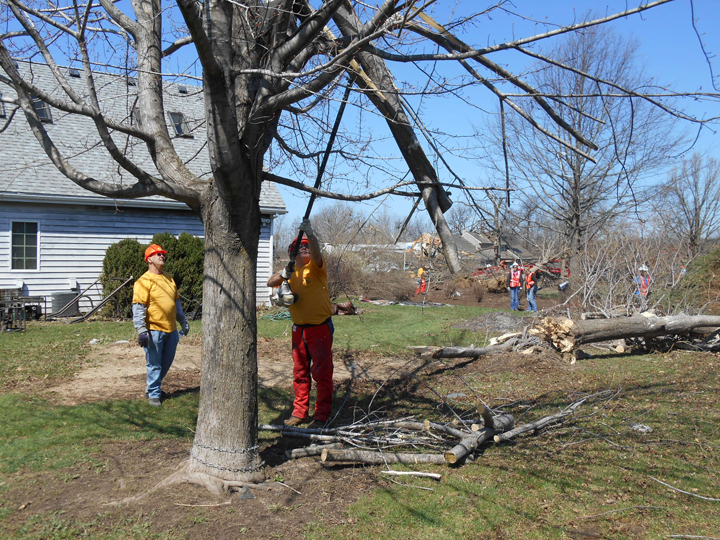
Illinois Baptist Disaster Relief volunteers worked over the weekend at three homes in Rochelle, Ill., one of the northern Illinois communities hit by a tornado April 9.

By Lisa Sergent

Rochelle, Ill. | Illinois Baptist Disaster Relief volunteers were busy Saturday removing trees and limbs downed by last week’s tornadoes in northern Illinois.

Chainsaw teams from four associations of churches—Fox Valley, Quad Cities, Sinnissippi, and Three Rivers—worked at three homes in the town of Rochelle, where 45-50 homes were damaged April 9.

Rex Alexander, Disaster Relief Coordinator for the Illinois Baptist State Association, said the response to the disaster was “almost overwhelming.”

“Streets were clogged with the cars of volunteers and the owners of damaged homes were inundated with volunteers and disaster relief teams from all over the state, as well as from other states. One home across the street from our team had over 50 volunteers working with them,” he noted.

Alexander said the town of Fairdale has not yet been opened to volunteers, but he is continuing to monitor the situation for future opportunities. However, he doesn’t expect there to be much work for IBSA volunteers to do. “If your house has been downed and is gone, you don’t go cut up trees.” The EF-4 tornado that hit Fairdale reportedly affected every home or structure in the unincorporated community—40 to 50 buildings. Two people were killed during the storm.

Rochelle_recovery_2For the response in Rochelle, Alexander wanted to publicly acknowledge the assistance of Brad Pittman, pastor of Grace Fellowship Church in Davis Junction. “He gave us most of his day on Friday and introduced us to homeowners he knows in the area that we were able to go in and help.”

Many recent disaster relief callouts have been in the southern part of the state. Alexander said this callout “was a good opportunity for northern teams to work in their own backyard.”

The Illinois teams finished their work Saturday afternoon.

A disaster relief training weekend is scheduled this Friday and Saturday, April 17-18, at Streator Baptist Camp. Online registration is closed, but anyone interested in participating can call Alexander’s ministry assistant, Alexis Dumire, to register over at (217) 391-3142.

The Illinois Baptist State Association has nearly 1,000 Southern Baptist member churches and missions in Illinois. IBSA’s main office is in Springfield and it was established in 1907. Southern Baptists operate the nation’s third-largest disaster relief organization, behind only the Red Cross and Salvation Army. To learn more about IBSA Disaster Relief, visit http://www.IBSA.org/dr.

Rochelle_recovery_3

IBSA Disaster ReliefSpringfield, Ill.  | IBSA Disaster Relief Coordinator Rex Alexander and other disaster relief leaders are in the Fairdale, IL area this morning assessing tornado damage. A deadly tornado hit the small town in northwestern Illinois at sunset Thursday night. Two people were killed and several others were injured. Tornadoes and severe storms also caused major damage in the nearby towns of Ashton, Belvidere, Kirkland, and Rochelle.

The Illinois Baptist State Association has nine churches and 15 missions and church plants in the storm damaged areas. None have reported any damage at this time.

Chainsaw teams from Metro Peoria, Sinnissippi, and Three Rivers Baptist Associations have been put on alert. “As soon as we are able to respond to the needs in the damaged areas, these three teams and available disaster relief volunteers from Region 1 (northern Illinois) will be the first ‘wave of response,’” Alexander stated.

Brad Pittman, pastor of Grace Fellowship Baptist Church in Ashton, is guiding Alexander and his team through the area to assess the initial damage.  “We will determine how accessible the damaged areas are which helps us to determine how quickly our volunteer teams will be able to respond,” shared Alexander. “If law enforcement agencies are keeping everyone out of the damaged areas, then we must wait until the areas are open to volunteers.”

Alexander asked Illinois Baptists to, “Pray for the people who have been impacted by the storms and that God will open doors for ministry and sharing help, healing, and hope in Jesus name.”

The Illinois Baptist State Association has nearly 1,000 Southern Baptist member churches and missions in Illinois. IBSA’s main office is in Springfield and it was established in 1907. Southern Baptists operate the nation’s third-largest disaster relief organization, behind only the Red Cross and Salvation Army.

THE BRIEFING | Meredith Flynn

After two police officers were shot March 12 in Ferguson, Mo., chaplains from the Billy Graham Rapid Response Team were back in the community where they served six weeks last year.

“It is not possible to solve a community’s deep-rooted problems with a team of chaplains deployed for six weeks, and we knew that before we started,” Billy Graham Association President Franklin Graham said then, according to a story on billygraham.org. “But God used the chaplains to touch many hearts and to plant fruitful seeds in the community.”


The_BriefingLawmakers in Tennessee proposed legislation in February that would make the Bible the official state book. Not surprisingly, some opponents say such an action is unconstitutional. But Rep. Jerry Sexton (R-Bean Station), who introduced the bill in the House, said the action recognizes the Bible’s “historical importance.”

“The Bible has certainly had a pivotal role in the history of our state as well as our nation,” Sexton told the Baptist & Reflector newspaper. “The Bible also plays a significantly important role in our state today with several companies in Nashville being responsible for publishing more Bibles than possibly any other city in the world.”


68% of evangelicals say Congress should act on immigration reform this year, according to a new survey by LifeWay Research. Other findings: 86% say reform should secure U.S. borders, and 61% say it should include a path to citizenship for undocumented immigrants.


The Christian Post reports San Francisco’s largest evangelical megachurch will no longer require celibacy from gay people desiring to be members of the church. “We will no longer discriminate based on sexual orientation and demand lifelong celibacy as a precondition for joining,” Senior Pastor Fred Harrell wrote in a letter on behalf of the church’s elder board. “For all members, regardless of sexual orientation, we will continue to expect chastity in singleness until marriage.”


In honor of today, check out this 2009 post from Russell Moore on “what evangelicals can learn from St. Patrick.”


NEWS | Meredith Flynn

“Our town is starting to come back,” said Pastor David Siere. For a year, he has watched Brookport, Ill., recover from a tornado that destroyed several homes and killed three people in Massac County, located at the southern tip of the state.

The storm hit on a Sunday afternoon, part of a tornado outbreak that wreaked havoc all over the state. Siere’s church, First Baptist in Brookport, sits next to a mobile home park that was almost completely destroyed, he said.

But Brookport is rebuilding, and Siere and his church are playing an integral role in the process. The town is starting to look a lot better, he said, and “we’re praising God for what He’s done so far.”

Brookport_1_1222

The Massac Pope County Recovery Committee has helped rebuild five homes since a tornado tore through the region last November. Nine more new houses are under construction. Photo from MPCRC Facebook page

Immediately after the tornado, FBC became Brookport’s ground zero for storm recovery. A ministry facility they had built in 2011 across the parking lot from the main building housed donated food, water and clothing. The pastor sees God’s provision in that building—“I don’t know what we would have done if we hadn’t had it.”

Illinois Disaster Relief teams moved quickly into the area to cut down damaged trees and visit with shaken residents. About a week after the tornado, Siere was approached by a city leader about being part of a long-term recovery team. Two of his church members, Bob Craig and Jerry Muniz, also joined the Massac & Pope County Recovery Committee.

So far, volunteer groups working through MPCRC have built five houses in Brookport, and nine more are in process. In August, the first homeowners moved in, including Clark Blasdel, who said he had never been through anything as bad as the tornado, and had never had anything as good happen to him as his new home.

“It’s unbelievable. I’m happy,” Blasdel told WPSD in Paducah, Ky.

The work of the committee is funded through grants and donations, combined with money provided to residents by the Federal Emergency Management Agency (FEMA). Their goal is two-fold: To provide housing for people who were displaced after the tornado, and to make Brookport a better place to live. In doing so, the team, which includes members of local churches, is also looking out for the spiritual well-being of their town.

“We keep God at the center of it, and I think that’s what makes a difference,” said Craig, noting that without God, it would be difficult to keep a sweet, loving attitude. The committee’s meetings start with prayer and Scripture reading, and they recently sponsored a “gospel sing” on the one-year anniversary of the
storm.

Craig, who pastored FBC Brookport before Siere, told around 200 attenders that with all the safety precautions people take—like storm shelters and weather radios—there’s a greater safety to be found in Christ. “You might not make it through another circumstance like this, and you need to have that provision taken care of,” he said.

When asked if there are stories from the past year that stand out, Craig recalls one young man whose mobile home rolled over several times during the storm, even as his wife and child were inside. They were bruised and banged up, Craig said, but survived. And the young man gave his heart to Christ.

“It was such a thrill, because it was a son-in-law of a long-time brother in Christ that I’ve known many years.”

To God be the glory
After the tornado, Siere was unsure what to put on the church sign, in light of everyone who had done so much to help Brookport. He settled on a simple message: “Thank you, everybody.”

Certainly, many are thanking the church in return. All of the houses built through the recovery committee have been constructed by volunteer workers, and those workers are fed at the church through the efforts of a woman from Metropolis who coordinates the meals. She was looking for a way to help and, Siere
said, “God led her here.”

The volunteer teams have slowed down for the winter; one group is scheduled for late December and one in January. But as the weather warms up, the committee expects more people will come to help.

When they started a year ago, eight houses was set as a goal, Siere said, and “God has seen fit for us to do a lot more than that.” The number 23 has come up, but whether or not the committee is able to see that many projects through, they want to help as many people as possible get a place to live.

Ultimately, he said, they want God to get the glory.

“We meet once a week still, here at the church, and as we’re seeing things happen, we just thank God because it has to be a God thing.”

Ferguson: The Morning After

Lisa Misner —  November 25, 2014

Churches minister together after grand jury’s decision sparks new violence

By Lisa Sergent

Pray for St. LouisFerguson, Missouri | First Baptist Church of Ferguson stands in the middle of the chaos. “It was a rough, volatile night,” said Ron Beckner, the associate pastor. “The Little Caesar’s [Pizza] that burned down to the ground was across from our building, [but] there was no damage or anything on our property.

“It’s very quiet and business as usual this morning,” he noted.

Violence erupted in the St. Louis suburb Monday night, after a St. Louis county grand jury refused to indict a Ferguson police officer on any criminal charges in the shooting death of a young black man. The streets were filled with protestors, some looting and setting cars and buildings on fire. Twelve businesses were burned and 61 people were arrested.

But, as of now, First Baptist Church is unharmed and still reaching out to a shaken community.

Two groups – one from FBC and another from a sister church – used FBC’s parking lot as a staging area Tuesday morning to go out into the community and pick-up trash and other debris left behind by the protestors. Beckner said the church “wants people to see that God’s people are on mission.”

The local school district cancelled classes the day following the grand jury’s decision, but requested the church be a pick-up point for student lunches prepared by the district. The church also allowed the district to have staff present for what he described as “students who wished to have an opportunity for education.”

Beckner described the situation as particularly frightening for people who live close by. “I was watching the Little Caesar’s burn down on TV and couldn’t help but think of the house that sits about 150 feet behind it. What must have been going through those people’s minds?” He walked by the house this morning and found no visible damage.

“We’re praying cooler heads prevail and that city leaders can shut the violence off. We need our leaders to take an active role.”

Referring to the protesters, he said, “It only takes a few to subvert the message… One of the saddest parts of the whole thing is the very businesses that were burned serve this community and provide jobs to the people who live in it.”

Local news is reporting that unlike the riots in August, the perpetrators of the damage to the community on November 24 where from the St. Louis area. Beckner said authorities had warned that outsiders could begin to arrive in 48 hours. “We were told it takes that long for instigators outside the community to arrive. When more and more people arrive from outside the area, it doesn’t bode well for the police or our citizens.”

First Baptist Church averages just over 200 Sunday morning worshippers. The congregation is diverse: over one third of its members are African American and that number continues to grow. “We want to look like our community,” Beckner said.

Beckner also lamented how the national media are portraying the community as racist and segregated. Most of Ferguson is “fifty-fifty white and black,” Beckner said. “There’s not a lot of tension here especially among the older, more mature individuals. This picture being presented is not we lived before this incident took place.”

Throughout the tension that has existed since the August shooting, First Baptist has stood as a beacon of peace in the community. Beckner said, “We’re praying that God will get the glory and that His people will stand tall.”

“Sometimes we pray God will keep evil away from us,” he said. “That’s very noble, but we need to be God’s advocate in the midst of that evil. We need to be looking for doors of opportunity to be His hands and feet.”

Two weeks ago, First Baptist Church hosted a prayer meeting for spiritual awakening in the heartland, an event that was planned months before the August riots. Southern Baptist leaders joined local church leaders and members to pray for the salvation of Ferguson. That story appears in the December 1 issue of the Illinois Baptist newspaper and online at IBSA.org.