Archives For November 30, 1999

News of interest to Illinois Baptists

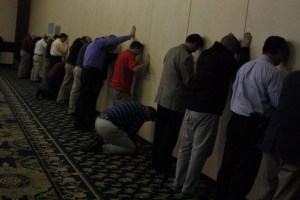
Pray-ers lined "wailing walls" inside the Springfield Crowne Plaza during the "lament" phase of the Concert of Prayer.

Pray-ers lined “wailing walls” inside the Springfield Crowne Plaza during the “lament” phase of the Isaiah 6 prayer cycle.

NEWS | Eric Reed and Meredith Flynn

Messengers to the 108th Annual Meeting of the Illinois Baptist State Association Nov. 5-6 pled for spiritual awakening and revival, highlighted in a Concert of Prayer based on Isaiah 6.

Vocal quintet Veritas led in worship during the service, and attenders were led to pray through a four-phase cycle: lament, repent, intercede, and commit.

“I believe we need to cry out to God for spiritual awakening and for revival in our churches,” said IBSA Executive Director Nate Adams as he opened the Concert of Prayer. He asked attenders to lament the decline of our culture.

Adams invited the people to move to the walls of the room and use them as a sort of “wailing wall,” not unlike the famous one in Jerusalem where Jews pray. Soon a chorus of voices and some sniffles filled the space.

“I’ve never been to the Wailing Wall, but knowing the purpose of the wailing wall and what it represents just kind of got me,” said Rick Dorsey, pastor of Beacon Hill Missionary Baptist Church in Chicago Heights.

Veritas, a group started in part by "Truth" founder Roger Breland, led in worship during the Concert of Prayer.

Veritas, a group started in part by “Truth” founder Roger Breland, led in worship during the Concert of Prayer.

“It hit me in the gut. And just made me lament that we are still struggling to reach a lost world and not doing everything that He needs us to do, that we need to do in order to reach this lost world.”

After a season of personal repentance, attenders formed small groups and began interceding for lost people they know personally.

“‘Spiritually refreshing’ is the only way I can describe the wonderful Concert of Prayer we experienced Wednesday night,” Adams said later. “Dozens and dozens of folks came to me afterward and told me how very much they needed it. In fact, many described it as the best thing they’ve ever experienced at an Annual Meeting.”

The messages of preachers at the Pastors’ Conference, which precedes the Annual Meeting, and the IBSA President’s message resonated with the prayers:

“The world is at its darkest, it’s a mess—in America, and sure enough in Illinois,” declared Marvin Parker, pastor of Broadview Missionary Baptist Church. “Darkness is covering our state, with same-sex marriage and more. It’s messing with the fabric of the family.”

“If we’re going to push back the darkness in Illinois and in our nation, we’re going to have to get desperate,” IBSA President Odis Weaver said. “If we’re going to push back the darkness, we have to ask the question, How desperate is my church for spiritual awakening? How hungry are our hearts?” And in phrase repeated by others several times, Weaver said, “We will either hunger for God’s righteousness out of desperation or…out of devastation.”

Church planting urgency
With prayer permeating the Annual Meeting and the Pastors’ Conference that preceded it, messengers also voted on officers for the coming year, welcomed new churches affiliating with IBSA, and heard reports from IBSA entities.

In his report, IBSA Executive Director Nate Adams shared encouraging news about the ministry of Illinois Baptist churches, including four new campus ministries begun this year, 260 congregations now registered as Acts 1:8 churches, and 140 pastors and leaders engaged in leadership development processes.

Adams also pointed out areas in need of growth. Through August of this year, IBSA has helped start 16 new churches, down from 24 last year, he reported. “We are not satisfied with that level of church planting in Illinois, and it will not allow us to significantly impact the desperate need of the lost of Illinois for relevant new Baptist churches that can deliver the Gospel in their context,” he said.

Citing the need for more church planters and more church planting sponsor churches, Adams urged, “Together, we must ask the Lord of the harvest to send out workers into his harvest field, particularly in the area of the church planting in Illinois.”

Messengers approved six resolutions brought by the IBSA Resolutions and Christian Life Committee: affirming the Bible’s authority; encouraging prayer for elected officials; repenting of sinful choices related to media consumption; including younger leaders in denominational life; encouraging prayer for the Palestinian Church; and affirming the resolution on transgender identity approved by messengers to the national Southern Baptist Convention in June 2014.

An additional resolution on Common Core education standards was referred back to the committee for further study and revision.

Amendments postponed
Leading up to the Annual Meeting, the IBSA Constitution Committee was prepared to ask messengers to suspend the rules of the IBSA Constitution—bypassing the usual two-year process

needed for revision—so that the IBSA Constitution could allow for the Baptist Children’s Home and Family Services to have its own bylaws, in compliance with Illinois not-for-profit law.

“Upon further examination, however,” Adams told the Illinois Baptist, “the Committee came to believe that it would not be proper parliamentary procedure to apply the ‘suspending of the rules’ action that Robert’s Rules of Order allows to the Constitution itself.

“Rather than go against the IBSA Constitution’s requirement for two readings at separate meetings, then, they decided that approval of separate Children’s Home bylaws and revision of their articles of incorporation at the IBSA Annual Meeting would allow for legal compliance, and that a first reading of the proposed revisions to the IBSA Constitution would be sufficient.”

Messengers at the Annual Meeting unanimously approved the new bylaws and articles of incorporation for BCHFS. “If the IBSA Constitution is amended at the second reading next year, all the necessary documents will have been revised,” Adams said.

Budgets from IBSA, Baptist Children’s Home and Family Services and Baptist Foundation of Illinois were approved during the business session. IBSA’s Cooperative Program goal for 2015 is $6.4 million, 43.25% of which goes to national and international SBC missions causes, while 56.75% stays in the state to support Illinois missions and ministry.

The association’s four current officers were each re-elected by acclamation: Weaver, pastor of Friendship Baptist Church, Plainfield, as president; Kevin Carrothers, pastor of Rochester First Baptist Church, as vice president; Melissa Carruthers, member of Lincoln Avenue Baptist Church, Jacksonville, as recording secretary; and Patty Hulskotter, member of Living Faith Baptist Church, Sherman, as assistant recording secretary.

At the start of the Wednesday evening session, messengers welcomed seven new churches affiliating with the association. IBSA’s Credentials Committee also recommended during its report that the association disaffiliate with seven churches that have been non-cooperating for eight or nine years.

Through the annual Ministers’ Relief Offering, taken during the Annual Meeting for pastors facing unexpected transitions, attenders gave $1,651.

The 2015 IBSA Annual Meeting and Pastors’ Conference is scheduled for November 10-12 at First Baptist Church, Marion.

HEARTLAND | Meredith Flynn

In two out of three Southern Baptist congregations, fewer than 100 people gather for worship on Sunday morning. Megachurches may get more attention, but small churches are the backbone of the SBC, Frank Page has said.

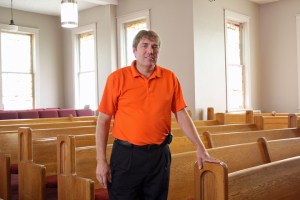
Illinois pastor Cliff Woodman is part of a new advisory council on small and bivocational churches.

Illinois pastor Cliff Woodman is part of a new advisory council on small and bivocational churches.

Still, small church pastors often feel overlooked and marginalized, left out and under-resourced. A new advisory council assembled by Page, president of the SBC Executive Committee, exists to communicate the unique needs of these categories of churches with denominational leaders.

“I will not allow the Southern Baptist Convention to forget who we are,” said Page during the first meeting of the Bivocational and Small Church Advisory Council. “Part of my goal in this is to elevate the role of the small church pastor and the bivocational pastor, period. And that’s going to happen.”

Illinois pastor Cliff Woodman is part of the 21-member council, which will work over the next three years to develop a report on the statistics that define Southern Baptist churches. The group, one of several Page has brought together in his first four years as Executive Committee president, represents a large majority of Southern Baptist churches.

“Some would say 35,000 of our 46,000 churches, maybe more than that, are in the two categories of small church or bivocational,” Page said at the Sept. 11-12 meeting in Atlanta. For the council’s purposes, he defined a small church as one with 125 people or fewer in Sunday school attendance. The group also looked at research on the percentages of SBC churches by worship attendance. According to 2013 data, 68% of Southern Baptist churches have 100 or fewer people in worship, compared to 78% of IBSA churches and missions.

Woodman, now pastor of Emmanuel Baptist Church in Carlinville, spent more than 25 years as a bivocational pastor at Harmony Baptist Church in
Medora. He told the Illinois Baptist small church and bivocational pastors (most who also work a second job) often feel out-of-the-loop. Sunday school curriculum may feel tailored to larger churches with more people and more classroom space, for example, and large church pastors often are the ones invited to speak at meetings or conferences.

But non-megachurches can be effective churches. Woodman, whose Carlinville church reported an average worship attendance of 145 in their 2013 Annual Church Profile, is leading Emmanuel to look closely at what makes a congregation healthy. He referenced LifeWay President Thom Rainer’s 2013 book “I Am A Church Member,” which outlines members’ responsibilities to their congregation.

“If a church member’s not supposed to look at ‘what’s in it for me,’ then maybe churches ought to stop looking at ‘what’s in it for me,’” Woodman said. The better question is, “What can I do for the bigger body?”

Major shift toward bivocational
Page has used a “fault lines” analogy to describes areas of SBC life where there are rifts between different groups. One of those fault lines, he said in the Atlanta meeting, is related to church methodology, or how churches do church. The discussion centered on bivocational ministry, a strategy Page called “the wave of the future.” It’s also the wave of the past.

Southern Baptist churches have long relied on bivocational pastors to lead churches. Decades ago, many pastors were farmers; today, they also drive school buses, deliver the mail, and run small businesses.

“I’m convinced that in the 21st Century, the best stewardship model is bivocational,” Page said. “We’ve got a lot of students coming out of seminary now who have no intention of being full support.” In other words, they’re prepared to work more than one job to make ends meet.

That news was encouraging to Woodman. There was a day, he said, when “the underlying current was that the bivocational guy wasn’t good enough to have a full-time church.” Page shared with the group that some Christian universities are now training students to be pastors along with learning another vocation.

While there will always be churches that want their pastor to be full-time, Woodman said, bivocational ministry is imperative if Southern Baptists want to extend the reach of churches into more communities. “And we’re going to have to do a better job at it,” he said, and at preparing future leaders for it. Because bivocational pastoring is “a different game.”

Quit the comparison game
Small church pastor Job Dalomba posed a pointed question in an April blog post: “We have to ask ourselves an honest question: Do we want to see the glory of God shining from larger churches or do we just want their numbers, resources and notoriety to be our numbers, resources and notoriety?”

The SBC Voices post by Dalomba, pastor of a new, small church in Southaven, Mississippi, called for small church pastors to stop comparing themselves to men who lead larger congregations, and to pray for those big churches too.

It’s a strategy the congregation at Emmanuel has utilized this year. A church’s prayer requests are a good measure of its health, Pastor Woodman said. “Throw them up on the wall, and see what your prayer requests do. And when you get done, you begin to think about what does that tell you your view of God is.

“And in essence, you’ll find in most churches that he’s healer, a physician; he’s an employment agency; he’s Triple A. But what’s lacking is that he’s a savior.”

Woodman’s congregation was already praying by name for people who don’t know Christ when he arrived as pastor last year. To that focus, they’ve added regular prayer for sister churches in Macoupin Baptist Association. The prayers are scripted, with a focus on reaching people who don’t know Christ. Woodman is hopeful the strategy will help build a spirit of teamwork between his church and others in the community, he told SBC Life earlier this year.

“When we started praying for our sister churches, that helped us be healthier. If we as pastors and churches would take the same attitude, then we’d stop looking at what others were doing for us, and we’d start doing for others.”

With reporting by Baptist Press and SBC Life. Meredith Flynn is managing editor of the Illinois Baptist newspaper, online at http://ibonline.IBSA.org.

Church planter Scott Venable (second from right) shares about the process of starting Mosaic Church in Wicker Park, during a listening session hosted by SBC Executive Committee President Frank Page.

Church planter Scott Venable (second from right) shares about the process of starting
Mosaic Church in Wicker Park, during a listening session hosted by SBC Executive Committee
President Frank Page (photo below).


NEWS | Frank Page
is president of the Southern Baptist Convention’s Executive Committee, but he also carries the title CEO, which he has often said means “chief encouraging officer.” Operating in that role, Page joined pastors and church planters in northern Illinois for two “listening sessions” in August.

Throughout the year, Page has met with leaders in several states. In Chicagoland, he and members of his staff hosted church planters at a luncheon in Edgewater to discuss specific ministry challenges related to planting in the city. They also were at Broadview Missionary Baptist Church for a session with more than 50 leaders.

“I think the key is building relationships and building trust,” Page told SBC Life about the listening sessions. “It’s time to build some momentum on correct relationships.”

Broadview Pastor Marvin Parker said he was impressed Page “is taking the time to go around the country, to hear what SBC pastors are talking about.” In the Chicago sessions, Page and leaders addressed several issues:

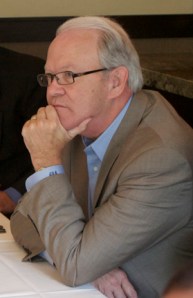
Page_blogChurch size and diversity. Page previously has called small churches the “backbone” of the convention. In the session at Broadview, he told leaders that a large majority of Southern Baptist churches run 100 people or less, said Pastor Don Sharp. “And to me, that’s a story that needs to be told over and over and over again,” said Sharp, pastor of Faith Tabernacle Baptist Church in Chicago.

“…We hear these stories of people coming in places and [the] membership’s quadrupled and the baptisms are off the board, so to speak, but it doesn’t speak to many of us” pastors of small churches, Sharp said. Faced with the comparisons, leaders can fall into fear that they’re the reason their church doesn’t measure up.

“If nothing else, I came out of that meeting with a sense of, ‘Keep doing what you’re doing, and leave room for God to do the rest.’”

The group also discussed diversity in the SBC, and the need for more ethnic groups to be represented in convention leadership, Sharp said. He paraphrased Page’s words: “The election of Fred Luter (as the SBC’s first African American president) should not be an anomaly…it shouldn’t take another 30 or 40 years for something like that to happen again.”

Cooperative Program education. The CP is Southern Baptists’ main method of supporting missions around the world, but it doesn’t have a Lottie Moon or Annie Armstrong to help promote it. “One of the keys for the future is to somehow put a face on the Cooperative Program,” said IBSA’s Dennis Conner during the Edgewater meeting of church planters. “We are deep into a cultural shift where people want to know the people they support.”

That challenge is something his team deals with every day, Page said, asking for ideas. The planters suggested using social media or daily news briefs to connect Southern Baptists with missionaries they support through the Cooperative Program.

The Executive Committee’s Ashley Clayton suggested a more foundational plan to help communicate the importance of CP giving in the next generation. “Perfunctory” support for CP has been tailing off for several decades even among older Baptists, Clayton said. There’s a need to elevate again Baptists’ core values, like international missions, reaching unreached people groups, planting churches, and theological education.

“These are core values, that when you say it in a room full of pastors, they nod their heads, they’re in agreement, they go, ‘Yeah, I’ll support that.’”

The Chicago challenge. Also in Edgewater, Page heard from Chicagoland church planters about how long it often takes to grow a church. Michael Allen, city coordinator for Send North America: Chicago, said he tells planters, “When you come to Chicago to plant a church, buy a cemetery plot.”

“In other words, don’t come to Chicago thinking I’m going to try this church planting thing and see if it works out….Many [church planters] who start do not last, and I think primarily they didn’t realize just how hard the ground is, and how much gumption you have to have.”

Page told the leaders around the lunch table that he understands the role of a sponsoring church pastor, but hasn’t had personal experience as a church planter. “I don’t even pretend to understand what you might be going through,” he said.

“I will tell you that what I hear, what I’ve seen in the past four to five years, is that things are changing across our nation….Even in the deep south, we’re seeing an encroaching lostness in some areas that is profoundly more than what you might think.”

The planters and Page discussed the temptation church planters have to move to a new place with the hope of winning the city, but without really understanding its culture and context.

Page said he was praying for “an indigenous move of God, that native Chicagoans will be able to reach the city for Christ, in addition to those that God does bring in from the outside that has called, and equipped, and [that] have the staying power to get it done.”

IMB Trustee Chairman John Edie (left) and Tom and Jeannie Elliff (right) pray over new IMB President David Platt and his family. IMB photo

IMB Trustee Chairman John Edie (left) and Tom and Jeannie Elliff (right) pray over new IMB President David Platt and his family after he was elected August 27. IMB photo

NEWS | New International Mission Board President David Platt answered media questions by phone shortly after IMB trustees elected him on Wednesday. Platt addressed concerns about his church’s giving through the Cooperative Program and the importance of local churches to the work of the IMB.

From the Baptist Press report on the conference call:

On cooperation in the SBC
“There are scores of non-traditional churches that are totally disengaged from the SBC and the Cooperative Program and even from the IMB,” Platt said. “…I don’t think the way to mobilize them is to tell them they ought to give or make them feel guilty for not giving but to show them that this is worth giving to.”

Platt added that cooperation within the Southern Baptist family is “the wisest, most effective means for working together with other churches to see the Gospel spread.”

On local churches and the IMB
Local churches are central to the IMB’s work, Platt said, noting that congregations must do more than merely provide funds for overseas ministry.

There is a common misperception that “the local church just exists to send money and send missionaries and then the IMB kind of takes care of it,” Platt said. “We’ve really got to make sure that paradigm is turned upside down so that the local church is the agent that sends missionaries and shepherds missionaries, and the IMB comes alongside local churches to do that.”

On the Cooperative Program
Platt was asked whether he will urge churches to give to missions through the Cooperative Program—Southern Baptists’ unified program of supporting missions and ministries—or encourage designated giving directly to the IMB. In response, he acknowledged a constant need to evaluate and improve CP but said it should continue to be “the primary economic engine that fuels” Southern Baptists’ cooperative ministry endeavors.

“The last thing the SBC needs is a do-it-alone IMB that’s trying to in any way undercut the Cooperative Program,” Platt said.

Platt was asked specifically about the CP giving of the congregation he pastors in Birmingham, Ala., The Church at Brook Hills. The church has contributed to the SBC Cooperative Program Allocation Budget and, according to an IMB news release, has contributed directly to the IMB. Gifts sent directly to the Executive Committee or an SBC entity are defined as designated gifts, not CP giving.

In 2013, The Church at Brook Hills gave $100,000 to the SBC CP Allocation Budget through the Executive Committee; $25,000 to the Cooperative Program; $12,500 to the Alabama Baptist Children’s Home; $15,000 to the Birmingham Baptist Association; $300,000 to the Lottie Moon Christmas Offering for International Missions; and $325,000 to the International Mission Board in special designated gifts, for a total of $777,500, or 8.9 percent of the church’s total receipts for the year, to Alabama Baptist and Southern Baptist causes.

Projections for 2014, according to the IMB report, are: $175,000 through the SBC Executive Committee; $25,000 to the Cooperative Program; $15,000 to the Alabama Baptist Children’s Home; $68,000 to the Birmingham Baptist Association; $300,000 to the Lottie Moon Christmas Offering for International Missions; and $718,000 to the International Mission Board in special designated gifts, for a projected year-end total of $1,301,000, or 13.8 percent of total projected church receipts.

Platt said he does not consider The Church at Brook Hills a “perfect model of giving” and is not holding it up as an example for every church to emulate. However, he said the church was “totally disengaged” from the SBC when he arrived eight years ago and has made “major strides” in cooperation.

It has been a blessing, he said, “over the last eight years, to see how we have made by God’s grace major strides in working with associations [and] conventions in planting churches here in North America, and then through the IMB sending church planting teams overseas.”

As he works with churches, Platt said he will advocate CP as a means rather than an end.

“What I want to trumpet more than anything else is the Great Commission and disciples made here and among the nations,” he said. “That’s what we cooperate together for, right? It’s not just cooperation for the sake of cooperation. We’ve got cooperation with a goal in mind: We want to see God glorified in the church here, God glorified among peoples around the world that haven’t even heard the Gospel.”

David_Platt

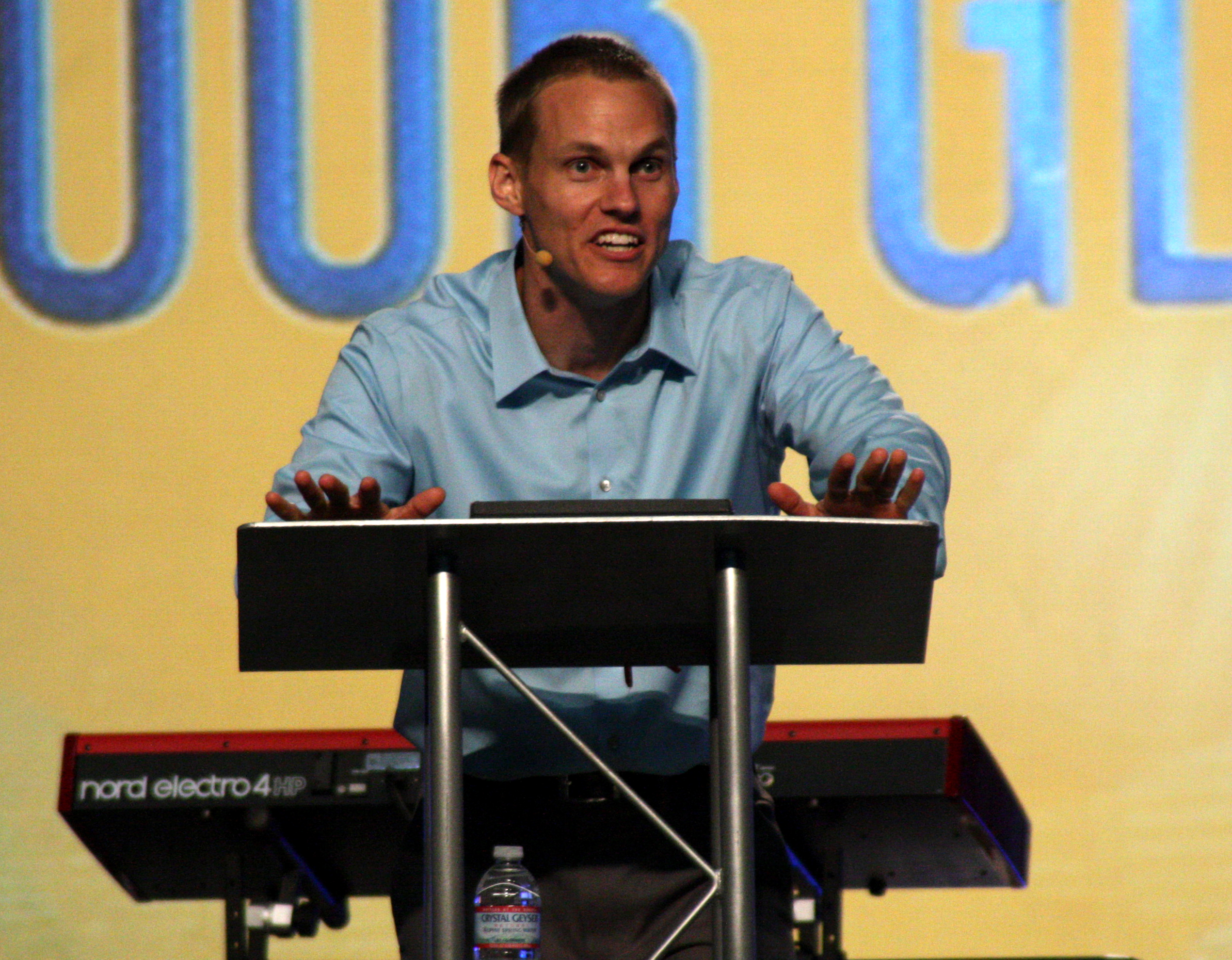
David Platt, preaching at the 2014 Southern Baptist Pastors’ Conference in Baltimore

BREAKING NEWS | Trustees of the Southern Baptist International Mission Board have elected David Platt to succeed Tom Elliff as the agency’s president. More than 4,800 missionaries serve around the world through the IMB, the world’s largest evangelical, denominational missions agency.

Platt, author of the bestselling book “Radical” and a popular conference speaker, is known for his intense preaching and focus on authentic discipleship. The 36-year-old currently is pastor of The Church at Brook Hills in Birmingham, Ala.

Due to an online mix-up, his election was announced prematurely, causing some confusion in the Southern Baptist blogosphere. The SBC Voices blog made light of it, offering a sequence of updated headlines and finally landing on “David Platt is the New IMB President (It’s Official NOW!??!).”

A video message and letter from Platt to his congregation was posted immediately on Brook Hills’ website after the official vote was announced.

“We talk all the time about laying down a blank check with our lives before God, with no strings attached, willing to go wherever He leads, give whatever He asks, and do whatever He commands in order to make His glory known among the nations of the earth, particularly among people who have never heard the gospel,” Platt said.

“Over these past months, God has made it abundantly clear to both Heather and me that He is filling in that blank check in our lives and family with a different assignment. Along the way, God has used the elders of our church to affirm His call, and today He used the leadership of the IMB to confirm it.”

David Uth, chairman of the search committee who recommended Platt, said the new IMB’s new president will be instrumental in mobilizing the next generation of missionaries.

“I think the missionary force, the young people God is calling … represent one of the greatest forces in Christian history right now,” Uth said in an interview after Platt’s election.

“While the world is becoming more hostile and anti-Christian in some places, it’s as if [young missionaries’] passion is growing equally to go to those hard places. That’s where we hear young couples saying they want to go, that they want to be radically obedient to what God has called us to do for the nations. The passion is there. How do we equip them and resource them? How do we incorporate strategy that’s effective? David is going to address that in a way that’s going to bring maximum impact.”

On August 16, church planters in Chicagoland and northwest Illinois partnered with missions volunteers for a “Serving Across Illinois” focus day. Teams helped planters prepare for back-to-school season with landscaping projects, community celebrations, and other outreach events.

This slideshow requires JavaScript.

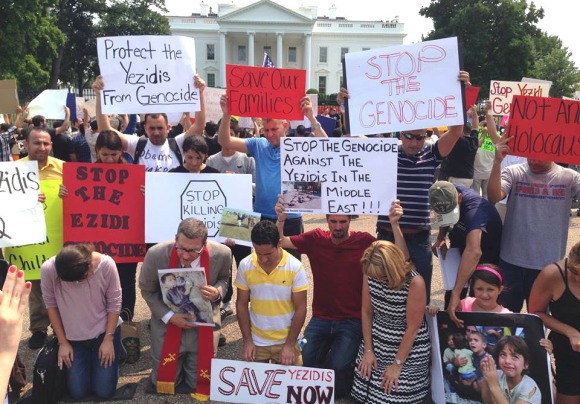
Rob Schenck (front, red scarf), president of Faith in Action and the National Clergy Council, prays Aug. 7 for the Yazidis and Christians suffering in Iraq. IMB photo

Rob Schenck (front, red scarf), president of Faith in Action and the National Clergy Council, prays Aug. 7 for the Yazidis and Christians suffering in Iraq. IMB photo

Christians around the world face heightened persecution

NEWS | From Baptist Press and IMB reports

An unfamiliar symbol began showing up on social media pages late last month. The curved line under a single dot is the Arabic letter “Nun,” reportedly used by militants in Iraq to mark the homes of Christians in the country.

“Nun” stands for Nazarene, or Jesus.

Extremists with the Islamic State of Iraq and Syria (ISIS) have forced Christians from their homes under threat of death. The Iraqi believers and other religious minorities joined millions of Syrian refugees already displaced by civil war. In a region rich with Christian history, many have noted, very little evidence of Christianity is left.

The onslaught of persecution this summer has awakened many in the Western church to the needs of Christians around the world. Many pastors and Christian organizations in July changed their Twitter avatars and Facebook profile photos to include the letter “Nun.” They also used the hashtag #WeAreN as a show of solidarity with the persecuted believers.

“The Islamic militants mean it for evil when they mark homes with ‘N’ for ‘Nazarene,’” wrote Russell Moore, president of the Ethics and Religious Liberty Commission. “They assume it’s an insult, an emblem of shame. Others once thought that of the cross.

“But in that intended slight, we are reminded of who we are, and why we belong to one another, across the barriers of space and time and language and nationality. We are Christians. We are citizens of the New Jerusalem. We are Nazarenes all.”

Iraqi refugee crisis

“There are no Christians left in Mosul.”

That’s how religious freedom advocate Nina Shea described conditions in Iraq’s second largest city in July.

Shea, director of the Hudson Institute’s Center for Religious Freedom, told CBN News that Islamic militants have eradicated virtually every trace of Christianity from Mosul, the center of Iraq’s Christian community for 2,000 years. Mosul is located on the site of the ancient city of Nineveh.

In June, militants with the Islamic State in Iraq and Syria (ISIS) extended an offer to let Christians in Mosul practice their Christian faith behind closed doors, after they paid a hefty tax and agreed not to proselytize. However, multiple sources in the region said that offer was later withdrawn and all Christians were told to leave or face execution.

Members of Assyrian Christian and Chaldean Catholic groups left empty handed, Shea said. Militants confiscated all of their possessions, including homes, cars, clothes “and even their wedding rings, sometimes with the finger attached if it would not come off.”

Christians aren’t the only religious minority targeted by ISIS. On August 3, militants seized the city of Sinjar, forcing the Yazidi Kurdish population to flee. Many escaped to the nearby Sinjar Mountains, a barren heap of rock where daytime temperatures can top 120 degrees.

More than 150 Yazidi immigrants rallied in front of the north lawn of the White House August 7 to plead for American involvement in the growing crisis. (President Obama announced that evening he had authorized military airstrikes on Iraq.) The protestors came from across the U.S. to rally on behalf of the Yazidis, who do not practice Islam but instead follow an ancient religion ISIS equates to “devil worship.”

Christians and religious minorities in other nations also have faced recent persecution due to war and religious hostilities:

Syria | The recently released International Religious Freedom Report included a daunting sentence about the country that shares Iraq’s northwestern border: “In Syria, as in much of the Middle East, the Christian presence is becoming a shadow of its former self.”

A three-year-old civil war has resulted in millions of refugees and increasingly persecuted religious minorities, including Christians caught between the regime currently in power and militants fighting against it. The report, released annually by the U.S. State Department as a picture of the state of international religious freedom the previous year, found that in the city of Homs, only 1,000 Christians remain. There were approximately 160,000 Christians there before the war.

Nigeria | Approximately 1,505 Nigerian Christians have been killed for their faith this year, as the Boko Haram terrorist group and other extremists continue their campaign of religion-based violence in the West African nation. Boko Haram and other groups have killed nearly as many Nigerian Christians in the first seven months of this year as were killed in all of 2013, the advocacy group Jubilee Campaign reported July 29.

Christians killed to date include seven fathers of the 223 Chibok school girls still missing after Boko Haram kidnapped more than 300 students in mid-April. (The group is dedicated to fighting the influence of Western education.) The fathers were killed July 20 when Boko Haram attacked the city of Damboa and hoisted a Boko Haram flag there, the Associated Press reported.

Response from the West

David Curry is president and CEO of Open Doors USA, which offers assistance to persecuted Christians around the world and lobbies repressive governments to cease religious persecution. In July, he called the plight of Christians in Mosul and the remainder of northern Iraq “unprecedented in modern times.”

“This latest forced exodus of Christians further shows why Western governments and the people in the West need to cry out in support for religious freedom in the Middle East and elsewhere,” Curry said in a statement. “If this does not move us concerning the near extinction of Christianity in the Middle East, it’s likely nothing else can.”

Since the United States invaded Iraq in 2003 to overthrow Saddam Hussein, nearly one million Christians have fled the country for safer surroundings.

In an editorial this month for The Christian Post, Curry expressed doubt that the persecution of Christians would ever be treated as “a major humanitarian crisis” by governments and secular media. “However, we should be able to count on our own family,” he wrote.

“The persecution of Jesus followers should be preached from every pulpit and prayed for at every kitchen table. One day soon it may be your faith that is under attack and you will be hoping that others will be praying for you…or even notice that it is happening.”

The International Mission Board and its ministry partner Baptist Global Response are coordinating relief efforts among Iraqi refugees. For more information about how to help, go to www.IMB.org.

Syrian refugees cross the border from Syria to Jordan. IMB photo by Jedediah Smith

Syrian refugees cross the border from Syria to Jordan. IMB photo by Jedediah Smith


NEWS | Ava Thomas & Eden Nelson
(Baptist Press)

Aman* used to be a banker in Syria, but that’s a life he can hardly remember anymore.

Now three years on the other side of a harrowing escape from his war-torn homeland, he’s stuck in a bleak job market, washing dishes for 10 hours a day to feed his starving family.

And worst of all, he’s starting to wonder if it’s ever going to end.

It’s an exhausting life for Aman and the 3 million other Syrian refugees who have flooded surrounding countries, Don Alan*, a Christian leader in the region, said.

Think back to a day when you missed a meal, or a night when you weren’t sure you were ever going to get home, Alan said. “Multiply that by 100 or 1,000, and that is a portion of what the Syrian refugee feels.”

Alan hopes Christians in the West will take up the cause of their Syrian brothers and sisters and persist in holding them up.

“Pray that we would not become weary of this crisis,” Alan said. “Some of them have been refugees for more than three years. We must persevere in supporting them.”

Aid funds from government organizations are drying up, he said, and Syria’s neighbors are bending under the burden of refugees spilling over their borders.

Lebanon’s tallies indicate that by year’s end, one third of the tiny country’s population will be refugees from Syria. Ross Mountain, the U.N. resident and humanitarian coordinator, called it an “existential crisis” for Lebanon. More than one million refugees have amplified the country’s water shortage into a serious problem.

Refugees are also straining the country’s economy, accepting jobs for less pay than Lebanese, Mountain said.

To the north of Syria, many Turks are also growing weary of absorbing more and more waves of their neighbors.

Though the Turkish government has extended health care and other continuing aid to Syrian refugees, in a January poll 55% of Turks indicated they would like to see the borders closed to fleeing Syrians. Going further, 30% of those wanted to send back the Syrians already living in Turkey.

“Surrounding countries continue to seek ways to find stability in the midst of such a crush of refugees,” Alan said.

Those countries also face fresh challenges, thanks to the emergence of the Islamic state spanning parts of Syria and Iraq, he said.

The militant group ISIS, which recently declared the Islamic state, is exacerbating the region’s refugee problem at an extraordinary rate through broad violence and religious persecution, Alan said. Iraqis are now joining their Syrian neighbors in pouring over the borders – especially Christians.

In mid-July, ISIS gave thousands of Christians in northern Iraq an ultimatum to leave the region or face execution. As a result, Christians are being forced to leave homes and villages where they have lived for centuries, Alan said.

Thousands have fled, and many people are asking if this signals the end of Christianity in Iraq (see sidebar).

The ramifications of the Middle East’s refugee crisis will be “felt for decades to come,” Alan said. It’s a bleak situation, he said, but he hopes Christians around the globe will pray that in the midst of the darkness God will do “something new in our day.”

“Pray that we would be courageous and bold. The Gospel is one of peace, even in the midst of pain and turmoil,” he said. “Pray that we would respond with open hearts and open hands. There are ways we can help today by giving, praying and speaking of the hurt of those fleeing this conflict.”

When the Bible is so clear about helping the marginalized, Alan said, how can Christians not respond to “one of the greatest crises of our time?”

“The question to you and me is will we catch His vision for what He is doing?” Alan said. “As Jesus reminded us, if we do it to the least, the one most forgotten, then we do it to Him.”

*Name changed

Baptist Global Response is providing food and hygiene kits to refugee families. For more info, go to www.gobgr.org

Ava Thomas and Eden Nelson are writers for the Southern Baptist International Mission Board. Story excerpted from Baptist Press.

By Lisa Sergent

Two women recently visited Mindy Cobb’s Sunday school class at Uptown Baptist Church in Chicago. They told Cobb they were in a lesbian relationship and asked if they would be accepted by the class. “I told them we would welcome them and love them, but not affirm their relationship,” she recounted. They didn’t come back.

It wasn’t the class’ first experience with the issue. Several years ago, a transsexual named Jackie asked to join the class. “I said no,” Cobb said. “This wasn’t the sort of person I wanted in my class.” But Cobb agreed for Jackie to share her story and let the class make its own decision.

Similar questions are affecting churches across Illinois and the nation. How would they respond if Jackie came to Sunday school? Or if a same-sex couple like TV’s Mitch and Cam and their adopted daughter, Lily, showed up on Sunday?

Same-sex marriage is legal in 19 states including Illinois; in all of the remaining states, bans on same-sex marriage are being challenged. The majority of Americans believe gay couples should be able to get married. And conservative, Bible-adhering churches that never expected to find the issue of homosexuality on their doorsteps are instead finding it in the pews.

Bob Dylan was right. The times, they are a-changin’.

We will walk with you

In April, 24-year-old author Matthew Vines released a book that some have called a game-changer for the church. In “God and the Gay Christian,” Vines, who says he holds a high view of the authority of Scripture, attempts to prove the Bible does not condemn same-sex relationships.

The book is unique because it’s a message to the church from someone who grew up there. Vines, raised as a Presbyterian in Kansas, is asking that gay people not only be welcomed in churches but also affirmed – and he says the Bible supports his view. Vines is a voice for gay people who are looking for a place to belong in the church.

At Mosaic Church in Highland, Ill., teaching pastor Eddie Pullen preached last year on what the Bible says about homosexuality. A woman in attendance that day became angry and left. She later shared her disapproval with Pullen, telling him she was a lesbian.

Churches looking for easy answers in the conversation about homosexuality likely won’t find any. “If we accept his [Vines’] argument we can simply remove this controversy from our midst, apologize to the world and move on,” said Albert Mohler, president of The Southern Baptist Theological Seminary and author of an e-book that counters Vines’ work. “But we cannot do that without counting the cost, and that cost includes the loss of all confidence in the Bible, in the church’s ability to understand and obey the Scriptures and in the Gospel as good news to all sinners.”

At Mosaic, Pullen said God had been preparing him for the conflict with the offended woman. Two years prior, he had written a sermon that he “prayed and poured more into” than any sermon in years. His message for all who would come to the church was:

• No matter who you are, you need Jesus.

• Jesus does love you.

• You are welcome at this church.

• You may not agree with us.

• We will not single you out.

• We will walk on your journey with you.

“What Christians and even churches miss is that Christ-followers need to be known for their love,” Pullen said. “Too many Christians are afraid to reach out [to homosexuals] because they’re afraid it will be received as affirmation. That’s not true.”

He told the woman who visited Mosaic, “We don’t have to agree on everything, but we don’t have to run away [when we disagree]…We don’t want you to leave because of our disagreement.” She came back to Mosaic, and has continued to participate in church activities.

“Usually it takes someone seeing Jesus in us to convince them He’s real,” Pullen said. “If they never see Jesus in His followers, why would they want to become one?”

What Mindy’s class decided

At Uptown Baptist, Mindy Cobb’s Sunday school class heard Jackie’s story and welcomed her with open arms. They spent almost a year getting to know her as a new Christian who wanted to study the Bible. That first Sunday, Jackie told the class she had been born as a man, undergone 29 surgeries, and was now a woman.

She became a member of the class, and started bringing her friends too. Every week, she gave a testimony. “It got to the point where everybody was sitting on the edge of the chair to see what Jackie was going to say this week,” Cobb said.

Then, after about a year, a man with short hair and a suit came into the class. “I wanted to tell you I am now ready to be the man God created me to be,” said Jackie, now called Willie. He had been in Christian counseling and was ready to be his male self. It was his last Sunday in Cobb’s class; the next week, Willie began attending a men’s Sunday School class at Uptown.

“God used Jackie to show me how I put people into a box,” Cobb said. “I learned to love and accept people for who they are and to let God do the changing.” Looking back on the experience, she said, “There are no quick answers. Sometimes lives are just messy. People do need help to see things a new way.”

Lisa Sergent is director of communications for the Illinois Baptist State Association and contributing editor of the Illinois Baptist newspaper.

NEWS | The U.S. Supreme Court has issued additional protection to Wheaton College as it fights a mandate in the Affordable Care Act that requires employers to cover drugs like the morning-after pill in their employee health plans.

Wheaton, a Christian college in a western Chicago suburb, already qualified for an exemption from the Affordable Care Act offered to faith-based non-profit organizations. But many have said the government’s plan – to let non-profits sign a form allowing insurers to pay for the drugs, rather than the organization itself – isn’t enough. As the Associated Press reported July 3, “Wheaton and dozens of other non-profits have sued over the form, which they say violates their religious beliefs because it forces them to participate in a system to subsidize and distribute the contraception.”
The Supreme Court’s unsigned opinion July 3 says that during its court case, Wheaton doesn’t have to sign the form but can write a letter to the U.S. Department of Health and Human Services explaining its objection to the requirements.

The Court’s three female justices – Ruth Bader Ginsburg, Elena Kagan and Sonia Sotomayor – disagreed with the temporary injunction. Sotomayor wrote that the Court’s action “undermines confidence in this institution.”

On June 30, the justices ruled 5-4 that “closely held,” for-profit businesses Hobby Lobby and Conestoga Wood Specialties don’t have to cover abortion-inducing drugs in their employee plans. ChristianityToday.com has a helpful infographic from The Becket Fund forecasting next steps in court cases against the mandate.