Archives For November 30, 1999

By Meredith Flynn

Evangelism

DOOR TO DOOR – Kyle Walker (left), vice president for student services at Southwestern Seminary, and his wife Lauren (kneeling), share the gospel in Fort Worth during the Crossover evangelistic outreach prior to the SBC annual meeting.

Taking the gospel to the world is a critical task—one that will require Baptists to work together, reported a task force appointed by outgoing SBC President Steve Gaines. The group, named by Gaines at last year’s annual meeting, presented their report in Dallas, where it was adopted by messengers.

Before the vote, the task force concurrently submitted to messengers a list of 12 evangelism affirmations and denials, based on and supported by Scripture. The report also includes several recommendations for individuals, churches, pastors, SBC entities, and the denomination as a whole—all meant to renew evangelism.

“We wanted to take the opportunity to provide a clear set of principles in terms of things we believe Southern Baptists can heartily affirm as it comes to speaking about evangelism,” said task force chairman Adam Greenway, “and with clarity saying things we do not believe evangelism entails.

“One of the most important things we can give to our convention of churches, and to a watching world, is a clear statement about…where Southern Baptists stand on the issues related to evangelism.”

The task force, which met throughout the year to develop the report, was created to study how Baptists can be more effective in evangelism, amid continually declining baptism numbers across the SBC. Doug Munton, pastor of First Baptist Church in O’Fallon and a member of the task force, said the group noted the element of personal responsibility inherent in evangelism. “We need to be intentional and purposeful,”

Munton told the Illinois Baptist. “I was glad to hear our convention talking about evangelism. The evangelism task force work will be, I pray, a helpful step.”

The report, available in full at BPNews.net, alludes to differences in theology in the SBC, but also calls Baptists to unify around the Great Commission given to all Christians.

“We affirm that the Scriptures teach that gospel conversations should seek to include both clear presentations of the ‘good news’ of salvation and genuine invitations for all people to receive Jesus Christ as Savior and Lord,” the group wrote in one of the affirmations. Following it, the group denied “that gospel conversations are merely general talk about spiritual things and that an evangelistic invitation may only be extended by a singular methodological approach.”

The task force recommended the SBC Executive Committee put a “Baptism Day” on the denominational calendar. Illinois is among the states who have celebrated a statewide baptism emphasis—more than 400 people were baptized this spring on One GRAND Sunday.

Pat Pajak, IBSA’s associate executive director of evangelism, said the report was a great reminder of Baptists’ mission to share the gospel and disciple people who come to faith in Christ.

“Anything we do that reignites a passion for evangelism is a good thing,” he said. “It’s so easy to get distracted by doing good things, busy work, administrative duties, and daily church work that we neglect the Great Commission. And, in eternity, the most important thing will not be if the newsletter was attractive, the calendar was up-to-date, the deacon meetings were on time, the piano was in tune, or the building was clean.

“What will count for all eternity is did we, as believers, share the good news of Christ’s death, burial, and resurrection with others?”

– With additional reporting by Baptist Press

B21 panel

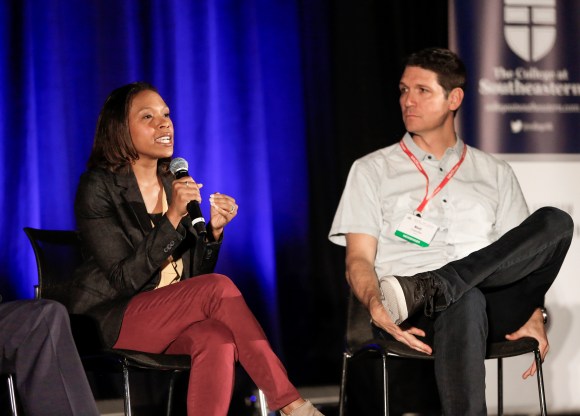
Trillia Newbell, left, director of community outreach for the Ethics & Religious Liberty Commission of the Southern Baptist Convention, and Matt Chandler, pastor of Village Church near Dallas, were part of the B21 panel discussion,. BP photo

The church’s handling of abuse and the #MeToo moment were major topics prior to the SBC’s Annual Meeting and at two panel discussions adjacent to the convention itself. Within the official meeting, actions were limited to passage of two resolutions on the role of women in ministry and an apology to abuse victims, some explanation in reports from seminary presidents, and a motion from the floor asking if a woman could be elected president of the Southern Baptist Convention.

All this comes on the 100th anniversary of women first being elected as voting messengers to the annual convention, and more important, following weeks of controvery surrounding the handling of abuse cases on two SBC seminary campuses, and remarks about women by former Southwestern Baptist Theological Seminary President Paige Patterson. Also former President of Southeastern Seminary where some of the allegations arose, Patterson was first removed from the SWBTS presidency by the full board of trustees, which promoted him to president emeritus with salary and benefits. A week later, as more allegtions emerged, the seminary trustees executive committee fired Patterson from that role and withdrew the offer of housing on the Southwestern campus.

Against this backdrop, messengers arrived in Dallas to find the topics of women and abuse allegtions handled mostly in ancillary panel discussions.

“You need to be trained in this like you’ve never been trained in this,” Matt Chandler, pastor of The Village Church in Flower Mound, Texas cautioned ministry leaders at a luncheon sponsored by B21. “Most of these men who’ve done this are narcissists and are going to come off as great guys,” he warned. He warned that pastors should make what is meant by submission clear in their sermons. “Every time you talk about submission you need to add the caveat about spiritual, physical, sexual, emotional abuse, because these guys are using this.”

In the B21 panel discussion and another by the Ethics & Religious Liberty Commission, the debate assumed a theological position of complementarianism, meaning men and women serve complementary roles in marriage and leadership.

Southern Seminary President Al Mohler said, “If you want to be a patriarchal abuser, complementarianism is an idiology you can grasp onto… Let’s just own this.” Mohler condemned “the distortion of complementarianism to justify predatory and abusive behavior (as) heresy and sin.” He also stressed that complementarianism doesn’t mean every woman is supposed to be submissive to every man.

metoo-panel

A panel discussed preventing and dealing with sexual abuse in the church June 11 at the Cooperative Program stage in Dallas. BP photo

At the same session, James Merritt, pastor of Cross Pointe Church in metro Atlanta said, “I don’t know of anything that Scripture prohibits within our denomination that a woman can’t do,” he said. “A woman can be president of the Southern Baptist Convention…. I don’t know of any position a woman cannot hold biblically. Outside the position of elder, I don’t know of any position of authority a woman cannot hold in the church.”

Merritt noted, “I think sometimes we complementarians go into a Pharisee mode of going beyond what the Scriptures teach, and I think it’s a good wake-up moment for us today.”

Southeastern Seminary President Danny Akin told B21 attendees his school did something historic by electing a woman to chair the trustees. “Becky Gardner is one of the most godly, competent women that I’ve ever met. There’s no sense in which you can make a biblical argument about it. She’s not serving as an elder, a pastor, or an overseer. She’s serving as an administrator.” Gardner is the wife of Joe Gardner, an IBSA zone consultant and director of missions at Metro Peoria Association.

But there’s much the local church can do.

Russell Moore, president of the ERLC, said to be careful when using spiritual language such as grace and mercy. “In almost every abuser in a church context I’ve ever seen…[he] wants to identify himself as King David and says we need to forgive this, and move on, ‘I need to continue on the same place where I was before.’”

Moore said the church needs to be bold and say, “That is not what grace is as defined by the gospel of Jesus Christ. You cannot use the grace of God in order to harm and to destroy Jesus’ flock.”

Several of the panelists noted that some churches fear public reports of abuse can ruin their witness in the community. “This is not a public relations issue to be managed,” stated Moore.

“Jesus does not need you to rescue his reputation by covering up sin.”

Kimberlee Norris, sexual abuse attorney with Ministry Safe, said background checks are not enough. She recommended adding to the background checks “training, screening, and appropriate policies that address grooming behaviors.”

Some of the most poignant advice come from ERLC Outreach Director Trilla Newbell, herself a survivor of sexual abuse. She appeared as a panelist at both events. Newbell advised pastors and churches to think ahead about how to handle such incidents. “It is incredibly important that we have (reporting) procedures already developed so that women in your midst, and men, know that they are already safe,” said Newbell, “so that they know you have already been thinking of this. So that they know that they will be loved.”

By Nate Adams

Editor’s note: The bill remains in committee in the House at the close of the spring session.

How churches can respond to LGBT curriculum vote

ADF-IBSANot long ago, someone used a word that wasn’t familiar to me. I immediately began breaking the word apart in my mind, realizing that I recognized pieces of it. Those pieces, along with the context in which the word was being used, allowed me to develop a pretty good idea of what the word meant. Later I found I was right.

Almost every time that kind of thing happens to me, I am thankful for Miss Daisy McCabe, my seventh-grade orthography teacher. Orthography may not be a familiar subject to many today, but it’s kind of like spelling on steroids. By studying the different parts of words and their origins, you can piece together what they mean, where they came from, and how to use them properly. A student of orthography is often good at spelling, grammar, hyphenation, punctuation, and any number of word skills.

I wasn’t crazy about orthography in seventh grade. But it has served me well throughout my life. Those of us who paid attention as Miss McCabe drilled words and participles and usages into our young minds came away better writers, and thinkers, and problem-solvers.

For some reason, I thought of orthography when I learned of legislation that recently passed the Illinois State Senate, and that now is under consideration by the Illinois House. Senate Bill 3249, which passed in the Senate 34-18 on May 2, would require a portion of public school history courses to include study of lesbian, gay, bisexual, or transgender (LGBT) figures, and that history books be “non-discriminatory” overall.

If the bill becomes law, Illinois would be just the second state, after California, to require public schools to teach LGBT history. Regional Superintendents would be tasked with enforcement, and if passed, the law would take effect in Illinois July 1, 2019.

I think my mind turned back to my orthography days because of the stark contrast between that useful subject and its lifelong, educational value, and this latest attempt by liberal legislators to impose not education but blatantly political and, for many, objectional moral values in public schools. Instead of giving all students, regardless of their background or personal choices, the skills they need for life, this type of legislation seeks to indoctrinate a belief system, and to normalize and condone behavior that the Bible clearly calls sin.

As Illinois Family Institute lobbyist Ralph Rivera said in a memo to legislators, “Schools should teach that we should be respectful of each student and each person. This is what we all agree on. However, schools should not be used to advocate for lifestyles that are against the religious values of the students and parents.”

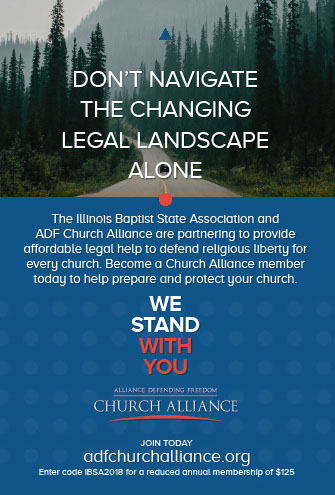
This disturbing trend in our culture is one more reason that churches should be vigilant and well prepared in guarding their own religious freedoms. It’s one reason that IBSA has entered a partnership with Alliance Defending Freedom (ADF), and why IBSA is offering to pay half the $250 first-year fee for any cooperating IBSA church that enrolls in ADF’s Church Alliance program.

Churches that join the Church Alliance program receive a religious liberty audit, including legal review of their church bylaws and policies. They receive direct access to attorneys who can answer the church’s questions about protecting its religious liberty. And they can receive consultation and/or legal representation in cases involving the church’s religious liberty. You can learn more about ADF’s Church Alliance program, and receive the half-price IBSA church partnership discount, through the IBSA.org website.

In addition to advocating for our churches’ religious freedoms, church members today must also be vigilant in communicating Biblical views and values to our state legislators. It’s a shame that we have to defend even public education this way. It makes me miss orthography.

Nate Adams is executive director of the Illinois Baptist State Association. Respond at IllinoisBaptist@IBSA.org.

2018-am-pre-reg-open

Aim of task force is renewed passion, effectiveness

With hopes of catalyzing “a fresh wave of evangelistic passion,” the Southern Baptist Convention’s evangelism task force has finalized its recommendations to the convention and will release them a week before the SBC annual meeting in Dallas.

“The ETF has prayed and worked hard,” said Doug Munton, pastor of First Baptist Church, O’Fallon, and a member of the group appointed last year by SBC President Steve Gaines. “We have tried to seek the Lord and to consider ways to encourage the SBC in evangelism,” Munton told the Illinois Baptist.

The task force is scheduled to report Wednesday morning, June 13, at the SBC annual meeting.

“We will bring to the convention a list of affirmations and denials that we hope will sharpen our evangelistic focus, as well as some recommendations which we hope will encourage our convention toward greater effectiveness,” Munton said. “We certainly recognize that the SBC needs to seek the Lord as never before and to have a greater zeal for the Great Commission.”

The task force held its third and final meeting May 14-15 at Southwestern Baptist Theological Seminary in Fort Worth, Texas. In addition to adopting its recommendations unanimously, the 19-member group elected Southern Baptist Theological Seminary administrator Adam Greenway as vice chairman. Southwestern Seminary President Emeritas Paige Patterson is chairman.

Greenway, dean of Southern’s Billy Graham School of Missions, Evangelism and Ministry, said the meeting “was characterized by constructive conversations about our report and recommendations.”

“The evangelization of the world remains our top priority as a convention of churches, and the prayer of all of us serving on this task force is that God will use our efforts to help bring us together by renewing our passion for and increasing our effectiveness in bringing people to Christ,” Greenway told Baptist Press.

“We know that we need a fresh wave of evangelistic passion, but we also need the presence and power of God,” Munton told BP. “We won’t get it all right, being imperfect members of an imperfect convention in an imperfect world. We do pray we bring encouragement to the SBC to refocus our attention and energy on reaching the lost with the Gospel.”

Steve Gaines, who is finishing his second one-year term as SBC president, thanked Southern Baptists for their prayers on behalf of the task force and requested continued prayer “for the SBC as we renew our commitment to take the gospel to all people everywhere.”

High attendance anticipated
Dallas attendance is in line to be the highest at a Southern Baptist Convention annual meeting since 2010, according to an event coordinator.

Advance hotel reservations, which ended May 14, were about 25% ahead of reservations this time last year, said William Townes, SBC Executive Committee vice president for convention finance. Between 8,000 and 9,000 messengers could attend the meeting June 12-13 at the Kay Bailey Hutchison Convention Center, he projected, based on current hotel reservations and advance messenger registrations.

Messenger attendance at an SBC annual meeting has not been that high since the 2010 annual meeting in Orlando. Topped with 5,000 to 6,000 invited guests, exhibitors and other attendees, total Dallas attendance could surpass 14,000.

SBC President Steve Gaines urged messengers and guests to leave their neckties at home, recommending a casual dress code to beat the heat in Dallas.

– From Baptist Press, w ith additional reportingby the Illinois Baptist

Updated May 23, 2018

By The Editors

As with most things in Texas, this gathering of Southern Baptists promises to be a bit bigger than usual, both in attendance and in the scope and possible impact of the issues likely to be discussed.

Generation and direction: The two announced candidates for SBC president are markedly different, both in age and theology. While recent conventions have concluded with some attempt at conciliation and commitment to work together, this two-man race serves to highlight the differences. Its outcome will likely be interpreted as a shift in direction.

This presidential election is marked by an increase in campaigning by the candidates’ supporters. Young and Reformed J.D. Greear was the candidate who stepped aside two years ago, rather than force a second run-off election and risk deepening divisions between younger leaders beginning to take their place and their parents’ generation, and between Reformed Southern Baptists and those who would call themselves “traditionalists” on the topics of salvation and election.

The elder Ken Hemphill’s experience in a variety of SBC leadership roles positions him as a statesman candidate. A number of other SBC leaders support him as a defender of traditional theology and the Cooperative Program.

The need for assurance: Messengers will arrive in Texas feeling some fallout from Frank Page’s departure as head of the SBC Executive Committee due to personal moral failure. And David Platt announced his intention to step down as International Mission Board president earlier this spring. Both entities have search committees working to fill the vacancies.

The search for new leaders has generated conversation about diversity among denominational leadership. One pastor said it’s “imperative” that at least one of the two roles be filled by a minority candidate (see our report from MLK50 on page 10).

Diversity: The SBC’s process for nominating trustees for its entities is in the spotlight for a lack of diversity among this year’s nominees. According to the “SBC This Week” podcast, the announced group of 69 nominees to serve on SBC boards is made up of 58 men and 11 women; 67 are Anglo, one is African-American, and one is Asian-American.
Southeastern Seminary President Danny Akin tweeted in response to the report, “We have got to do better than this. Our trustee boards must reflect the WHOLE SBC.”

The report from the Committee on Nominations is still a work in progress (the group generally has to fill 5-10 spots that come open prior to the convention). Chairman James Freeman said the committee initiated measures at their March meeting to increase diversity, a decision that he said was reinforced by the social media discussion.

ERLC AND social justice: Racial justice and unity may be raised again in Dallas. Throughout his tenure, ERLC President Russell Moore has galvanized younger Baptists with his brand of compassionate activism. Others, though, bristled at his harsh words for supporters of then-candidate Donald Trump, and have since questioned whether the ERLC’s policies reflect the majority of the SBC.

Last year the convention voted on a Moore-led resolution condemning “alt-right racism.” Now Moore has raised the issue of race again at an April conference that ERLC hosted commemorating the life and death of Martin Luther King, Jr. The ERLC’s report to the convention is, like last year, near the end of the meeting agenda. Moore will be among the last leaders heard from before Baptists leave Texas.

Paige Patterson: The man who led the conservative reclamation of the SBC starting in the 1970s is scheduled to preach the convention sermon in Dallas and many are calling on him not preach the sermon. On May 23 at a special called meeting of the Board of Trustees at the Southwestern Baptist Theological Seminary in Fort Worth he was removed as president and appointed president emeritus.

It comes after comments he made in 2000 about domestic abuse recently required a statement from the seminary offering clarification 18 years later. In the comments, which resurfaced last month, Patterson said his counsel to a woman being abused by her husband would depend “on the level of abuse to some degree.” He said he never counseled divorce, and at most temporary separation.

In the wake of the #MeToo movement, Patterson’s full statement is more stunning today. Fellow Texan Beth Moore, who will speak at an event for pastors’ wives in Dallas, was among the hundreds who tweeted in response, posting “We do not submit to abuse. NO.”

As the trustees met the Washington Post released an article about an incident at Southeastern Baptist Theological Seminary where Patterson was president in 2003. A former student said she told Patterson she had been raped and he urged her not to go to the police, but to forgive the student who was alleged to have committed the crime. Southeastern is investigating the report.

The cost of unity: Perhaps what will mark the Dallas convention isn’t which difficult conversations will be had, because there will certainly be some, but how we Baptists emerge from them. Will the meeting be marked by willingness to stand in unity because what unites us is the gospel? Or will our differences over the nature of gospel itself, and how God brings people to salvation, make the divide, largely generational, even clearer and wider?

Also read #SBCtoo: What we forgot to report may also be forgotten after the convention

– The Editors

Uphill climb

Lisa Misner —  May 14, 2018

Fifty years after Martin Luther King’s death, racial unity is more dream than reality in America. But what about the church?

I am a man

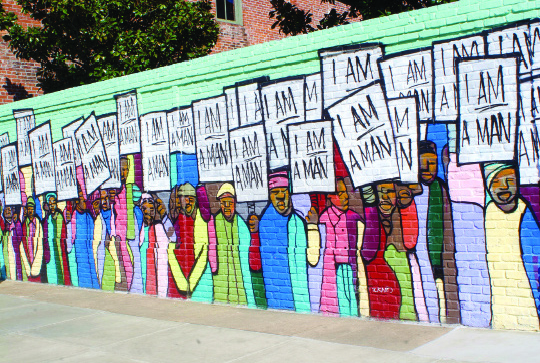
Personhood and justice were the themes of a 1968 sanitation workers’ strike memorialized today by a mural in Memphis. Managing editor Meredith Flynn returned home to Memphis to learn what has developed in racial equality and unity, as the city observed the 50th anniversary of the death of Martin Luther King, Jr.

By Meredith Flynn

In 1968, striking sanitation workers carried signs in Memphis proclaiming “I Am A Man.” They marched to protest working conditions that had recently left two of their own dead. It was their protest that brought Martin Luther King, Jr. to Memphis, and to the Lorraine Motel, where he was asassinated.

Fifty years later, people convened at the site to see what has happened with civil rights, and nearby, Southern Baptist leaders questioned the state of race relations and unity in the church. About 4,000 people met at the city’s convention center for MLK50, a conference on race and the church, co-sponsored by the SBC’s Ethics and Religious Liberty Commission.

The meeting featured a diverse group of speakers on an even broader list of topics: race and politics, systemic injustice, coming to terms with the past—and present. In their messages was this plea: Churches can no longer be silent on the issue of racial justice.
“We have expected you to be our greatest allies in the struggle against injustice,” Chicago pastor Charlie Dates told fellow pastors. “And we wanted you to shout it from your pulpits.”

In a letter written from jail in Birmingham, Ala., in 1963, Dr. King expressed similar disappointment with white ministers who were either opposed to the Civil Rights movement or cautious about getting too involved. King’s words for the latter are hard to read— they “have remained silent behind the anesthetizing security of stained glass windows,” he wrote.

“Often, we can fool ourselves into believing that somehow history itself will take care of problems of racial injustice,” said Russell Moore, president of the ERLC. “That somehow inevitably, these things will work themselves out.”

But they haven’t. Racially motivated violence took the lives of nine members of a black church in Charleston, S.C., in 2015. White supremacists marched in Virginia and elsewhere, just last year. While most people don’t use racial slurs or march behind the Confederate flag, Moore said, we still retreat to the places and mindsets where we’re most comfortable.

All the while, the church has the solution: the power of the gospel to redeem sinners, and to transform  brokenness. Speakers on the MLK50 stage implored pastors and Christians to work toward a radical view of unity—one that lays down personal preference and seeks to understand others, for the glory of God and for the sake of the gospel.

It starts with courageous leaders, said Kevin Smith, executive director for the Baptist Convention of Maryland/Delaware. “Nothing changes about the church in America without the pulpit changing.”

Lessons from Lorraine Motel
To grow up in Memphis is to be well acquainted with Dr. King and Rosa Parks and the Freedom Riders. The Lorraine Motel is a city landmark, and when the museum opened downtown in the mid-90’s, school groups started taking field trips there. Still, in a city so closely entwined with the Civil Rights movement, it’s surprisingly easy to grow up holding history at arm’s length.

On April 4 of this year, attenders at the MLK50 conference took a break to join the city’s celebration of Dr. King. At the motel, the courtyard and parking lot under the balcony where he was shot were cordoned off. Folding chairs were set up for guests invited to attend the ceremony in his honor. Other visitors to the site stood well behind them, at the top of a small hill overlooking the hotel.

Down the street, pop-up booths sold T-shirts and other memorabilia. Upbeat music poured out of an open shop door. At 6:01 p.m., the festivities stopped for a moment of silence in observance of King’s death. What resounded at the event, over the beat of reggae music and over the momentary silence, was an invitation to lean in and learn.
The same was true at the conference. A Southern Baptist pastor crystallized a call to action for the denomination: “Every time there’s an opportunity to drive a nail in the coffin of racism, every white Southern Baptist should be very quick to grab the hammer,” said Vance Pitman, pastor of Hope Church in Las Vegas. He was one of four Baptist leaders who took part in a panel discussion on the SBC and race, a session that started with a look at the denomination’s historical struggle to overcome prejudice and discrimination.

This is an ongoing struggle. In 1995, Baptists approved a resolution repenting of racism and asking African-Americans for forgiveness. In 2016, messengers repudiated the Confederate flag, and in two emotional sessions last year, messengers resoundingly approved another resolution condemning “alt-right” racism.

“It’s something that we’re going to have to constantly—as a convention, as a denomination—deal with and address as we move forward to continue to work towards the kind of reconciliation that we need to see happen,” Pitman said.

The panel, which also included Kevin Smith, National African American Fellowship President Byron Day, and Iowa pastor Jeff Dodge, discussed the “missiological consequences” of not pursuing racial unity, as well as the value of individual relationships across racial boundaries. When the conversation eventually turned to leadership of SBC entities, Pitman said it is “imperative” that at least one of two vacant posts—president/CEO of the Executive Committee and president of the International Mission Board—be filled with minority leadership.

Representation and leadership are key issues on the local church level as well, said Randle Bishop, an elder of Immanuel Baptist Church in Chicago, who attended the MLK50 conference. “One area that lacks unity in our churches and other Christian ministries is the glaring lack of submission to minority leadership,” Bishop told the Illinois Baptist.

“The reason for this is surely complex,” Bishop said. “However, if whites were to join biblically-faithful black and Hispanic churches and Christian ministries, this could be an additional approach to advancing greater unity in the body of Christ.”

A biblical imperative
Many of the addresses given in Memphis had at their root the Bible’s words about unity among Christ-followers. They called racism by its name—sin—and described its effect on American society and the church. “Namely,” said Bishop, referencing Genesis 1:27, “sin has deeply affected the way we relate to one another as image-bearers.”

“One takeaway for me was seeing how clearly the Bible addresses the hypocrisy of those who sinfully act out in racism towards other people. We do not have to take our cues in this conversation from the world and we must not,” Bishop said. “Jesus has clearly spoken in his word. He has said, ‘Love your neighbor as yourself.’”

Throughout the conference, speakers made it apparent that how to go about loving your neighbor as yourself, especially in the realms of racial identity and justice, is an exceedingly complex matter. But, they seemed to say, it starts with humility, and a willingness to set aside personal preferences in order to pick up unfamiliar burdens.

“We’re free to love each other,” Moore said. “Free to listen to each other. Free to be led by one another. Free to serve one another. We’re free to be the church of Jesus Christ. And if we have to change our worship styles, let’s crucify our worship styles. If God’s way upsets our political alliances, let’s crucify our political alliances.

“To be a gospel people means that we don’t seek a cheap reconciliation, but a cross reconciliation.”

Meredith Flynn is managing editor of the Illinois Baptist.

The best offense

Lisa Misner —  May 7, 2018

By Nate Adams

During the years I played basketball, my teams had some winning seasons and some losing seasons. After one of those losing seasons, our coach decided to make some changes.

They weren’t personnel changes—our best players were on the floor most of the time. The problem was that most of our competitors were taller and bigger than we were. And none of us were great outside shooters.

But we were quick. And we played hard. And by the start of the next season, our coach made sure we were in excellent condition. Because his new strategy, and our new life, we learned, was defense.

ADF-IBSAAt first we complained, at least among ourselves, because three-fourths of our practice time focused on guarding and running. Most basketball players like to shoot the ball. But our coach shook off our looks of discouragement with this promise: “Guys, this year our best offense is going to be good defense.” And as our defense created steals, and those steals created easy baskets for us, we grew to believe him. It was good defense that was creating new opportunities, and victories, for us.

For churches in today’s rapidly changing moral and legal climate, good defense is also essential. Religious freedom is being assaulted again and again, and often by giant, imposing foes that can range from the courts, to the schools, to the entertainment elite, to the culture itself. Churches that were once noted for the good they do are now often viewed with distrust and, in some cases, those churches face direct legal challenges.

One excellent “coach” in this changing and challenging climate is a Christian organization named Alliance Defending Freedom. ADF has over 23 years of experience providing religious freedom legal services to churches and Christian organizations, and has played a role in at least 52 Supreme Court victories. Now, through its recently developed Church Alliance program, it provides member churches with religious freedom legal services ranging from facility or land use, to unconstitutional regulation, to tax exemption issues.

Churches that join ADF’s Church Alliance program receive a religious liberty audit, including legal review of church bylaws and policies. They receive direct access to attorneys to answer the church’s questions about protecting its religious liberty. And they can receive consultation and/or legal representation in cases involving the church’s religious liberty.

Seeing that these services are now so valuable to churches, IBSA recently entered a partnership agreement with ADF to provide these services to IBSA churches for a flat annual membership rate, regardless of the church’s size. In fact, IBSA believes so strongly in the value of these services for individual churches, that IBSA will pay half of the first year’s annual $250 fee for any IBSA church that enrolls in ADF’s Church Alliance program. The religious liberty audit of a church’s key documents alone is worth well more than this amount, especially compared to the cost of an individual attorney for these services.

You can learn more about Alliance Defending Freedom, and receive the half-price IBSA church partnership discount (enter code IBSA2018), through the IBSA.org website, or call or e-mail the IBSA offices for a free brochure on how the ADF Church Alliance program works.
For my basketball team, playing serious defense was a game-changer, and a season-changer. We scored more points, and we won more games. But our offense was triggered by a solid, hard-working defense.

I am hopeful that hundreds of our IBSA churches will realize the threat they are facing, and get serious about defending their biblical beliefs and religious freedoms. Perhaps in doing so, we will also find new opportunities to go on offense with the gospel. Sometimes the best offense really is a good defense.

Nate Adams is executive director of the Illinois Baptist State Association. Respond at IllinoisBaptist@IBSA.org.

Hope that endures

ib2newseditor —  April 30, 2018

Disaster_Relief_logo_ILAfter six weeks of work in flooded homes, Illinois Baptist Disaster Relief volunteers and partners from other states completed almost 200 jobs. But even more amazing than the amount of work they did in Iroquois County, said Dwayne Doyle, is the care they showed for homeowners.

“You give of your time, you give of your talent, you give of your treasure to come serve people who need someone who has not forgotten them,” Doyle told volunteers serving in Watseka this spring. “Thank you for doing that.”

The multi-week response in Iroquois County was done in partnership with a local IBSA church—Cornerstone Ministries in Watseka. Pastor Jerry Parker and his church opened up their building as a command and housing center for the volunteers, and worked “tirelessly” to serve them meals every evening, Doyle said.

Through the work in Watseka and surrounding communities, four people prayed to receive Christ. “This is truly more important than the number of work requests that were completed, which was amazing,” said Doyle, state director for Disaster Relief and IBSA’s director of men’s ministries and missions.

Also amazing, Doyle continued, is seeing how God works through churches that work together to meet practical needs, and advance the gospel.

John Lindeman is a Disaster Relief supervisor from Williamson Association. He started with the ministry in 2011, he recounted in a recent video interview onsite in Watseka, but didn’t really understand the true value of the work back then.

“As we served people we got to know what the real value of our work was,” said the volunteer from Cornerstone Community Church in Marion. “The real value was sharing Jesus.”

John’s wife, Francie, is a Disaster Relief chaplain with the Williamson team. She says a lot of times, people in difficult situations just need someone to listen. During the response in Iroquois County, she talked to a young mother whose home the team was working on, and eventually had the opportunity to ask whether she went to church.

“That opened up the door for me to share the gospel with her,” Francie Lindeman said, “and that’s what it’s all about.”

After Easter

ib2newseditor —  April 23, 2018

idyllic landscape

Easter, of course, is about new beginnings. Those of us who know the risen Savior find in Easter new hope, new life, new power, a new covenant, new perspective, and more. Even for those who don’t yet know Jesus, Easter often means new clothes, new plantings, and new spring projects. But just after Easter a few years ago, it was the idea of beginning a new church in our community that brought my wife, Beth, and I together in prayer with three other couples.

Praying was all we knew to do at first. But soon all kinds of new thoughts and ideas started flowing. We began talking about who in our community didn’t know Christ or didn’t attend church, and why. We talked about the spiritual and physical needs we sensed those people had, and how a new church could help address them. We talked about what events we could host, and where we could meet, and how we could invite people to a new beginning.

Over the next several months, we had lots of new beginnings. We began three new Bible studies in our homes. We began a rental contract with a grade school. We began buying sound equipment, and children’s ministry supplies, and everything we could imagine that a portable church might need. We began developing a constitution, and a logo, and mailers, ads, and door hangers.

In this season of new beginnings, consider how a new church can bring new hope to people who don’t know Christ.

And we began surveying our community for feedback on a name for our community’s new church. Together, we chose the name New Hope.

That first year flew by quickly, and as it did, the Lord gathered about 40 people into our core group. Not surprisingly, we chose Easter Sunday one year later as the launch date for our new church. A hundred and eighty-two people responded to our invitations to come to a new beginning that Easter, and found New Hope, in more ways than one.

Looking back, more than a new church began that Easter. For me, it was the beginning of a firsthand understanding that new churches reach new people in ways that existing churches don’t. We were meeting in schools and homes, and baptizing in swimming pools, and making disciples of people who hadn’t been to church in years. It was the most challenging and most rewarding church experience of my life. And it convinced me forever that church planting is essential to go where lost people live, and to reach people that are “lost in the cracks” between existing churches.

New Hope had only been around a couple of years when the North American Mission Board called and asked if I would bring my communications and management background to help start hundreds of new churches each year. I’m not sure I can think of anything else the Lord could have used to lead me away from that new church, but that did it. We moved our family to Georgia, and spent almost a decade encouraging others to live a life that’s on mission, and to start new churches.

And now here we are in Illinois, and it’s just after Easter, again. There are 10 counties in Illinois that still have no Southern Baptist church, and another 12 that have only one. There are at least 200 places in Illinois that need a new church now—most of them in communities where there’s no evangelical church of any kind.

Easter is still about new beginnings, and in many ways the most-needed new beginnings in our state are the planting of new churches that will reach new people, and bring them new hope. I’m praying that there are still clusters of families out there, willing to start praying after this Easter, about what might be possible by next Easter.

Nate Adams is executive director of the Illinois Baptist State Association. Respond at IllinoisBaptist@IBSA.org.

Going public

Lisa Misner —  April 16, 2018

Hundreds across Illinois take the baptism plunge on One GRAND Sunday
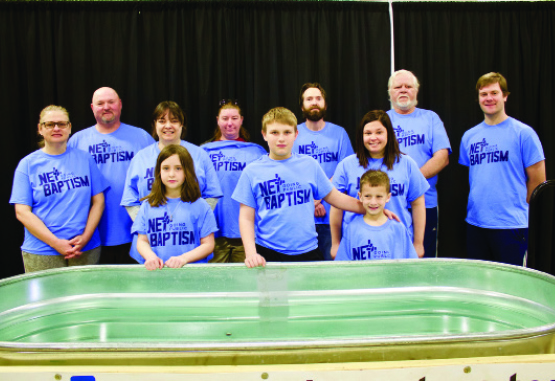
Net Church Staunton Group


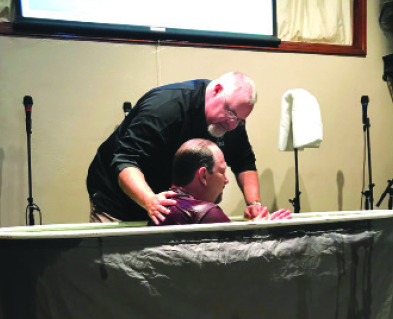
Eleven people at NET Community Church in Staunton joined hundreds more that were baptized across the state on One GRAND Sunday April 8.

On Sunday, April 8, volunteers at NET Community Church carried a livestock feeding trough into the high school gymnasium where the church meets. The trough had a lofty purpose—11 people were baptized during the morning worship service. They wore shirts with the words “going public.”

“Their life stories were all very different, but their life conversion was the same,” said Pastor Derrick Taylor. “It was so exciting to witness each one going public with their new lives in Christ, thus declaring I’m not ashamed of the Lord Jesus Christ!”

Across Illinois, hundreds of people were baptized on the day dubbed “One GRAND Sunday.” IBSA’s Pat Pajak first shared the goal of 1,000
baptisms in one day last fall. As word came in of baptisms around the state, Pajak celebrated the 321 reported so far, and the renewed excitement about evangelism that seemed to characterize the day.

“The real purpose of One GRAND Sunday was to remind churches that our responsibility and privilege is to have gospel conversations outside the walls of the church,” said Pajak, associate executive director for evangelism. The day “was a reason to reignite our passion for the Great Commission and rejoice in both salvations and baptisms, which some of our churches had not seen for many years.”

Read a few of the many stories from a day focused on baptism, and on “going public” with faith in Jesus.

‘I’m serious about this’
Brittany Miller grew up going to church, but when she went away to college, it never became a priority, she says. Over the past year, she felt a pull to go back. When a co-worker told her about his new church, NET Community in Staunton, Brittany decided to check it out.

“The pastors were so, so dedicated and just really believed in what they were preaching,” she says. “And I liked how it was just taken right from the Bible.”

There was a disconnect, though. Everyone kept talking about salvation, an unfamiliar concept for Brittany.

Net Community Brittany Miller

Brittany Miller was baptized by her pastor, Derrick Taylor, on One GRAND Sunday.

“I kind of just kept it all to myself,” she remembers. “I didn’t want to ask too many questions, because I didn’t want anybody to think I was a non-believer. Because I believed.” A personal relationship with God, though, was something she didn’t have—yet.

At a small group Bible study one evening, Brittany got up the courage to ask her questions. The group’s leader, Nancy Taylor, pulled in associate pastor David Baker, and together, they walked Brittany through what it means to have saving faith in Christ.

“After hearing what salvation was, I knew that that was what I wanted,” she says. “I wanted that relationship with God; I wanted to deepen my knowledge of him. I wanted him to live through me.”

There was one hang-up, however. “I was so worried that I couldn’t do this because I was going to let God down. And I didn’t want to do that,” she says. “It took a while for the pastor to assure me that that is not how this works.”

After two hours of talking, she prayed to receive Christ. “It all makes sense now,” she says. “It was God pulling me, little by little, to that moment.”

Over the next days and weeks, Brittany started telling family and friends what had happened to her. They were supportive in some cases, and skeptical in others. In some cases, the news didn’t go over as well as she had hoped. Brittany says she’s leaning on her church family to deal with the relational difficulty. She also downloaded a Bible app on her phone, so encouragement is always nearby.

Her baptism April 8 was a way to publicly give God the glory for her faith, and a testimony to the people in her life, she says.

“I need to do this so these people know I’m serious about this.”

All in the family
Willow Krumwiede decided to be baptized so she could share her decision to follow Christ with her church family, among others. Her public profession of faith April 8 also had a profound impact on her dad.

Willow’s father, Tim, came to Grace Fellowship Church in Amboy on that Sunday morning to support his daughter. The church planned baptisms for the end of their first worship service, Pastor Brian McWethy explained, so Tim sat through the entire service that day. Unbeknownst to him, Willow, her fiancé Andrew, and their pastor were actively praying for his salvation.

Throughout the sermon on biblical baptism where McWethy explained why each person must choose to be baptized for themselves, Willow’s father faced his own life decisions. McWethy said he could see the Holy Spirit was at work in Tim’s life during that sermon.
Grace Fellowship Amboy

Willow Krumwiede’s baptism at Grace Fellowship Church in Amboy compelled her dad, Tim, to profess his faith in Christ and be baptized.

As the band played an invitation of “O Come to the Altar”, Willow’s father stood up. He stepped forward and grabbed McWethy by the arms, saying, “I just surrendered my life to Jesus Christ.” McWethy was thrilled at the news. Before he could say much, Tim also said that he was ready to be baptized. Today.

So, a few minutes later, Tim followed his daughter into the baptismal trough. After everyone celebrated with them, McWethy asked Willow, “Did you have any idea this would happen?” Incredulous, she smiled and replied, “No.”

The pastor gives all glory to God. “There is power in his word. There is power in the gospel.” One GRAND Sunday’s emphasis on baptism helped him and his church to focus not only on baptizing, but also evangelism, McWethy said.

“If I’m gonna baptize somebody, they’ve got to get saved.” McWethy has found a renewed focus in sharing Christ daily because he was given the charge to renew his commitment to baptizing believers. “If it did nothing else, it got our minds thinking about the lost.”

‘One happy Grandma’
McKenzie Boston and Kaitlyn Warren are 15-year-old cousins whose “carefree” lifestyle completely changed when McKenzie’s mother suddenly passed away February 8.

McKenzie and Kaitlyn were brought up rarely going to church despite their mothers’ Christian upbringing. But during their visits with their grandparents, John and Carol Warren, the church-going became more frequent.

“I had a burden for all my children and grandchildren,” Carol said. “But I had especially been praying for my daughters and granddaughters.”

Carol wasn’t satisfied with just praying, however, and put her prayer into action. She wanted her children and grandchildren to know where her faith stood. “Every time they visited, I would take them to church.” Carol’s influence paid off and her daughters began attending Emmanuel Baptist Church in Carlinville—the church where they had both been baptized.

Emmanuel Carlinville

Pastor Cliff Woodman of Emmanuel Baptist Church in Carlinville baptizes McKenzie Boston.

The death of McKenzie’s mom came as a shock to the family. The young cousins started thinking more seriously about their own faith and what happens after life on earth. Kaitlyn’s mom, Cheryl, began talking to both girls about Jesus and the salvation he offered from ultimate death.

“The girls were ready by this time to have a relationship with Christ,” Carol said. She laughed, “But they wanted to wait for their grandmother to talk to them.”

On Friday, April 6, Carol talked through the Romans Road with her granddaughters and prayed with them as they received Christ. “It was such an answer to prayer!” she said. “And such a relief for me to know the hope of their salvation.” After talking to their pastor, Cliff Woodman, they prepared to publicly proclaim their salvation to the church on April 8—One GRAND Sunday.

“It was a very emotional time for us all,” Carol said. “But perhaps most especially for me.”

Carol had led her own daughters to the Lord years earlier and had seen the two of them get baptized. Now, she was watching her own granddaughters, whom she had also led to Christ, get baptized in the same church.

“It was very special for me,” Carol said. “I’m just one happy grandma!”

-IB Team Report