Archives For November 30, 1999

My job and the Gospel

Meredith Flynn —  April 7, 2014

Carrie_Campbell_blog_calloutHEARTLAND | Carrie Campbell

Looking around my middle school classroom in Springfield, I’m struck by how different it is than where I was eight months ago, surrounded by the beautiful mountains of eastern Kentucky.

Or five months ago, when I was immersed in the bright and flashing lights of New York City.

After college, I decided to take a season of my life and do full-time ministry. I spent two years in Kentucky working with at-risk kids. I followed that up with a
few months in Brooklyn, learning about ministry in an urban context. I came back home to Illinois in November and felt called to live out a personal dream: becoming a teacher. I received an exciting job offer to teach current events to sixth, seventh and eighth graders.

My classroom isn’t as scenic as the mountains or the city, but it’s certainly a mission field.

Going from a mission-minded environment to a secular workplace was a big jump for me. In many ways it was one of my biggest life challenges. I went from being surrounded by those who have the same eternal goal in mind, to working with people who have lots of different goals. I quickly learned that the “harvest is plentiful but the workers are few.” But God has given me opportunities to share the Gospel.

One of the first things I noticed among my co-workers was that the environment in my school was very negative. I started writing encouraging notes to the teachers on my team as well as the administrative staff. My coworkers quickly took notice of that and sought me out to talk about their struggles. A before-school prayer meeting started up again. People are more positive now. I realized that sharing the Gospel starts with the small things, and God can take those small things and transform a school.

The most valuable part of my job is getting to know my students and letting them know I care about their needs. Even though I’m not allowed to say, “Christ has a future for you,” I can give positive feedback and point them toward their strengths.

One student recently was placed in my room for a behavior problem. He quickly got bored, so I gave him the simple task of fixing my three-hole punch. He liked that I gave him some attention and that he was able to accomplish this task for me. We’ve had a positive relationship since then, and he knows that I care about him and want him to do better in school.

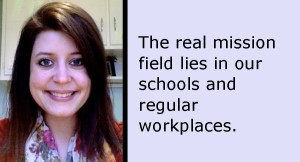
Even with the challenges this new workplace brings, I have been constantly reminded that Christ is in control, and that the real mission field lies in our schools and regular workplaces. People with needs are crying out and, for us who are Christians, being able to step into those places and bring the Gospel is an honor.

Carrie Campbell is a member of Delta Church in Springfield.

map of Ukraine - vector illustrationHEARTLAND | Frank Page, president of the Southern Baptist Convention Executive Committee, prayed over the phone recently with Vyacheslav Nesteruk, president of the Baptist Union of Ukraine. Here are four requests the Ukrainian leader shared, reported by Roger Oldham of the Executive Committee:

  • That there would be no war in Ukraine, but peace.
  • That there would be a sense of peace in the hearts of Ukrainian people, rather than a sense of unrest or anxiety.
  • For the economic situation, as sanctions imposed by Russia have already begun making life difficult in Ukraine.
  • Most of all, that people would be open to the Gospel and actively seek the Gospel during these troubled times.

Ukraine has had a turbulent year so far, with the overthrow of its president, violent protests, and recent Russian military action in Crimea. Read more about the conversation between the Baptist leaders at BPNews.net.

Baptist_hymnalHEARTLAND | Nate Adams

Our youngest son, Ethan, recently mentioned to his mom and me that he had heard a couple of great new Christian songs he really liked. We asked what they were, hoping that we had been listening to enough Christian radio to perhaps recognize them.

Imagine our surprise when the songs he named were 100-year-old hymns.
We couldn’t help but show our disbelief. “Have you never heard those hymns before?” we asked. “Have you not been in churches that sang either of those?”

Perhaps he had, we decided, but apparently not often, or not at a time that he remembered. As we then reviewed the churches our family attended since Ethan was born, we realized that each of those churches had a contemporary worship style, or at least a blend of contemporary music and hymns. Therefore, hymns that I know by heart, sometimes even by page number, have become almost lost treasures to my son.

Music is just one example of the things in church life that sometimes need to change or evolve over time in order to stay relevant to new generations. But as my son’s new love for old hymns illustrates, sometimes we let treasures that have lasting value slip away simply because we have not properly maintained them, or passed them along effectively.

Nate_Adams_blog_callout_4Cooperative missions giving is one of those time-proven treasures that I fear we risk losing in the next generation if we do not more intentionally teach its value and practice its power. As with hymns, we may be assuming that what we have known so well by heart will always be with us, even if we’re not rehearsing it regularly with new church leaders and members.

That’s one reason many Southern Baptist churches set aside one special Sunday in April to inform and educate their church members on the incredible, week-after-week power of our ongoing missions support system known as the Cooperative Program. This year the national Cooperative Program promotion Sunday is April 13, but since that happens to fall on Palm Sunday, many churches may choose another nearby date for this emphasis.

Whether it’s April 13 or some other time, intentionally educating everyone in the church about Cooperative Program missions is extremely important. Church members need to understand that the Cooperative Program portion of their church budget provides
foundational support for thousands of faithful Baptist missionaries, throughout North America and around the world. They need to know that hundreds of people groups in more than 150 countries are receiving the Gospel through these missionaries, and that thousands of new churches are being planted as a result. Right here in North America, more than 900 new churches are being established each year, and coordinated ministries such as Disaster Relief help place thousands of Southern Baptist volunteers and chaplains right in the middle of people’s deepest physical and spiritual needs.

Cooperative Program giving helps make theological training at six world-class seminaries affordable for tomorrow’s pastors, church staff, and missionaries. And it gives us an important voice in the culture through the Ethics and Religious Liberty Commission and the SBC Executive Committee. Right here in Illinois, CP helps train more than 23,000 leaders each year, and start 25 new churches.

There are lots of good resources at http://www.IBSA.org/CP and http://www.sbc.net to help church members understand how the CP works, and, more importantly, how many lives are being transformed through it as the Great Commission is advanced. There are short videos to use in worship services or small groups, and well-designed print pieces ranging from bulletin inserts to multiple-page articles.

Many of us may assume that, like a treasured hymn, the Cooperative Program will always be there, always fueling the most effective and far-reaching missionary system in history. But that will only happen if we consistently and continually teach new
generations of church leaders to carry the tune.

Nate Adams is executive director of the Illinois Baptist State Association.

David_Jeremiah_blog_calloutHEARTLAND | David Jeremiah

“I apologize for the length of this letter but I didn’t have time to make it shorter.” That seemingly contradictory statement has been attributed to a number of great writers, but as far as I can tell, Blaise Pascal gets the earliest reference.

Regardless of who said it first, it’s one of the most intriguing statements you’ll ever read. The implication is that it is harder to write a short sentence than a long one. Why? Because it takes effort to eliminate all extraneous words diluting the meaning.

The Bible uses the shorter-is-better idea as well. The shortest verse I know of is one of the most profound: “Jesus wept” (John 11:35) over Lazarus. Packed in those two words is the heartbreak and grief over the death of a friend. John, the writer, could have gone on and on about “why” Jesus wept. But he didn’t need to. Two words said it all.

As powerful as many short phrases are, I don’t know of a more important three-word phrase than “God loves you.”

I checked a handful of modern Bible translations and the phrase “God loves you” occurs only once in Scripture: Deuteronomy 23:5. And there, it is not a simple three-word sentence. It is offered as an explanation for why God protected Israel from the curses of the false prophet Balaam: “Ö the LORD your God turned the curse into a blessing for you, because the LORD your God loves you.”

“God loves you” is such an accurate summary of the entire redemptive message of the Bible that we can think of it as a biblically accurate statement. Jesus told His disciples, “for the Father Himself loves you. …” (John 16:27), and said that those who love Him (Jesus) “will be loved by My Father” (John 14:21). Yes, those “God loves you” statements are referring to believers in Christ, which I hope includes you.

Before considering who else is included in that short statement, let’s consider what “God loves you” means.

— First: “God.” Depending on your understanding of love, let me go out on a limb and say that this first word is a game changer. Why? Because God’s love is like no other love you (or I) have ever experienced. The Bible says that “God is love” (1 John 4:8,16). You can’t say that about anyone else in your life — your spouse, your Grandpa Bill, your favorite Aunt Minnie. No matter how much they love(d) you, their love is not the same as God’s love. On a given day, it might have been unconditional, even sacrificial. But every moment of every day of every month of every year? No way. Nobody loves like God. Right now, at this very moment, whether anyone else in this world does or not, GOD loves you.

— Second: “loves.” The Bible doesn’t use this image, but I like to imagine God’s love as being like Niagara Falls — with me standing right at the base, completely surrounded and engulfed by the never-ending flow of love all around me. The apostle Paul says in Romans 8:35-39 that nothing can separate me from that love. Nothing can stop the flow of that love upstream, and nothing can remove me from being engulfed in it. And the same is true for you. Right now, at this very moment, whether you realize it or not, God LOVES you.

— Third: “you.” We are so used to thinking in the world’s terms about love — whether we have earned love or deserve to be loved — that we have a hard time believing that God loves us. Right now, at this very moment, in spite of the fact that you feel unworthy of His love, God loves YOU.

The most well-known verse in the Bible affirms this love, John 3:16: “For God so loved the world that He gave His only begotten Son, that whoever believes in Him should not perish but have everlasting life.” To say “God loves you” is like saying “Here’s a gift.” You must reach out with hand and heart and accept the gift of His love in order for the power of that short statement to become a reality in your life. My prayer is that you will receive His love today.

David Jeremiah is the founder and host of Turning Point for God and pastor of Shadow Mountain Community Church in El Cajon, Calif. For more information on Turning Point, visit DavidJeremiah.org.

Do you know Carol?

Meredith Flynn —  March 10, 2014

Guinea_boats_blogHEARTLAND | Meredith Flynn

Mark Emerson had spent several hours on a boat off the coast of Guinea, looking for the Mbotini people group. It was getting late, and the group would eventually have to turn around. But Emerson had a good reason to find the Mbotini.

They were Carol Stewart’s people.

Before his trip in January, Emerson talked to Stewart about the people group she and her church adopted several years ago. Stewart, a member of Lincoln Avenue Baptist in Jacksonville, Ill., had visited Africa’s west coast. But still, it was surprising how many times
Emerson heard the question:

“Do you know Carol?”

From two missionaries and a local pastor, on the other side of the world. “This Illinois Baptist is known in Guinea because she went there in representation of her church,” Emerson said.

He’s hoping others will follow her example. The International Mission Board is calling congregations to be “engaging churches” who will adopt an unreached, unengaged people
group (UUPG) and send small teams several times a year.

Reaching unreached people groups will require a long-term investment. “This was my first mission trip I’d ever participated in that we didn’t win anyone to the Lord,” Emerson said of
his time in Guinea. Referencing William Carey, he said, “We forget that these hall of fame missionaries of the past spent years before they saw anyone come to the Lord.”

When he joined IBSA’s missions team, Emerson said he had a goal to get as many Illinois Baptists to the mission field as possible. Now, “I’m thinking we need to get the Gospel
where it’s not.”

Read more Africa stories in the newest issue of the Illinois Baptist newspaper, online here.

Nate_Adams_blog_callout_3HEARTLAND | Nate Adams

I’ve recently found myself in several different settings where I have been asked to help clarify what Baptists believe, and how those beliefs may be distinct or different from those of other groups. Sometimes the question comes from Christians of another faith background. Sometimes it’s from a non-Christian who wants to understand if his or her perception is accurate. Occasionally, those from a different Baptist denomination simply want to understand why all Baptists aren’t alike.

I have to admit, dialoguing with that latter group sometimes has made me wonder if we Baptists aren’t too quick to stand apart from one another, or to divide into different groups over relatively minor issues. But in most cases, looking for the reasons that we stand apart as Baptists makes me glad that we do.

Late last year, my more frequent conversations along these lines led me to set aside 18 weeks of our weekly chapel at the IBSA building, and to devote one week to each of the articles in The Baptist Faith & Message. We only have 30-45 minutes for chapel, which includes worship and prayer. So we did not do an in-depth study. But each week, I asked the staff to look at a different article from The Baptist Faith & Message, and to ask with me, “What is distinct here? How are Southern Baptists different from other groups, even other conservative, Christian groups?”

Our staff agreed it was a helpful and enlightening exercise. Often we found ourselves saying, “Well, many Christians believe that, or certainly most conservative or evangelical Christians would say something similar to that.” But every week, on almost every doctrinal topic, we also found ourselves identifying distinct beliefs or practices that make our Baptist faith and message meaningfully unique.

After the chapel series was over, I sat down with my notes and jotted my own personal summary of the Baptist beliefs that, to me, seem to differentiate Baptists from others. This list will help me summarize our Baptist identity when I am asked to do so. And, with great love and respect for my many Christian and evangelical friends from other denominations, these are the reasons I will always look for a Baptist church when I move to a new town, or when I choose to declare a doctrinal identity.

My list didn’t simply include a high view of Scripture, or faith in Jesus as the only way to salvation, or a literal resurrection and second coming, because many Christians share those beliefs. But it did include things like believer’s baptism, by immersion and symbolic. It included local church autonomy and congregational governance, combined with passionate, organized cooperation in missions. And it included belief in eternal security, biblical marriage, and personal responsibility for evangelism.

This rich discussion of “What does it mean to be Baptist, and does it really matter?” has also contributed to the creation of a new feature, beginning in this issue of the Illinois Baptist. You will find it on pages 9 and 10. This new “Baptist 101” section will help clarify and reinforce what it means today to be Baptist, not just doctrinally, but also in cooperative missions endeavors and practical church matters. In fact, I hope it will help all of us who read the Illinois Baptist become more articulate proponents of Baptist, evangelical, Christian faith.

Of course the autonomous nature of Baptist churches and people makes it impossible, even undesirable, to try and paint everyone with the same broad stroke. Baptists are a diverse group! But while we are not uniform, we are strangely, almost miraculously, unified. Our best understanding of the Bible has led us to stand, with humility and respect for others I trust, on core Baptist beliefs and practices. If we believe these are important enough to protect and
preserve for our children and grandchildren, then we must continue to understand them and articulate them for others. Across the centuries, and I believe now and into the future, Baptist faith matters.

Nate Adams is executive director of the Illinois Baptist State Association.

Nate_Adams_blog_callout_2HEARTLAND | Nate Adams

Last month Directors of Missions and other associational leaders from around the state gathered at the IBSA Building for a time of leadership development, fellowship, and strategic thinking about how best to assist churches. Dr. Chuck Kelley, president of New Orleans Baptist Theological Seminary, was invited to speak to us on “Fostering a Positive Baptism Trend in an Association.”

To set the stage, Dr. Kelley reminded us that the number of baptisms in SBC churches overall has been on a 50-year plateau, and has now actually declined six of the past eight years. Nationwide data for 2013 is not yet available, but in 2012 baptisms declined 5.5% from 2011, to only 314,956. That’s the lowest level since 1948, when SBC churches reported only 6 million members rather than the current 16 million. In fact, to give those numbers some further context, baptisms totaled 445,725 in 1972, and 429,063 in 1959.

Here among IBSA churches, baptisms were actually up 3.1% in 2013 to 5,063, building on the previous year’s 2.6% increase. Still, 2013 is our churches’ first year above 5,000 baptisms since 2009. And in 2005, IBSA churches reported 6,499 baptisms.

While all of us were eager to hear what Dr. Kelley would suggest, none of us were really surprised when he said there are no easy answers to reversing the current baptism trend. I was personally grateful to hear him underscore that we shouldn’t seek to affix blame or pass the buck. Instead, we all need to focus passionately and sacrificially on the urgent need to reach people with the Gospel in an increasingly challenging environment.

While I don’t have space here to recap everything Dr. Kelley shared with us, I can share his alliterated outline. He said we need to Focus on Filling (of the Spirit, or revival), on Fruitfulness (intentional evangelism), on Faithfulness (a return to true discipleship), and even on Fighting (embracing the inevitable conflict that comes when change is needed, yet with Christ-like attitudes and righteousness).

All of these points hit home deeply with me, and couldn’t have come at a better time. Not only are we beginning a new year of ministry here at IBSA, and in all our churches, but we are also beginning our planning and budgeting for 2015. We can’t keep doing ministry as usual and expect a much different result.

As Dr. Kelley urged, we must persistently ask God to fill us afresh with His Spirit, and bring revival to our churches and spiritual awakening to our land. We must focus much more intentionally on fruitfulness, starting new Bible studies and Sunday School classes and evangelistic ministries, and equipping believers to courageously share the Gospel. We must more carefully embrace true discipleship, investing God’s Word deeply in those who will be faithful to live the Gospel and pay it forward into the lives of others. And yes, we must be so committed to a different level of fruitfulness that we are
even willing to engage the conflict that often seems to come with change, even in churches.

Those of us leading and serving churches today have lived most of our adult lives on the downwardly sloping plateau of this baptism trend. In many ways we have been maintaining our processes and doing church in comfortable ways, and if we simply continue our current patterns in the face of a changing culture, we will soon see the downward slope of the current trend steepen dramatically.

So as we prepare to plot one more year of baptisms on the chart of history, it is this urgency of reaching spiritually lost people with the Gospel that must compel us, and our churches. Baptisms may not be the only measure of fruitfulness, but they are a measure that we cannot be content to see in even gradual decline.

Nate Adams is executive director of the Illinois Baptist State Association.

BIG_pic_0210HEARTLAND | It had been a long, frustrating boat ride.

Mark Emerson and Harold Booze were just off Africa’s west coast, trying to locate a people group everyone seemed familiar with, but no one could find. With evening approaching and no place to stay for the night, Emerson knew they needed to go back to Kamsar, the city they had left a few hours before.

Go to IBSA’s Facebook page for a slideshow from the trip.

“The crushing blow is, I’ve had to turn this boat around, and I haven’t gotten to give the Gospel to anyone,” he said.

Emerson and Booze had come to Guinea with three other Illinois Baptist pastors to share Bible stories with people in the mostly Muslim, largely illiterate country. The group had split up, each with a missionary guide and an interpreter, and each in search of people groups who haven’t yet been engaged with the Gospel.

On the boat, “I’m going to give the Gospel to somebody,” Emerson decided. Along with the boat captain, two other Guineans were also on board. Emerson started telling “every ship story of Jesus, one right after the other,” he said, laughing at the memory.

On a later visit to an historic village, the Americans took a turn as listeners, hearing the story of how the people had come to settle there. When they finished the detailed account, the villagers said, “You tell us a story.”

Emerson replied, “I’ve got a great one.”

The International Mission Board will host a Base Camp training conference March 28-29 at FBC, Woodlawn, Ill., for churches interested in engaging unreached people groups of Sub-Saharan Africa. E-mail MarkEmerson@IBSA.org for more information.

Mark Emerson, pictured here, and a team of four volunteers from Illinois spent a week in Guinea engaging people there with stories from the Bible.

Mark Emerson, pictured here, and a team of four volunteers from Illinois spent a week in Guinea engaging people there with stories from the Bible.

HEARTLAND | In Guinea on a short-term mission trip, Mark Emerson met his own version of the man from Macedonia (see Acts 16:9).

Emerson and fellow Illinois volunteer Harold Booze were waiting for a boat to take them and their missionary guide to share Bible stories with an unreached, unengaged people group. As they endured the six-hour wait, they met John, a soldier from a nearby village. When they told him where they were going and why, John asked, “Why are you passing by me?”

“So, on our return, we came back a day early to tell stories to him and his family,” Emerson said.

John was one of many Guineans who heard true stories from the Bible that week. Five volunteers from Illinois partnered with International Mission Board missionaries to locate and share with unreached people groups in the country. The mostly Muslim nation is largely non-literate; the people rely on stories to pass down their traditions and culture. In one historic village, the Americans listened first to the story of how the people had come to settle there. After detailing hundreds of years of their people group’s history – including specific names – the Guineans turned to the Americans and said, “You tell us a story.”

“I’ve got a great one,” Emerson said before launching into the account of the Good Samaritan.

The Bible stories were the group’s inroads into the villages, a way to begin building relationships so that missionaries and future teams can go back and keep sharing about Jesus. In a village where they stayed several days, the chief brought a sick child to them. After they prayed for him, the Muslim chief was so moved by the passion of their prayers that he took the group from place to place so they could pray for more people.

They met a man near death and prayed for him, that he would choose Jesus. Their missionary guide felt like they shouldn’t leave the room until they had given the man the Gospel, so, “I gave him the whole thing, the full-barrel Gospel,” Emerson said. The man didn’t turn to Christ, but the missionary encouraged Emerson and the other volunteers. “At least he had a choice.”

“My responsibility is to help people have a choice,” Emerson said once back in the U.S. “I didn’t win anybody to Jesus, but I got a whole lot of people closer.” Like the chief who told him, with his hand on his own chest, “God has designed us to know Him in our hearts.”

200255412-001HEARTLAND | Meredith Flynn

I got stuck in a shopping center right before Christmas. My ride wasn’t coming for another hour, and I had already been in every store. I pulled out my phone, hit the round button and…nothing. Dead battery.

Without anything else to do, and almost an hour of free time stretching out in front of me, I decided to think.

For 45 whole minutes. (It took me 15 minutes to decide to think in the first place.)

It was an idea that had been percolating for a few weeks. In my work, and probably every other job, good ideas are essential. Creativity is key. And I had been out of both for a while. Maybe if I think – just think – for a few minutes, I’ll have some good ideas, I thought.

So I did. And as I thought – in my case, going through the next issue of our newspaper page by page – thinking quickly turned into praying:

What feature story should go on page 11?

Which columnists should we use on page 5?

What headline will catch people’s attention on page 1?

When my husband pulled into the parking lot, I didn’t have any big answers. But I did have some ideas. And I felt calmer after having turned over some of my concerns to God, who understands the value of creativity.

That’s why one of my New Year’s resolutions is to think. For at least half an hour every day. I admit, I’ve already failed; it will be a difficult discipline for me. But its value extends to areas outside of work too. If I thought a little more – about how I could give more generously, speak more lovingly, or live more joyously – I’m sure God will be faithful to show me how.

I know what you’re thinking – this is less about thinking than it is about praying. It’s basically a resolution to pray more, which lots of Christians probably make every year. All true. But I find that resolving to pray more often ends up in me staring at the ceiling, thinking about all I need to do.

I’m a list maker. Maybe you are too. As the lists get longer of everything I need to do, I can get too busy to think or pray about what I’m doing. But what if I resolved to take seriously the charge in Philippians 4:6? “…Through prayer and petition with thanksgiving, let your requests be made known to God.”

So, I’ll think in 2014. My prayer life depends on it.