Archives For November 30, 1999

January 17 is Sanctity of Life Sunday

Schumacher

At just over one-and-a  half pounds. baby Grace was born a micro-preemie.

When Grace Schumacher turned one last October, it was a milestone that once seemed impossible. Her story of survival against the odds has reminded a church and a community about the sanctity of human life.

When Grace’s mom, Mindy, was pregnant, a blood-screening test indicated possible problems. More testing revealed a high likelihood of Down Syndrome. At only 29 weeks, Mindy’s doctor wanted to monitor her because baby Grace was “off-the-charts too small,” said Grace’s grandmother, Charmel Jacobs.

This routine procedure became a two-day hospital stay, which then became an emergency C-section as Grace’s heart rate continued to drop much too frequently. The baby needed to be delivered, despite the chance she might not survive. Charmel’s husband, Jerry, started praying out loud as this decision was made.

He said, “Lord, we just need your grace.”

And Grace the Lord gave, literally. Born October 24 at 5:44 a.m., weighing only 1 lb. 9 oz., she was considered a micro-preemie. The family was warned she probably wouldn’t cry. But she gave a little squeak, and then started wailing away.

Grace was in the hospital for three months after that, “an emotional roller coaster for everyone,” her grandmother said. She faced a host of medical complications, and family and friends weren’t even allowed to visit. But finally, one week after her original due date, Grace’s parents took their daughter home.

Charmel wanted to thank Rockford Memorial Hospital for everything they did for their family during that difficult time. So she got the idea (which she credits to the Lord) to write a letter to the editor in their local paper. This was also around the time that she was wrestling with how to influence the culture and put a positive pro-life message into the community.

She enlisted prayer from her pastor that the Lord would give her the ability to construct this letter concisely and positively. Jacobs awoke one morning at five o’clock and started writing. “It was done within an hour,” she said.

In the editorial she expressed her gratitude to everyone in the neo-natal intensive care unit that had been Grace’s first home. She concluded by giving ultimate thanks to her Heavenly Father, praising him for gifting the family with the care the hospital gave them and their vulnerable, yet extremely valuable treasure, Grace. She then wrote, “I wish everyone could peek inside those cribs and understand that each one is a precious soul created by God—no matter how tiny.”

Within days, the letter was in print and on Facebook. It was taped to every monitor at the hospital, and the newspaper later published an article celebrating Grace and the hospital’s acclaimed NICU department. “Over and over, God has confirmed that he wants this story told,” the grateful grandmother said.

‘It’s not up to us’

In the same church in Machesney Park, another young girl’s life—once in question—now stands as a testimony to the goodness of God.

Michael and Jessica Miller were encouraged to terminate a pregnancy because of complications, but they chose not to. Now nine years later, Machesney Park’s former associate pastor, Larry Wells, says, “Riley is an inspiration to all of us.”

At 20 weeks into the pregnancy, the Millers were asked if they wanted to find out the baby’s gender. From the images, they could tell they were having a girl, but also that something was definitely not right. “She had a tumor at the base of her tailbone,” Jessica said. A specialist came in soon after they got the news and told them the child had almost no chance of survival and would need to be monitored very closely.

“That same day, they sent us to a genetic counselor who said we should have an abortion,” Jessica said. The baby would have a host of mental, physical, and developmental problems, and in the eyes of the doctors, the cost of the complications outweighed the value of her life.

The Millers made it very clear that wasn’t an option and never would be. “We told them that doesn’t need to be suggested again. It’s not happening,” Jessica recalled.

But the tumor continued to grow, quickly. By 27½ weeks, it was affecting everything and causing Riley’s heart to fail. It was also starting to affect Jessica. The doctor said they would perform one last ultrasound, and if Riley’s heart was still beating, they would deliver her. The Millers were warned, though, that even then she would have only a 50% chance of survival.

“But I had confidence,” said Jessica. “We had been praying about it.”

The test revealed that somehow, against all medical odds, her heart was beating. So they delivered Riley—not breathing at first, blue and swollen, but alive.

She initially weighed just over four pounds. Riley immediately underwent surgery to remove the tumor, a genetic anomaly that affects only one in 40,000 babies. After the procedure, she weighed 1 lb. 5 oz. She remained in intensive care for two months.

Although Riley is small for her age and some scars remain from her multiple surgeries, her mother says, “She’s nine years old now. She has no learning disabilities. Looking at her you would never know!”

When questioned how her daughter’s story has impacted other people over the years, Jessica talked about how opening up about their experiences has been a real encouragement to the people in her church, bolstering their faith as they hear about and witness what amazing things God can do.

About two years ago, she was also able to talk to another mother who was faced with the decision either to terminate the pregnancy or trust their baby into God’s hands. Although they lost their child, they chose the latter.

“The main thing I’ve learned,” Jessica said, “is that you never know what’s going to happen. It’s not up to us to make that choice.”

– Morgan Jackson is a freelance writer living in Bloomington, Illinois.

Leadership Summit 2016 logoAbout 250 leaders from IBSA churches will gather in Springfield January 26-27 for the Illinois Leadership Summit. As a follow-up to the Midwest Leadership Summit last January, which brings together leaders from 10 state conventions every three years, this Illinois-focused conference is expected to build on the momentum of the large regional event.

“I believe this is the first of its kind training that we have designed specifically for individual leaders,” said Mark Emerson, associate executive director of IBSA’s Church Resources team. “IBSA often holds training that focuses on church positions or ministry skills, but this training is unique in that it focuses on the individual leader.”

The Illinois Leadership Summit is part of IBSA’s ongoing leadership development plan. The conference will feature 27 speakers in 32 breakout sessions, including some Illinois pastors who will share experiences from their churches. Among the speakers are Heath Tibbetts of First Baptist Church of Machesney Park, Michael Nave of Cornerstone Church in Marion, Sammy Simmons of Immanuel Baptist Church of Benton, Adron Robinson of Hillcrest Baptist Church in Country Club Hills (metro Chicago), and Doug Munton of FBC O’Fallon. (The full list is here.)

Keynote speaker for the event is Bob Bumgarner, executive pastor of Chets Creek Baptist Church in Jacksonville, Florida. He is a leadership expert who formerly served with the Florida Baptist Convention.

Bumgarner will teach IBSA’s four-phase leadership development process: leading self, leading followers, leading leaders, and leading the organization.

“This training is important for pastors because it is common in the ministry to reach a leadership lid,” Emerson said.

“Some of us are dealing with barriers to growth in our church that are out of our control—buildings, parking, location. But growing as leaders is something that all of us can do this year. If we grow as leaders, the church also grows.”

Seating is limited. Register online at IBSA.org/summit.


Higher resolution

Lisa Misner —  December 31, 2015

Higher resolutionWe have a new TV at our house. It was probably overdue, because our previous TV was 15 years old, square, and only showed about two-thirds of the information that now seems to scroll continuously along the bottom of the screen.

But that outdated, misshapen, low resolution, antiquated TV simply would not die on its own, though I would occasionally toss the dog a ball in its direction, hoping something would happen. The old TV was still functional, and so year after year, we kept settling for that increasingly dated picture of our world.

As we now enter a new year, I feel the need for higher resolution in my spiritual life as well. Perhaps you do too. I don’t want to keep settling for an old picture of how things are, or how they should be, while the rest of the world is so quickly changing around me. I want my life and my church to have a sharp, accurate new picture of our purpose and mission in the world.

What does that mean? Well first, I think I need a new, higher-resolution picture of lost people. I need to stop seeing those around me who don’t know Christ as satisfied, self-sufficient neighbors who deserve their privacy. I need to see them clearly as hollow souls, spiritually dead on the inside, who are living life with quiet, inward desperation until someone finds a way to break through with the good news about Jesus.

I also need a higher resolution picture of what it actually takes for me and my church to deliver this good news. I can’t keep seeing the routine weekly schedule of my church as an adequate witness in my community. I need to see clearly what behaviors and changes are needed to actually share the gospel with people, and welcome them into the family of disciples that we call church.

I wrote recently about five actions that, statistically speaking, most often result in people coming to faith in Christ. They are an evangelistic prayer strategy, Vacation Bible School, witness training, outreach events, and starting intentional new groups. If my church and I don’t at least embrace those proven actions, we’re probably not seeing clearly at all.

Finally, I also need a higher resolution on what people, organizations, and partners are actually advancing the gospel, and most deserving of my time and resources. A couple of years ago, my wife and I updated our estate plan, and it made us think carefully about where we want the resources of our life to go. Sadly, in just a short time, some of those organizations or people have changed or drifted enough that we feel a need to rethink our plan. We want to generously give our best, but with a clear, current picture of where our investment brings the greatest Kingdom return. I’m happy to say that our cooperative missions work here in Illinois is still on the top of that list.

You should see our new TV. It’s not only larger than the old one, the picture is incredibly sharp, it’s relatively lightweight, and because it’s a “smart” TV, we can now access all kinds of new features through the Internet. It’s amazing. Yet it cost less than half of what we paid for its antique predecessor 15 years ago.

I can see things so much more clearly now. It makes me wonder why I waited so long to get a better picture. I don’t want to wait any longer to get a clearer picture of what it takes to reach people with the gospel either. I think that higher resolution will also give me higher resolutions for this new year.

Nate Adams is executive director of the Illinois Baptist State Association. Respond at IllinoisBaptist@IBSA.org. This column appears in the 1/4/16 issue of the Illinois Baptist.

cultureBy Nick Rynerson

“Unless the gospel is made explicit,” says Matt Chandler in his book “The Explicit Gospel,” “people will believe that Jesus’s message is that he has come to condemn the world, not to save it.”

Much has been made lately of this idea, that the gospel must be consistently made the explicit focus of our ministry, teaching, preaching, writing, thinking, and living. At first it sounds good; who wouldn’t want to center their life on the gospel explicitly preached? Declaring, believing, and enjoying God’s grace given to us through the sacrificial death and resurrection of Jesus Christ is the penultimate privilege of the Christian.

But what does this mean for Christian bakers, musicians, filmmakers, writers, and insurance salesmen? Does this mean we need to weave gospel presentations into everything we do and avoid things that don’t fit in with our understanding of the gospel?

According to the Bible, maybe not.

While Jesus said that the whole Bible testified about him (John 5:39), in the first 39 books of the Bible, there is basically no explicit mention of Jesus. But that certainly doesn’t mean the gospel wasn’t present in the Old Testament. After his resurrection, Jesus on the road to Emmaus applied the explicit gospel to the less obvious gospel message of the Old Testament: “Beginning with Moses and all the Prophets, he interpreted to them in all the Scriptures the things concerning himself” (Luke 24:27).

One of the wonderful things about the gospel is that it is a story. It’s the story of man’s rejection of God and God’s redemption of the creatures that rejected Him through the blood of the sinless son of God. And in this story there are themes that any good gospel presentation will communicate: rebellion, love, grace, redemption, and unmerited favor.

When we see the world through these “gospel-colored glasses,” we begin to see those themes in unexpected places. Understanding the explicit gospel helps us see the implicit gospel. By having a level of explicit “gospel fluency,” as Pastor Jeff Vanderstelt puts it, we aren’t provoked to put gospel demands on earthly things. Instead, we begin to see echoes of the explicit gospel in those same earthly things.

The apostle Paul, maybe the most “gospel fluent” person to ever walk the earth, modeled this for us in Acts 17. Here, Paul preaches the explicit gospel in Athens and then, incredibly, cites Greek pagan poetry as examples of the love and graciousness of God! This means that Paul must have read these poems and thought, “Wow! The themes of the gospel are so strong, I bet I could use these to actually preach the gospel!”

He saw the implicit gospel because he knew the explicit gospel.

This means we are free to see the good gospel themes in the “secular” world. Whether it’s a movie, song, book, or TV show, if we are familiar enough with the themes of the gospel we can pick out those gospel themes when they show up in culture. The Christian appreciation of culture is possible when we are convinced that God’s world, even in its fallen state, echoes God’s word (i.e., the gospel).

Seeing the world through gospel-colored glasses also allows us to not have to tell the whole story every time. This is why good fiction written by Christians can be so powerful. Flannery O’Connor, C.S. Lewis, J.R.R. Tolkien, and Marilyn Robinson can bring me to tears not because they present an elaborate gospel presentation, but because they use well-crafted stories to imply gospel truth. It’s truth that circumvents propositional logic and hits the heart.

Art, music, and stories have a funny way of doing that. They speak to something deeper than our logical mind, as if when we read a good story or listen to a good song, something deep within us is stimulated and our hearts “burn within us” (Luke 24:27). So yes! Preach the explicit gospel, and put on your “gospel-colored glasses” to be on the lookout for the implicit gospel too. We need both. As Martin Luther reminds us, “God writes the Gospel not in the Bible alone, but also on trees, and in the flowers and clouds and stars.”

Nick Rynerson is a staff writer for Christ and Pop Culture and works for Crossway Books publishing house in Wheaton.

The New Seekers

Lisa Misner —  December 21, 2015

Today’s magi are young and worldly wise, but naïve about Christ

Worldly wise, spiritually curious

Worldly wise, spiritually curious | The magi in this nativity hail from Uganda. http://www.worldcrafts.org

By Mark Coppenger | While a 60-year-old church planter in a university town just north of Chicago, I had at least one big personal question: Why would college students come to a basement rental space to hear a balding, overweight preacher who was often the only one in the service wearing a tie? At least I knew it wasn’t my effort to “dress for success,” which used to mean gray slacks, a blue blazer, rep tie, and such, but had come to mean work jeans and an untucked shirt. The best I could tell, sartorial and tonsorial factors were not much in play.

And lest you have the impression that I was some sort of maven at reaching Millennials, I should hasten to say that a lot of them stayed away, and a lot of them who gave us a look never came back. As the old joke goes, “We had three decisions on Sunday. One was for God, and two were against.” I think that goes with the territory when you preach “the whole counsel of God” in an age when feelings, relativism, and political correctness rule.

In our 11 years in Evanston reaching out to the Northwestern University campus, our church plant grew about five per year in average attendance, ending with about 55 a week. Of course, college communities are very fluid, and we’d regularly have our heart broken by graduations, where we’d lose a chunk of our treasure. But we labored on in joy and with some fruitfulness, and today we take great satisfaction as seeing our former parishioners on the mission field in Germany, India, and China; as Christian faculty at such universities as Maryland and North Carolina; in corporate positions from New York to San Francisco; in military service bands, medicine, the urban classroom, magazine staffs, NASA consultancies, symphony orchestras, etc.

Many of these folks were already walking with the Lord, and we simply had the privilege of walking with them on a segment of their journey. But some were also coming in from the pagan pool. Some were old guys—one was an aging veteran of Iwo Jima who was concerned with “studying for finals”; another was a middle-aged Baha’i, who wanted a chance to bone up on one of the many faiths they somehow embraced.

All this being said, here are some things that come to mind about our linkup with Millennials, many of whom were not believers when we met them.

They’re seeking a way out

First, let me say that in the talk about “seekers” and “seeker-friendly churches,” we see something of a duel between those who point to Romans 3:11 (“there is no one who seeks God”) and Jeremiah 29:13 (“You will seek me and you will find me, when you seek me with all your heart”).

The former say that the lost have little or no appetite for the true God, at least until he intervenes in their hearts. The latter emphasize the human will and point to cases, whether biblical (John 12:21), historical, or contemporary, in which people did, indeed, come looking for the Lord.

Of course, this leaves open the question of why they were looking. (For what it’s worth, I’m persuaded that the overarching answer is that God puts it in their hearts to seek him, and they’re not really seeking him until he does this.)

I think it’s fair to say that most of our seekers were looking more for a door out of their current spiritual situation than for one into the Kingdom of Christ. They’d made a mess of their lives or come up empty in one way or another. They were unlucky in love, academics, employment; depleted and damaged by addictions, sexual sin; exhausted by the grind, betrayed by friends, marginalized by the culture and such, and they were willing to try something new. So they weren’t so much homing missiles intent on pursuing the righteousness of God, as they were anxious travelers thrashing about in the woods, spotting a cabin light in the distance and walking toward it.

Some were happy to join in the life of the cabin, glad to receive the mercies and life of the one who had invited those who were “weary and heavy laden” to come to him for rest. But others soon got cabin fever and sought the exit.

They loved the warmth and camaraderie and words of grace and love, but they couldn’t abide the language of Zion or imposition of the biblical prerogatives, and so, after warming their hands at the hearth, they plunged back into the darkness. There were, for instance, those who couldn’t or wouldn’t give up their intimate co-habitation without benefit of marriage. If they had been looking for the true God, they would have stayed, but they were only interested in trying out a new drug.

I was struck by the testimony of one of our Chinese students that her father had urged her to check out Christianity since it seemed connected with human and economic wellbeing. He wanted her to get a fix on what those Christian birds were up to that made them fly so high.

For those who had a heart to stay, we made a way for them to grow “in wisdom and stature and favor with God and man.” For the others—the rich young rulers, if you will—they’d had a look at what discipleship meant, like it or not.

Despite what the critics say, the church still has a lot of cachet, and we should expect people to give us a look if only to figure out, “What is it with those guys?”

Spiritual nomads need roots

Fewer and fewer young adults come from gratifying homes, and those that do so miss what they had when they move away. Either they don’t much know what a family is supposed to look like, or they long for a substitute. And that’s where the church can come in big time.

In Evanston, Sharon and I were empty nesters for most of our years as a church-planting couple, so we had a lot of freedom to connect in fatherly/motherly (or grandfatherly/grandmotherly) ways. We’d go to their plays, recitals, sporting events, and such, taking photos, making over them at receptions, and basking in the moments of their achievement.

I remember one night at a club in Rogers Park, we went to hear a group called the Blind Anabaptist Blues Band, formed by one of our Northwestern students. They performed in all sorts of venues, high and low, in the Chicago area. They offered a mix of secular and sacred music, the lead singer with something of a Bob Dylan/Tom Waits sound. That night they led with several of their “worldly” numbers (e.g., “Girl With Gin on Her Lips”), but then, 20 minutes or so into the set, they gave a straightforward rendition of an old hymn.

You might think this would come off like fingernails on the blackboard, for overnight hookups were shaping up at the bar, pitchers of beer sloshed everywhere, and a lesbian couple had taken to the dance floor in front of the band. But a sweet reverence came over the room, with strangers mouthing some of the words, and with, perhaps, a tear or two at this or that table.

Perhaps they remembered the days when their mommy took them to Sunday school, they sang in the youth choir, or they sat on the back row of some church, barely attentive to what was going on, but with their young impressionable minds absorbing those gospel strains. So we need to be careful about throwing old stuff under the bus, for it may well be a linkage point.

What they know, what they don’t

I may have this all wrong, but I don’t think the current young adults read or learn as much background material as we Boomers did. I’ve seen several studies showing that, in high school and college, they’re writing fewer and fewer term papers.

They’re juiced with music in their ear buds, tweeted to insensibility, selfie’d into the third celestial ring of narcissism, and often remindful of the French, who after their 18th-century revolution, started the calendar all over again, declaring themselves the founders of a new age, no longer beholden to the BC/AD business.

So while you may stumble on syncing your iPhone or some other item of technological arcana, you know who Lottie Moon was, how William Carey fought widow burning in India, what turned Wales upside down in 1904, how ‘Messiah’ and ‘Christ’ connect with oil, the connection between Nineveh and Mosul, and what difference Mordecai Ham and William Randolph Hearst made to Billy Graham.

Today’s seekers don’t. Of all the people in that list, they may not even know Billy Graham. They may know a lot of stuff, but they’ve missed a lot of important stuff their filters have kept them from learning.

These are folks who’ve been brainwashed in the paralyzing ideology of political correctness and overweening sensitivity, ever alert to the “gotcha,” by which they’ll lose their social standing, if not more.

They know that “Islam is a religion of peace,” that “gay is okay,” and any number of other secular pieties. They learn that the greatest sin is perceived intolerance (a foolish conviction exposed in Allen Bloom’s “The Closing of the American Mind”), and they’ve likely joined in the witch burnings of those designated “phobic” in one way or another.

But there you are, speaking the plain language of the Bible, whether the exclusivity of Christ, the reality of sin and hell, male headship in the home, and the sanctity of marriage and unborn human life. “You can’t say that!” they say.

“Oh, really,” I respond. “Well, here it goes again.”

Sure, some will stomp out grumbling, but others will be intrigued by the spectacle and stick around to see what the fundie mine sweeper will set off next as he covers his ears and goes lumbering through the fields of biblical teaching.

Some veteran missionaries in our church introduced “storying” for internationals, working off graphic wall hangings replete with Bible scenes, from Genesis to maps. The non-Christian Asian students were particularly receptive. (And, in this connection, I’ve really enjoyed my work at biblemesh.com—“One God. One Book. One Story.”)

I think stories in the form of illustration can also take sermons to a higher level. Some call them “raisins in the oatmeal.” Whatever. I know Jesus used them a lot, in the form of parables. And I know they connect powerfully—and legitimately, if they serve the task of true exposition.

Culture also offers opportunities to connect with Millennials. They’ve been taught to stereotype “fundamentalists” or “chauvinists” or whatever class of vermin is au courant, and they may be queuing up for their own Mizzou protest or Wall Street grump-in according to the demands of the professionally offended. After all, thanks to the modern university, Millennials are hothouse plants, oblivious to thinkers who don’t fit the school’s suffocating ideological template.

So when you suggest that you prefer Booker T. Washington to W.E.B. Dubois, Edmund Burke to Howard Zinn, or Norman Rockwell’s “Saying Grace” to Matthew Barney’s “Cremaster Cycle,” they have a tough time processing your comments.

You might tell them you prefer poems that rhyme to those that don’t, maybe like the work of Robert Frost and Robert Service. That’ll drive ‘em nuts. But do it with a mischievous smile, letting them know that you don’t wish them harm, and that we’re happily a part of a Divine Comedy, not a Divine Tragedy.

My tactic: unruffledness

With the breakup of the family and society’s precipitous descent into the abyss of relativism, hedonism, narcissism, and even nihilism, we are confronted with all sorts of waywardness and frowardness, and we do well to handle these with unruffledness. Today’s seekers will show up with alarming tattoos, mad theories, “father wounds,” and promiscuities, and we should not think it a virtue to swoon in the face of affronts to holiness.

Don’t blink.

Let them tell their story and even put on their displays of lawlessness. Then pick up as you can. That’s what Jesus did. He didn’t cover his ears and go “La-La-La-La” when he heard or saw something unpleasant. Unlike Jesus, we realize that we’re all a mess without his touch, and that none of us could endure a moment-by-moment projection of our lives in Times Square.

Don’t flinch from speaking a biblical word to sin, but don’t flinch from ministering to the sinner.

I’ve heard that, and have come to believe that, God honors our efforts even when they seem futile. We knocked on miles and miles of doors in Evanston, held a range of special events in city parks, and did a mass mailing to the city’s residents. In the end, very few came to church as a result. Or I should say, very few of those we contacted came to church. But a lot of others did, from sectors we’d not anticipated.

One congregant was a dear fellow who told the same stories over and over again over lunch, forgetting that he was repeating and repeating himself; another was a new convert from Islam; another was a theater student, working in constant tension with the values of the secular stage and the claims of Christ; yet another was a Messianic Jew who, as a policeman in uniform, dropped in on our services from time to time; another a pastor’s kid from Arkansas.

Call it an application of the “law of sowing and reaping”—that God keeps account of our witness efforts and rewards us with fruit from fields we’d not cultivated. We’d not sought them, but by his grace they sought out us.

Mark Coppenger is professor of Christian apologetics at The Southern Baptist Theological Seminary in Louisville, Kentucky. He is former president of Midwestern Baptist Theological Seminary and a church planter and pastor in Evanston, Illinois.

From there to here

Lisa Misner —  December 14, 2015
IBSA_Building_March21_13

The IBSA Building in Springfield, IL.

Over the past few weeks, I have spoken personally to more international missionaries than at any other time in my life. The International Mission Board has offered hundreds of personnel over age 50 a “voluntary retirement incentive,” and I have been working through IMB’s transition team to try and match at least two or three of those missionaries with IBSA’s current vacancies. The process has left me with three lasting impressions.


First, I’ve been reminded that international missionaries are regular people, just like you and me. In my various interviews and reference checks, I have met people from places like Kentucky, Indiana, and yes, Illinois. We’ve talked about the churches that sent them overseas, and the families they hope to see more frequently once they’re back in the states. We’ve talked about the schools, the jobs, and the Sunday school classes that prepared them for their service. Though some have been missionaries for decades and in one or more foreign lands, I could easily see them feeling at home in our IBSA churches.

Second, I’ve been pleasantly surprised to learn how many of these missionaries are doing jobs that prepare them well for service at IBSA. They are able to see their possible move from the international field to the state mission field as a change in venue and not a change in calling.

Three of our current openings at IBSA are in areas such as business, accounting, and communication technology. I often picture international missionaries as field evangelists or church planters, and, of course, many of them are. But supporting their work are also missionaries in roles such as “finance team leader” and “logistics coordinator.” Without those roles, evangelism and church planting would be difficult, if not impossible.

I’m very pleased that one of those logistics coordinators, Jeff Deasy, will join the IBSA staff in January as our newest Associate Executive Director, succeeding Melissa Phillips in leadership of IBSA’s Church Cooperation Team. Jeff and his wife, Kathy, have served for the past 20 years in Brazil, Tanzania, and, most recently, Kenya. Though he has taught music, learned Portuguese and Swahili, and done church planting fieldwork, it is Jeff’s years of administrative experience that have prepared him most specifically for his new role.

Jeff and his office staff in Nairobi have helped make it possible for up to 30 missionary families to serve the people and churches of Kenya. Now he will lead our office staff in serving the people and churches of Illinois.

The third lasting impression that I have from talking with multiple international missionaries actually came most poignantly from the Deasys themselves. As we got to know each other, we talked about what it would be like to leave their friends and home in Kenya after so many years, and make a new home in Illinois.

“We’re missionaries,” they both said. “We will be missionaries wherever we are. Here in Kenya, we talk openly about our faith. And in Tanzania, every Friday is designated by the government as a ‘religion day,’ where we can talk openly in schools and other public places about our faith. Even predominantly Muslim communities recognize this right, and many hear the gospel as a result.”

I was encouraged to see their eyes sparkle with optimism and newfound purpose as they continued. “We haven’t been in America often the past 20 years. But from what we understand, there seems to be more religious freedom in Kenya and Tanzania than in much of America today. We will be just as happy to be missionaries in Illinois.”

Nate Adams is executive director of the Illinois Baptist State Association. Respond to his column at IllinoisBaptist@IBSA.org.


Any leader who has led for any amount of time knows the sting of criticism and rejection. But getting through it isn’t a matter of external circumstances, but one of internal transformation, said Pastor Phil Hunter.

“If you’re struggling with the unkindness of your people, understand that God’s calling for you first and foremost is not for them to change and be kind to you,” Hunter preached at the IBSA Pastors’ Conference in Marion. Rather, God’s calling “is to love them like Christ loves you.”

“Sugars, you gotta be changed by God,” said Hunter, pastor of West County Community Church in Wildwood, Mo.

Using several terms of endearment for his audience—sugars, sweeties, buddies—Hunter exhorted pastors to stay the course in spite of difficulty.

Joining Hunter at the podium were Timothy Cowin, pastor of The Rock Church of St. Louis, Jimmy Scroggins, pastor of Family Church in West Palm Beach, Fla., and Shane Garrison, an associate professor and dean of online education at Campbellsville University. The four preachers each brought messages around this year’s conference theme: #BuiltUp.

Scroggins and Garrison both preached evangelism-themed messages about reaching people who are far from God. In his diverse community, Scroggins said, millions of people aren’t connected to a church. Therefore, he said, churches have to reject the “Pharisee school” model of church.

“We’ve got to be beggars trying to tell other beggars where we found the bread.”

Garrison echoed that theme in his message about Vacation Bible School, where he was saved as a child and self-described “spiritual orphan.” He urged churches to view VBS as an opportunity to reach out to kids who aren’t connected with the church. When you reach spiritual orphans, Garrison said, God reaches the family.

Cowin preached from Acts 4 on vital practices to be spiritually powerful and successful in the culture, and to avoid dead religion. The early church met together to praise God, he said. Likewise, modern worship services ought to be more exciting than anything in culture.

Following Cowin’s message, Hunter skipped his scheduled introduction and jumped on stage to ask the worship team to re-play the song they had just finished. Telling pastors there would never be a safer place to raise their hands in worship, he encouraged them first to open their hands to release whatever they were holding on to.

Hunter closed the Pastors’ Conference with a message on being “built to last” as a leader. He gave four foundational principles for leaders who don’t quit, beginning with an understanding that God does the building.

He told about a time early in his marriage when he and his wife were on the brink of divorce. They looked like the perfect Christian couple. But, “We got impressed by what God was going to do through us, when all along, the greater work was what God was going to do in us.”

If you’re impressed by anything in your life, Hunter said, you’re not going to be built by God to last. The second principle is related to the first: Without humility, there is no building. And the third points to eternity: The building is never completed until we see Christ face to face.

“Don’t ever think you’ve arrived,” Hunter said, “and don’t ever think you have to be where someone else is.”

Finally, resolve that you are going to trust God to build you, no matter what happens in your life. Hunter recalled advice he once received from a pastor and professor: Only allow yourself to have a major crisis every 10 years. So choose carefully.

He closed his final message the same way he had begun his first one the day before: by calling on pastors in the audience to stand and worship without any reservation or hesitation.

“I’m in a kickin’ disposition,” Hunter said, rallying his listeners again to lift their hands and clap in worship.

Officers for the 2016 IBSA Pastors’ Conference are President David Sutton, Bread of Life Baptist Church, Chicago; Vice President Brian Smith, Second Baptist Church, Granite City; and Treasurer Bob Stilwell, First Baptist Church, Paxton. The 2016 conference is Nov. 1-2 at Broadview Missionary Baptist Church.

Five to thrive

Lisa Misner —  November 30, 2015

IBSA Annual MeetingSpiritual results aren’t always easy to measure. And they certainly can’t be humanly manufactured. But one metric that can be at least an indicator of God’s Spirit at work, and of thriving spiritual health in churches, is baptisms. Healthy churches should consistently see new believers born into the Kingdom of God and united into church fellowship.

For the past several years, IBSA churches have reported right around 5,000 baptisms per year. But when the 2014 Annual Church Profiles from IBSA churches were compiled earlier this year, the total had dropped to just over 4,500.

There were a few extenuating circumstances in 2014, and I hope the total will be back up this year. But this stable-to-declining baptism rate has led our staff at IBSA to ask, “Is there anything we should do differently?”

Those discussions led us to some research. And we discovered that, while only the Holy Spirit can convict people of their need for Christ, churches that consistently baptize new believers are often engaging in one or more of the following five, seed-sowing commitments.

Vacation Bible School. 43% of Americans come to Christ before age 13, and 64% before age 18. An evangelistic VBS is still one of the most effective ways to reach children, and their families, with the gospel.

Witness Training. While most born-again adults believe they have a responsibility to share their faith with others, only 52% have done so within the past year, and 31% say they “never” evangelize. Churches that are seeing people come to faith in Christ equip their members with a variety of strategies and tools for sharing their faith story. And they create an atmosphere of encouragement, accountability, and celebration within the church that makes it “normal” to talk about how and with whom members are sharing their faith each week.

Outreach Events. Some Christians are confrontational evangelists like Peter and Paul. But many are natural “bringers” like Andrew. Churches that baptize new believers regularly have worship services that are accessible and truly inviting to guests each week. But they also provide multiple outreach events throughout the year such as block parties, concerts, fall festivals, or even service projects. These give their members natural opportunities to invite friends and family to meet other Christians and feel welcome at church.

New Groups. Whether it’s a new Sunday school class, new home groups, or new ministries such as mother’s day out or men’s service group, new groups can give a church multiple settings in which personal, evangelistic relationships can grow. Each new group can be a new bridge across which the gospel may flow, and across which new believers can enter the Kingdom of God.

Evangelistic Prayer. According to the Billy Graham Evangelistic Association, more than 95% of those who accept Jesus as savior report that they were regularly prayed for by someone else for a significant amount of time prior to their salvation. An intentional, evangelistic prayer strategy may be the single most important commitment a church can make toward seeing people come to Christ. It is prayer that sensitizes the church’s heart toward specific lost people. And it is prayer that invites the Holy Spirit to be at work in their lives.

At the IBSA Annual Meeting this month, messengers were challenged to consider and commit to these five evangelistic actions. 146 of them did. During the coming year, our IBSA staff will be working in a focused way with these churches. If your church would like to be part of a regional cohort to focus on these areas, please contact us. We believe that churches that embrace these evangelistic commitments will thrive. And that just happens to rhyme with five.

Nate Adams is executive director of the Illinois Baptist State Association. Respond to his column at IllinoisBaptist@IBSA.org.


“I never really did much with religion,” said Austin Owen. “I went to church and never understood anything about it.” But things changed for Owen at IBSA’s Youth Encounter conference on October 11. The 17-year-old was one of many students who made decisions to follow Christ or deepen their commitment to him.

He had never read the Bible before, Owen admitted. “But today I guess is a good day to start.”

Student ministry leaders say Millennials are looking for the kind of faith that transcends family history or tradition and leads to real life change.

Usually held right after Christmas in Springfield, organizers changed the format to one day in three locations. “We were hoping to make it more accessible to more of our churches,” said Barb Troeger, ministry coordinator on IBSA’s Church Resources team, and that more unchurched kids would attend as a result.

The north site in suburban Chicago, the central site in Decatur, and the southern site in Mt. Vernon saw a combined attendance of 1,519, up from 961 people in 2014. The southern site sold out a week before the event­­—in part due to well-known evangelist David Nasser being the scheduled speaker.

The northern site featured Christian hip-hop artists FLAME and V.Rose. And the central location hosted bands Seventh Time Down, The Neverclaim, and Manic Drive, as well as Passion Painter Ministries artist Andy Raines. Sierra Jones said, “I just really like how the art dude is making all the paintings as people talk. It’s really cool!”

Leaders at each venue tailored the events to their audiences, but the focus was the same in each place: helping students develop an intimate belief in Christ, so that they might know they’ve been chosen and that the creator of the universe loves them.

“That type of belief changes your heart and life,” said evangelist Clayton King, lead speaker in Decatur at Tabernacle Baptist Church.

Many salvation decisions were made across the state—107 alone in Decatur. In Mt. Vernon, Owen responded with a firm, “Yes, I did,” when asked if he made a commitment to Jesus that night.

No more ‘playing church’

Changing the structure of Youth Encounter was admittedly a risk. But “ultimately, we hope people are led to the Lord,” said Daymont VanPelt, coordinator of the northern location at Hillcrest Baptist Church in Country Club Hills. That’s the main goal—students accepting Christ and taking a different direction in life.

Which is perhaps one of the toughest issues to address, said John Howard, student pastor at First Baptist Church in O’Fallon and IBSA’s student ministry consultant. How do we reach youth? How do we effectively present the gospel to teenagers?

“The most significant spiritual hunger I’m seeing among students is for an authentic faith experience,” Howard said. “That is, many have quit riding the coattails of their parents’ religious experience and are seeking an authentic faith of their own.”

In Decatur, Clayton King summed up the main message leaders at all three locations were trying to communicate. He didn’t pose the question, “Do you believe in God?” but rather, “How do you believe in God?”

In youth ministry, leaders know it is crucial that students not have an inherited belief—putting their faith in something simply because their family does. Their relationship with God also cannot be intellectual, having biblical knowledge in their head that never touches their heart.

One student who attended the south location said it stood out to him when Nasser talked about “just playing church.” Admitting to struggling with that himself at times, John Wittenborn, prior to the final session, said that if he made a decision for Christ he wanted to make sure it was a real one.

In the trenches

The post-Christian culture we live in often fuels teens’ spiritual crises. Even students who have grown up in the church are susceptible to society-prompted doubt.

“Leaders should walk through the trenches of these uncertain times with students, both counseling toward and modeling an authentic faith walk,” Howard said.

An especially timely example is the debate on homosexuality. Howard said one student in his youth group, a leader for others, has begun to question whether Christians have it right regarding their stance on the issue. His question then snowballed and soon he was perplexed about everything he once believed in, “to the point of questioning the existence of Jesus,” Howard said.

This spiritual crisis is not yet over for this student, he added, and although there are still many questions to wade through, “there have been strides made in the right direction.”

“Events like IBSA’s Youth Encounter seek to gather students from across our state in the name of Jesus Christ,” Howard said. “Despite our many differences, one thing many different people from [all] different places can converge on is our great God…Students engage in a relaxed atmosphere where they will hear great music, be led in genuine worship, and hear the true and relevant gospel of Jesus Christ proclaimed, explained, and applied.

“Much time, effort, resources, and prayer are poured into creating an avenue through which God can save souls, rebuild hearts, mature disciples, and call servants to serve him with their lives.”

And what about the temporary “spiritual high” that often results from big events? Howard said all the time, but especially after an event like Youth Encounter, be intentional about setting aside time to invest in “doing life” alongside students. Large scale, evangelistic endeavors can be the tool through which the Holy Spirit works, but remember that ultimately, “Only God can save a life and transform a heart.”

Morgan Jackson is an intern for the Illinois Baptist newspaper.

5 keys for more baptisms

The popular song “Build Your Kingdom Here” by Rend Collective inspired the 2015 Annual Meeting theme and this “word cloud” of phrases from the song’s chorus. The artwork was designed by Abby Walker of Jacksonville.

The popular song “Build Your Kingdom Here” by Rend Collective inspired the 2015 Annual Meeting theme and this “word cloud” of phrases from the song’s chorus. The artwork was designed by Abby Walker of Jacksonville.

HEARTLAND | When messengers gather for the 109th Annual Meeting of the Illinois Baptist State Association, they will be asked to consider revisions to the constitution and an amended 2016 budget, as well as commitments on behalf of their own congregation to help bring more people to faith in Christ.

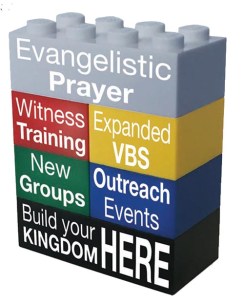
“Build Your Kingdom Here,” inspired by a popular Christian song, is the theme for the meeting. It focuses on five commitments local churches can make, with the goal of increasing professions of faith and baptisms.

The Annual Meeting will be held at First Baptist Church of Marion, which is celebrating its 150th anniversary this year, along with three other IBSA churches. There are currently 132 churches in the association founded in 1865 or earlier.

The meeting starts at 1 p.m. on Wednesday, Nov. 11 and concludes on Thursday, Nov. 12 at noon. It will be preceded by the IBSA Pastors’ Conference, starting at 1 p.m. on Tuesday, Nov. 10.

Consider the commitments

In the Wednesday evening session, messengers will hear uplifting reports from Illinois churches that experienced the salvation of lost people through evangelistic prayer strategies, effective witness training, outreach events, a renewed focus on Vacation Bible School, and new small groups and classes.

With Lego-style blocks as a visual device, messengers will be encouraged to consider which of these ministries would likely result in additional salvations in their communities. By pinpointing “Here!” on their own mission field, worship attenders may join a corporate prayer asking God to do a new kingdom work starting in the place they call home.

Official actions

Several items will require action by messengers. A constitutional revision introduced at the 2014 Annual Meeting will require a second vote. The change allows Baptist Children’s Home and Family Services to have its own bylaws, in compliance with Illinois law for non-profit organizations.

A revised 2016 budget will be presented, necessitated by changes in insurance provided by NAMB for some IBSA employees. “It’s unusual to need to consider a revision to the proposed IBSA Budget after the Board has approved it in September,” IBSA Executive Director Nate Adams said, “but in this case IBSA didn’t receive notice until September 24 that NAMB will no longer provide health insurance for jointly funded missionaries, starting in 2016.”

The proposed 2016 budget, as it appears in the Book of Reports, will be replaced by an updated version at the meeting, in an effort to make the revision and vote clearer.

“This decision [about NAMB-provided insurance] and its ramifications have a significant impact on multiple lines of the budget that was approved by the IBSA Board on September 15,” Adams said. “I’m sure both the Board and the messengers will understand and take the necessary actions to help us absorb this latest challenge and change.”

Eating, meeting

The IBSA Annual Meeting will be augmented by gatherings of IBSA Pastors, Ministers’ Wives, Associational Directors of Missions, Church Planters, and Young Leaders. The Pastors’ Conference includes a Tailgate Dinner on Tuesday evening ($5 per person at the door). The Wednesday evening session of the Annual Meeting concludes with a Fall Festival sweets reception. The schedules are posted at IBSA.org/IBSA2015.