Archives For November 30, 1999

COMMENTARY | Darlene Leatherwood

No parent wants to consider that their young child’s safety might have been compromised. Yet, that’s just where I found myself in the early 1990’s. Thankfully, after carefully discerning all the facts, it became clear that my own child was safe – perfectly free from harm. But the experience prodded me to consider safety standards at our church, First Baptist O’Fallon, where I served as a part-time staff member responsible for preschoolers and children. I talked with our senior pastor, and he and I began to gather information and research ways we could make our church safe for children.

We presented a plan to our church council, which included members of our deacon body, key ministry leaders, and Sunday school teachers. As you might imagine, the meeting was long with lots of opinion sharing. (Remember, screening workers was a fairly new concept in the early 1990’s.) After several meetings and a few Q&A sessions, our leadership core adopted a clearly defined Child Protection Policy:

  • Anyone volunteering in any ministry within the church would be required to complete a volunteer screening application providing personal history and references.
  • A church staff member would contact the volunteer, gather reference information, and then interview him or her before placing the person in ministry.
  • Volunteer screening forms would be kept in a locked file with minimal access for confidentiality.
  • At least two volunteers would be present at all times, as well as a walk-around supervisor.

Many of our volunteers readily understood the need for such a policy and were quick to comply. However, some long-time volunteers struggled with the need to screen everyone. After all, they had a proven track record! Providing all this information and references seemed invasive.

Our staff agreed that anyone struggling with the policy would receive a home visit and personal explanation. First Baptist O’Fallon has a burning goal – to reach new people for Christ. By reminding these long-term volunteers that we were preparing for new families, new workers, and new ministry opportunities, they became more open to the policy. We asked these volunteers to pave the way for the future volunteers. And, reassuring new parents that First Baptist cared deeply about safety by addressing cultural needs helped FBC be more effective at ministry.

Over the years, we’ve continued to refine our Child Protection Policies. Volunteers now agree to a criminal background check. All references are checked, the criminal check is completed, and training is provided before volunteers are placed with a seasoned volunteer in ministry. Walk-around supervision is firmly in place for all ministries. The building contains windows that provide a clear classroom view, and rooms are equipped with interior deadbolt locks to provide extra protection for children.

Today’s children are subject to greater physical, emotional, and sexual threats than ever before, and most children express some insecurity in these areas. Parents are certainly aware of increased threats.  Make your church a safe haven for families and children! Develop Child Protection Policies that fits your unique setting.

Dr. Darlene Leatherwood directs KidsLife at First Baptist Church, O’Fallon, Ill.

COMMENTARY | Joe McKeever

When a church of 120 members set out to assimilate 3,000 converts (from a one-day revival!) into the life of their family, they ranked “fellowship” among the top priorities in accomplishing the task.

“Koinonia” is a Greek word which, while almost always translated “fellowship” in our Bible, refers to sharing life, a partnership. My own personal definition is “hanging out.”

The FQ of a church — the fellowship quotient — speaks to how well the members love the Lord and one another and show hospitality to new believers.

Following are 10 aspects and insights about the FQ of your church. They are worth carving in stone, or better, engraving on the hearts of your leadership and membership.

1) Fellowship is the heartbeat of the congregation.

Fifteen minutes after the benediction in a church where I had been the guest preacher, I said to the pastor, “Listen! It’s the sound of fellowship.” His members were greeting one another, hugging, laughing, chatting, and talking. If anyone had left, I couldn’t tell it.

Just as the doctor places a stethoscope up to the chest and listens to the heartbeat, the pulse of the congregation is the sound you hear when church has ended. Pay close attention, friend. This is the life-beat of your people.

2) Fellowship may or may not be what draws people to your church, but it’s why they stay.

Recently, when a minister was forced to resign his position because of some personal habits that would require therapy, his family chose to remain in the church. A friend told me, “They love this church. This is family.”

Prospective members may give you a long list of what they’re looking for in their next church — strong Bible teaching, a great music or missions program, an emphasis on youth or children. While they want these things, nothing is more attractive to them than a congregation with a thriving family life — people loving the Lord, each other, and newcomers. They will join that church and remain there even if few other aspects meet their requirements.

3) Fellowship is made up of three parts: a commitment to Jesus Christ as Lord, a love for fellow believers as friends, and hospitality shown to newcomers.

4) However, the newcomer will notice these three in reverse order: first, hospitality (how they are welcomed), then joy within the family, and finally, that the people are committed to the Lord Jesus.

5) People on the outside are craving this fellowship.

God said of Adam, “It is not good for man to be alone” (Genesis 2:18). That’s true of you and me, too.

You’ve seen enough nature programs to know that when the lion is looking for lunch, it does not take on the whole herd but heads for the stragglers. The loner that has left the herd — it’s too young to keep up, too old, too sickly, or too headstrong — is targeted for the next meal. “Your adversary, the devil, walks about like a roaring lion, seeking whom he may devour” (I Peter 5:8).

We need each other. God made us this way.

6) A wise church works to build a stronger fellowship among its people.

Fellowship comes in planned and unplanned versions. The planned variety happens in Sunday School classes, committees, Bible studies, work projects, and at church dinners. Unplanned fellowship takes place casually and naturally before and after classes, studies, and worship services. Informal, unplanned fellowship occurs when members play golf together or go out for pizza after church.

7) The greatest enemy of fellowship in God’s people is the human heart.

We are all sinners. We tend to be self-centered, independent loners. Even the hearts of believers can grow cold quickly, turn inward naturally, become narcissistic, and delight in cutting itself off those we love best.

One of the ugliest things you will ever see is a church membership deciding to spend their resources on themselves, to direct all their ministries inwardly, and to turn their attention from the lost of the world to themselves. It’s a slow, subtle process, one for which we must always be alert.

8) A dying church will begin to die here first.

I see it in some of the churches where I’m the guest preacher. The service ends and everyone heads for the parking lot. No one stays to visit, no one greets the newcomer, no one affirms the leadership. The church is dying right before your eyes.

9) Leadership must value fellowship highly and protect it; otherwise it will be supplanted by a thousand lesser things.

An interim pastor once told me, “I don’t attend that monthly men’s breakfast. All they do is meet and eat.” I said, “I used to think that. But then I noticed that these guys pay for the meal, they cook it themselves, and clean up afterwards. But most importantly, this is the one time in the whole month for some of them to share a meal with a brother in Christ. It’s a wonderful ministry.” (What I did not say was the breakfast was the best in town!)

10) God loves it when His people love each other, when they get together for encouragement, when they “hang out.”

Recently, my wife and I celebrated our 50th wedding anniversary by flying in our children and grandchildren from around the country for a long weekend of activities. At one point, when everyone was on the back patio, I was struck by the sounds of these 15 people. They were laughing, talking, loving, playing, rejoicing in one another. It was music to Grandpa’s ears.

The Father in Heaven loves for His people to get the fellowship thing right.

Joe McKeever is a Baptist Press cartoonist and columnist, a former longtime pastor and former director of missions for the New Orleans Baptist Association.

– From Baptist Press

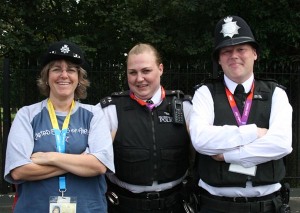
London Bobbies were among the many people Serena and the mission team members met.

These two Bobbies were among the many people Serena and the mission team members met and shared the Gospel with during their trip to London.

COMMENTARY | Serena Butler

Wow, what a trip! With everyone safely home and sleeping in our beds, we now have time to sit back and reflect on our time in London. As I sat last night and watched some of the Games on TV, I couldn’t help but think about all that took place. I found myself trying to pick out the Team Great Britain participants in the various events. As they mentioned places like Horse Guard Parade, I had visions of the Tube stations that service that venue.

But more than the Games themselves, my mind went back to the people we met. My thoughts and prayers were with people like the newspaper stand guy at Kings Cross who gave the team directions to the church on the first day. Or the Muslim man who Ian spoke with and, then another group encountered, who final made his way into Café Eden. A German and an Australian stumbled across Kings Cross Church while looking for a place to fulfill their traditional religious duties, and heard the truth about God wanting a relationship with us, not just traditional practices. One brought her friends to the Café the next day and even returned for church on Sunday.

I thought about Edgar who stopped into Southfields that first night to watch the Opening Ceremonies because he was lonely and wanted to watch with people from around the neighborhood instead of in his flat by himself. Throughout the week, he returned every day and many of us had the chance to have conversations with him about how much God loves him and understands his loneliness; and encouraged him to seek a relationship with God and to continue coming to the church.

Geraldine, the women I talked to on the Tube one morning, was also on my mind.  She had been baptized as a child, but had been away from church for a long time. We talked on the platform before boarding the Tube, where I had the chance to share the Gospel with her. We rode the train together and continued our conversation, and then just before she got off at her stop, she asked me to pray for her. I pray that God will bring others across her path to water the seed and finally bring her to the point of salvation.

There are so many others, like the ball girl from Wimbledon, the Pakistani man who volunteered at tennis venue, the lady in charge of the Southfields Tube Station, the head gamesmen at Wimbledon, the survivor of Sept. 11, the Bobbies who patrolled the area around the Southfields church, the Jehovah’s Witness who talked to Maddie for over an hour, the Muslim man I shared with at the station, the Muslim girl who Mari-Sue shared the Gospel with who missed her stop because she was so interested, and the hundreds of others whom we shared with while we were there. I am sure each team member has a list of their own.

But I am also reminded of the church leaders we met, encouraged, and were challenged by. Pete and Don at Kings Cross work so hard to minister in that hard neighborhood. May God continue to bless their efforts. Melissa and Nick and the other members at Southfields, may they continue to grow in their boldness to share Christ in their community.

Before I left, Melissa took me aside and told me that the church leaders have been discussing the possibility of opening the coffeehouse again during the annual Wimbledon Tennis Tournament. They were encouraged by our willingness to go out and invite others to come and to share the Gospel with them. They are seeking wisdom and asking God to help them reach out more to those who live in Southfields.

So many good things happened with so many hearing the Gospel! It is my prayer that the Holy Spirit will continue to work in the lives of everyone we met.

Two Americans in Paris

Meredith Flynn —  August 9, 2012

COMMENTARY | Serena Butler

There are certain things in life that bring comfort to us during times of trouble. Hugs, a cup of hot chocolate, a smile from a friend, knowing someone is praying for you – those are just a few of the things that come to mind. Recently I found comfort from something I never expected.

I was finishing up a mission trip to the Olympics in London when something went wrong. Our team had decided to end our trip with a day in Paris. We boarded the train and headed into Paris to see whatever time would allow. Crowded subways to us to Notre Dame, the Eiffel Tower, and a boat ride on the Seine. Then we headed back to the subway that would take us back to the train back to London. When we got off the subway, one of our team members discovered that her wallet, which contained her passport, credit cards, and money, was missing. (We assume she was the victim of a pick pocket.)

Without a passport, you can’t leave France. So, the rest of the team boarded the train to London, leaving two of us behind. We made phone calls to the States, filed a police report, and found a hotel. This all happened on Friday evening, and the US Embassy wouldn’t open until Monday morning at 8:30 am. So we found ourselves in Paris, with a lot of time to get all our papers in order for our visit to the Embassy.

We arrived at the gate at 7:20 am Monday morning to find 13 people ahead of us in line. We later learned that they were most likely French citizens applying for Visas to the US. At about 7:30 they opened the gate and we stood in line to go through security. As soon as I showed my US Passport we were put into a different line that put us ahead of everyone else. We were the first admitted to the Embassy and were sitting inside by 7:35, being smiled at by portraits of President Obama and Secretary of State Hilary Clinton.

Now comes the surprisingly comforting moment: I’ve heard others say this, but this morning I experienced for myself the peace and comfort that comes from knowing you are on American soil in a foreign country. I don’t think you fully understand it until you have experienced it. I felt a little bit of home and, most importantly, I felt safe. There were at least 13 other Americans there who had lost passports over the weekend and we spoke to them, joined together by the same circumstances.

As I sat waiting, I thought this might be something like the feeling we will have when we found ourselves ushered into heaven. Instead of the President, Jesus will be smiling at us. Instead of a portrait, He will be standing right in front of us. Instead of showing a passport, they will see our names in the Lamb’s Book of Life and they will point us to the open door. We will not have metal detectors or scanners to walk through, but will be greeted with open arms.

After a lifetime on earth, a place that is not our eternal home, we will finally feel at rest and at home, safely in the land of our heavenly citizenship.

Serena Butler blogged here about her adventures in London, and also will be featured in the August 13 issue of the Illinois Baptist. Sign up for your free subscription at IBSA.org/IllinoisBaptist.

COMMENTARY | Daniel Waters

Editor’s note: Just two weeks after a mass shooting at a Colorado movie theater, the country was rocked by a similar crime when a gunman opened fire in a Sikh temple in Wisconsin Sunday, killing six people and wounding four others. In this column, Daniel Waters shares his experience in another place of worship – a Baptist church in Texas – that was devastated by violence, and how God has answered a really big question in his life: How could a good God let this happen?

The recent, terrible shootings have left many asking, “Where was God?” and “How can a good God allow such a terrible thing to happen?” I know that, regardless of the correct theological answer, for people who go through an ordeal like that, the pain will not soon dissipate.

I asked the same questions when as a young man I went through a similar tragedy. At the beginning of my senior year of high school, I attended a city-wide worship service at Wedgewood Baptist Church in Fort Worth, Texas, to celebrate See You At The Pole. This was September 15, 1999. That evening, while we worshiping and reflecting on that morning’s success, a gunman entered the sanctuary and started firing. Seven people were killed and more were injured. I was devastated.

When I returned home that night I asked God those questions, and He led me to open my Bible to Psalm 27. “The Lord is my light and my salvation, whom shall I fear? The Lord is the stronghold of my life of whom shall I be afraid?” God was telling me that He holds my life and the only safe place is in His hands. If I had given the lordship of my life to God, I had to trust Him even when everything around me was failing.

This word from God comforted me. But the question, “Why would a good God allow this terrible thing to happen to me?” still had to be answered, and I had to grapple with His sovereignty in order to ever move on from that night. My journey to answer that question showed me a lot about God’s character, my relationship with Him, and the state of our fallen world.

Here’s what I determined: When I asked God, “How could You, a loving God, allow this to happen?” He showed me the problem has to do with the nature of love. If love can’t be chosen, it doesn’t exist. Under the umbrella of His sovereignty, God has allowed men relative freedom to be stewards of his creation and to choose to follow Him.

But if you can choose love, you can also chose hate, which is really only love of the wrong object – usually one’s self and one’s desires.

God showed me we suffer because we all choose to love things other than God. Because God loves the world, this suffering is only temporary; His sovereignty is displayed in his authority to judge everyone by His standard, to punish the wicked and make all things right. In Revelations 21:4, God tells us that, “He will wipe every tear from their eyes, and there will be no more death or sorrow or crying or pain. All these things are gone forever.”

When we face such heartache, it seems impossible to move forward. But thank God there is hope and healing when you place your faith in a God who makes the impossible, possible, and can answer even the hardest questions in our darkest hours.

Daniel Waters is associate pastor of Living Faith Baptist Church in Sherman.

COMMENTARY | Posted by Meredith Flynn

LifeWay Christian Resources recently released the Annual Church Profile, a statistical picture of the health of Southern Baptist churches and denomination as a whole. There was some good news: slight increases in baptisms, total number of churches, and giving. But also some bad news: a nearly 1% decline in total membership (from 16,136,044 million last year to 15,978,112 this year). It’s the fifth straight year total membership of SBC churches has dropped.

More concerning, said LifeWay Vice President Ed Stetzer, is the rate of decline. In a Baptist Press column June 13, Stetzer wrote total membership has declined 2% since 2007, including nearly one whole percentage point this year. “This trend points to a future of more and faster decline — and it is a 60-year trend.”

Rather than manage the decline like other denominations, Stetzer said, there are some steps Southern Baptist pastors and leaders can take to “fight for our future.” Four steps he suggests:

1. Rally around the things we agree on under the Baptist Faith & Message, and refuse to engage in battles over secondary issues that will only end in further division.

2. Raise up new leaders who represent a variety of ethnicities and generations.

3. Reach more people. “Southern Baptists love evangelism, as long as someone else is doing it,” Stetzer wrote. “But ‘someone else’ is not doing it either. Every year, it takes more Southern Baptists to reach one lost person, as the member to baptism ratio shows.”

4. Plant more churches by equipping and then supporting church planters.

Now it’s your turn: How can leaders, pastors and members of Southern Baptist churches help reverse the denomination’s trend of decline?

COMMENTARY | Mark Warnock

Editor’s note: Two Protestant denominations made important decisions on same-sex marriage this week. First, the Presbyterian Church USA narrowly defeated a motion to re-define marriage as being “between two people” instead of between a man and a woman. Then, the General Convention of The Episcopal Church approved a liturgy that can be used to bless same-sex unions during commitment services. Churches and denominations have traditionally opposed same-sex marriage, but as the lines become more and more blurry, columnist Mark Warnock looks at some ways Christians can answer the question: “Why do you believe what you believe?”

In the political discussion over same-sex marriage, religious views are almost always sidelined. Separation of church and state means, we are told, that religious reasons do not count. So when Christians talk in public about the Bible’s clear case against same-sex marriage, our position is dismissed as “religious” and therefore irrelevant.

But most people are deeply conflicted about same-sex marriage, especially in the privacy of the voting booth. Even as polling data shows growing support for same-sex marriage, voters keep saying no to constitutional amendments that would allow it.  The culture keeps saying it’s ok, but deep down it just doesn’t feel right.

We can and should attach reasons to that feeling.

But what happens when our biblical reasoning doesn’t get much traction in a culture biased against religion? We shouldn’t abandon biblical arguments, but we can show that the Bible’s position is well supported by historical experience and cultural practice.

Here are a few ideas:

Marriage came first, before governments and before religions. Thousands of years of experience have shown it to be good for society. When governments undermine marriage, however, the results are bad for society – alarmingly so. When states passed laws allowing “no-fault” divorce in the early 1970s, we were promised it wouldn’t affect other marriages and that the kids would be just fine.

That was a lie. No-fault divorce taught an entire generation that permanence in marriage is optional. The divorce rate rose immediately, and now, fewer adults are choosing to marry at all. And 40 years of research have proved that children are badly hurt by divorce.

The primary reason we have marriage is that it binds together the private dimension of sex and romance with the public dimension of parental responsibility. Once you separate marriage and parenting, there is no reason to have marriage any more.

Social trends like divorce have been pulling these dimensions apart, making marriage more and more about the private satisfaction of adults, and less and less about public responsibilities to children. Same-sex marriage takes the final step: marriage will become an entirely private affair stripped of its inherent public functions born of the creation of family. Thus, marriage becomes hollow, a public institution that serves no public function. It’s no wonder people are losing respect for what was once a holy, sacred estate.

Marriage is not to be entered into lightly or unadvisedly, the traditional wedding ceremony says. Nor should marriage be so unadvisedly redefined.

Mark Warnock is associate pastor of First Baptist Church of Columbia, Ill., and a Ph.D. student at Southern Baptist Theological Seminary.

COMMENTARY | Jay Ingram

As a former Journeyman missionary with the International Mission Board, I’ve had numerous people ask me, “What do week-long mission trips actually accomplish?” Well, if they are preceded and followed up with a long-term strategic prayer partnership, then a lot!

As I traveled to preach the gospel in Asian villages for two years, I can testify that my most fruitful time on the mission field was when my stateside prayer advocates were specifically praying for me that day or week (and they did this for two years).

Oftentimes, we fail to see the essential-ness of prayer in our daily lives. Maybe that’s why we reserve prayer to a formality in the church parking lot before the bus leaves or the Sunday before the trip. But once the trip over, what will we do to further the ministry? The unfortunate reality is that many mission teams and churches do not continue to pray for the ministry or locale to which they sent a mission team.

That’s why I propose that churches, small groups, and even families form strategic prayer partnerships with the ministry or communities with whom they will serve this summer.  People of all ages can be a practical part of this kind of ministry.

At Delta Church in Springfield, we have formed a partnership with the IMB’s Celtic Languages Team based in Wales. Since many people in our congregation won’t be able to participate in a mission trip to Wales, they remain a vital component of the partnership since they will be praying for the Holy Spirit to draw people to salvation.

Here are a few ways people in our church, and any congregation with a strategic prayer partnership, can stay involved:

1. Many missionaries and ministries send email updates each month or have prayer calendars. This is a great way to pray for urgent requests and long-term needs.

2. Current technology allows churches to connect live with missionaries from all over the world using Skype and other software. Use this opportunity to pray as an entire church for the missionary in real time.

3. Make examples.  If your church has partnered with NAMB or IMB missionaries, use their personal stories to promote the Lottie Moon and Annie Armstrong Offerings. This will remind our churches that “real live” missionaries are using their offerings to preach the gospel all over the world and remind them to pray for these efforts.

Make strategic, focused prayer a vital element of your church’s missions projects and trips. Whether your mission team is traveling around the world or staying local, a prayer partnership will extend your efforts well beyond the summer.

Jay Ingram is a member of Delta Church in Springfield.