Archives For November 30, 1999

pull quote_ROACHCOMMENTARY (From Baptist Press) | David Roach

It’s that brief season of the year when most people are still on track with their resolutions to eat more healthfully and lose weight. In pursuit of that goal, millions have consulted Weight Watchers, Jenny Craig, online diet plans, calorie-counting apps and a host of other nutritional guides – most of which have great value.

But what about the Bible? Does it have anything to say about our eating habits?

Certainly it does. Incorporating Scripture’s wisdom into our New Year’s resolutions could mean the difference between success and failure.

First of all, we should make a distinction between healthy eating and fasting. The Bible says a great deal about fasting, but that’s abstaining from food for a purely spiritual purpose.

Healthy eating habits are a different matter, which the Bible also addresses. For one, the apostle Paul calls the body “a temple of the Holy Spirit” and urges, “You are not your own … glorify God in your body” (1 Corinthians 6:19-20). The context is an exhortation to flee sexual immorality and not profane the body that was created to honor God, but there’s an application to diet as well. Honoring our bodies as sacred temples certainly includes eating healthy foods that keep them functioning well.

The Old Testament, in fact, includes an example of God’s blessing people who eat healthy food. When Daniel and his three friends resolved not to eat the rich food of Babylon but instead make their diet vegetables and water, “they looked healthier and better nourished than any of the young men who ate the royal food” (Daniel 1:15 NIV). Of course, health was not the reason for Daniel’s food choice. It had to do with ritual purity and being set apart from the pagan culture of Babylon, and God honored his obedience.

Nevertheless, it was also an occasion when God brought positive consequences from healthy eating. (It’s worth noting that the Old Testament ceremonial laws on diet are no longer in force under the New Covenant, though moral principles related to food still hold. See Acts 10:9-16.) Add Proverbs’ warning about the ruinous effects of gluttony (Proverbs 23:20-21), and this is enough to assure us that God cares about our caloric intake.

Thankfully, though, that’s not all the Bible has to say about eating. Paul says that God “richly provides us with everything to enjoy” (1 Timothy 6:17). The writer of Ecclesiastes makes the connection to eating explicit, telling us that we should enjoy food as a gift from God (Ecclesiastes 3:13). Perhaps that is part of the reason why the Old Testament law required Jews to participate in a series of feasts every year and why scriptural examples of godly hospitality commonly include large quantities of food (see, for example, Genesis 18:6-8; Judges 6:19; 2 Samuel 9:10-13; Luke 15:23).

Jesus Himself instituted the New Covenant at a feast, the Passover meal. And when God wanted to picture for the apostle John the joy that will occur in heaven at Christ’s second coming, He showed him a vision of the Marriage Supper of the Lamb (Revelation 19:6-10) – another meal. God not only cares about healthy eating, there’s also a place for feasting in His economy.

So what does all this mean for dieters? While the Bible doesn’t prescribe any specific diet plan, it does highlight the principle of balance – between healthy restraint and enjoyment of rich foods. In other words, make a habit of disciplined, healthy eating, but on occasion let yourself enjoy a feast of God’s good gifts. Looking forward to the feasts will help keep you going during the seasons of restraint. Interestingly, that distillation of the Bible’s wisdom on eating is the same conclusion that dieticians have reached after thousands of years of scientific research. In Scripture God truly does provide “all things that pertain to life and godliness” (2 Peter 1:3).

David Roach is a writer in Shelbyville, Ky. This article first appeared at Bible Mesh (www.biblemesh.com), an online discipleship resource to help people from all backgrounds grow in their knowledge of the Bible and how it applies to all of life.

pull quote_ADAMS_jan24COMMENTARY | Nate Adams

A few days ago I had the privilege of performing the wedding ceremony for our son Caleb and his now wife Laura. As is true for most young couples, it was arguably the biggest moment of their lives. So I was very pleased when, together, they told me their desire was for the ceremony to honor God. But I was especially moved when they went a step further, and asked me to make sure the Gospel was clearly presented.

You pastors that are reading this know what a welcome and freeing experience that is. We long, most of us, for opportunities to share Christ openly. But we also need to be sensitive to the couple’s or family’s wishes at times like weddings, anniversaries, or funerals.

And not everyone wants to give the big moments of their lives to the Lord. Even devoted Christians often expect the bride to be the primary focus of a wedding day, and that’s understandable. But I think you can focus on the bride, honor the Lord, and share the Gospel without diminishing any of the three. Let me share briefly here the few words I included in Caleb’s and Laura’s ceremony:

“Now let me pause here and say something to the rest of the congregation. When Caleb and Laura and I were planning this ceremony, I asked them, what would you like the central message of your wedding ceremony to be? What would you like the people gathered there on that special day to know above all else?

“Here’s what they said. ‘The most important thing about us and our story is that we would not be together except for the way God has worked in our lives. We want others to see His story in our story. We didn’t really know how to love each other until Christ became the center of our relationship. We would love everyone there to know what it means to have God at the center of their lives and their relationships.’

“You see, the way this young couple came to know and love each other is the way many people come to know and love God. It may begin with just a casual acquaintance, an occasional prayer, maybe even periods of disinterest and distance. And then one day, your realization that God loves you unconditionally comes alive, perhaps through the joyful expression and heartfelt testimony of someone who really knows Him. You realize the void in your life, and that God has been there all along, loving you and reaching out to you. Nothing would please Caleb and Laura more, and nothing would honor their wedding day more, than for you to turn to God as they have, and to surrender your life to Him.  Caleb and Laura want you to know that, with the certainty they do.”

Words along those lines can give wedding guests something to talk about at the reception. More importantly, they can give lost friends and family something to talk about on the drive home, or with the couple after they return from the honeymoon.

The biggest wedding day of all will be when the risen and victorious Lord Jesus returns to earth as a Groom coming for his bride, the Church. That day will certainly focus on the Bride, but it will also glorify God and lead every knee to bow at the truth of the Gospel. It will be a day when we will all be glad for the big moments of our lives that we gave to the Lord, especially if He uses them as opportunities to draw our loved ones to Himself for eternity.

Nate Adams is executive director of the Illinois Baptist State Association.

pull quote_STETZERCOMMENTARY | Ed Stetzer

(From Baptist Press) Louie Giglio withdrew from the program at President Obama’s inauguration in the face of criticism over a 15-year-old sermon referencing homosexuality as a sin. Many will want to debate and desire to nuance the specific wording he used in the sermon, but his points are largely mainstream evangelical beliefs.

This Louie Giglio moment, and the Chick-fil-A moment that preceded it, and the Rick Warren moment which preceded that, raise the question: Where do people of faith with long-standing traditional religious/scriptural convictions go from here?

For those of us who know Louie, this is a strange moment indeed — but also illustrative of how our culture has turned. Louie has dedicated his life to helping others — the poor, the enslaved, those trapped in sexual trafficking. Yet, I do not recognize the person I see portrayed on the news — a bigoted homophobe driven by his hatred for gays. You can be certain that is not Louie Giglio — even though some prefer to believe that any opposition to homosexual practice, and people who hold that view, must apparently be silenced for the common good.

In a recent LifeWay Research study, 37 percent of American adults agreed that homosexuality is a sin. That number is declining (down from 44 percent according to a 2011 survey), but it is still a substantial minority. Yet, such views (which were mainstream just a few decades ago) are indeed now a minority position — and viewed as unacceptable by many in society.

So, what does this mean for Catholics, Mormons, Muslims, Orthodox Jews and others who believe that their authoritative religious texts teach something the prevailing culture finds so unacceptable that they are no longer welcome in the public square? Must they jettison their sacred texts and adopt new views to be accepted as part of society? If they do not, will they be marginalized and demonized even as they serve the poor, care for the orphan or speak against injustice?

Or, instead, can we recognize that a substantial minority in our culture hold views they see as rooted in their scriptures and part of their faith, even though those views may not always be popularly accepted?

Yes, the First Amendment protects these views. But we also have to decide if the people who hold such views can be protected by our self-identified tolerant culture as they seek not just to hold those beliefs in secret, but also dare to utter them in public — even on a sermon tape 15 years ago.

Ed Stetzer is president of LifeWay Research. This column first appeared at USATODAY.com.

COMMENTARY | Eric Reedpull quote_REED

A man described to me a game his teenage son played at church. It’s an electronic version of paintball, where kids wired up in battle gear shoot each other with beams of light. “We’re going to give him all the equipment for Christmas,” the dad said. “It’s kind of expensive, but he’s a good kid. He doesn’t ask for much. I think he deserves it.”

“Really?” I responded. “He deserves to aim a laser gun at other kids and pull a trigger until they are all, um, eliminated? It sounds like you’re teaching your son to kill.”

“Oh, you’re making too much of it. It’s just a game.”

I objected. For more than an hour.

That conversation was two years ago. In light of the mass murder at a Connecticut elementary school in December, I feel even more strongly about my objection to the “game.”

As a denomination, Southern Baptists took up the cause of the unborn not long after abortion was legalized by the Supreme Court’s ruling in Roe v. Wade. By several counts, the number of babies aborted in the U.S. since 1973 is almost 56 million.

Every year, many congregations mark “Sanctity of Human Life Sunday” near the January anniversary of the court ruling. And many Christians participate in pro-life activities, standing outside abortion clinics, placing fields of white crosses on church lawns to demonstrate the numbers of babies lost, and supporting crisis pregnancy ministries to aid pregnant women.

That work is admirable, and must continue until abortion is ended. But what the killings in Newtown tell me is that in our recent discussions of the sanctity of life, we’ve missed the value of the already born.

Our culture has so devalued life that death seems to have little consequence. And we’re teaching that to our children every day. Parents might dismiss this as a predictable preacher’s rant, but I think it’s time to examine carefully the influences we allow into our kids’ lives and the values we uphold before them.

In so many movies and video games, for example, the goal is killing, and killing is rewarded. And for shooters who do the deed electronically, there’s no blood, no corpse, no funeral, no consequence for their actions – other than scoring points.

Perhaps it’s time for a field trip to the cemetery, so children can see that death is real, grief is deep, and life must be valued and protected.

And we need to broaden our discussion of the sanctity of life again, starting rightly with the unborn, but also including the first-grader in the classroom, the teenager on the gang-dominated streets, the despondent contemplating suicide, and the terminally ill. Sanctity of life is about protecting all the living.

Life has value – on earth and ultimately in heaven. But let’s not rush getting there.

Eric Reed is a pastor and journalist living in Wheaton. He serves as editorial consultant for IBSA media.

A prayer for Newtown

Meredith Flynn —  December 20, 2012

COMMENTARY | Matt Tullos

At Christmastime we read the prophecies of a soon coming King. Coming to give us hope. Coming to give us comfort.

“Comfort, comfort my people,” says your God. “Speak tenderly to her and proclaim to her.”

During this holy season we’ve encountered a world filled with terror and mourning. “A voice is heard in Ramah, weeping and great mourning, Rachel weeping for her children and refusing to be comforted, because they are no more.”

That was the world in which Christ was born. This is the world where He still lives. We are His hands and feet. We are His voice of tenderness. Hands that serve those whose burden defy description. Feet that walk toward the mess and give grace. And a voice to pray.

LET’S PRAY

Father of comfort, Lord of life

Once again, we’ve witnessed the fallen-ness of our world.
The evil that sends kids to coffins and parents into dark tunnels of hopelessness. May we rise up to give hope and peace.

We must confess through tears and moments of disbelief that the battle is not over.
The enemy is not simply a villain of bones and flesh.
It’s the spirit that turns us from joy to hopelessness.
It is a serpent in a garden.
It is a sneering giant.
It is an evil that caused nations to crumble and hearts to grow cold.
It’s the fear of the chaos and heartache untold.

May the brokenness of the world break us.
May the grace of the Lord remake us.

Comfort the community of Sandy Hook Elementary.
We ask your spirit to reside in their homes of unfathomable agony.

Kindle our spirits.
Compel us to pray.
Sing over this weary world.
And may we join in with comfort.
Comfort, comfort your people
In the Name of the Savior who was acquainted with grief.

(Scriptures from Matthew 2:19 and Isaiah 40:1)


Matt Tullos is pastor of Bluegrass Baptist Church in Hendersonville, Tennessee. This article first appeared on lifeway.com.

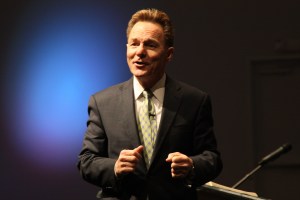
FRIENDLY INVASION – “Invade your city strategically,” advises Ronnie Floyd. The Arkansas pastor and SBC leader urged Illinois pastors to identify local people groups and customize ministry to share the Gospel with them.

“Invade your city strategically,” advises Ronnie Floyd. He urged Illinois pastors to identify local people groups and customize ministry to share the Gospel with them.

COMMENTARY | Eric Reed

Many pastors and church leaders may wonder if they could be more effective in a different community or congregation. But Ronnie Floyd, who has served his Arkansas church for more than 25 years, warned against longing for a better location.

“Some of you wonder if He forgot your e-mail address and your cell number, but He’s got you fixed where you are,” said Floyd, who spoke to Illinois leaders during the IBSA Pastors’ Conference November 13.

He told a story about his community of Springdale, Arkansas, which is home to up to 8,000 people from the Marshall Islands. It’s a long way from Arkansas to the tiny collection of atolls in the North Pacific Ocean. In fact, fly out of Little Rock to Honolulu, and you’re still only about halfway there.

These thousands of Marshallese have journeyed to the middle of America in search of jobs, mostly in the poultry industry. They found jobs. But more important, they found the Gospel.

“They thought they were coming for chicken,” Floyd said of the Marshallese immigrants, “but they were groping for Jesus.” Today, Floyd’s congregation hosts the first Southern Baptist congregation for Marshallese in North America.

God’s placement of people – whether it’s a pastor or someone who needs to hear the Gospel – is providential and purposeful.

“God had brought everyone of those people to town for a purpose, that they might seek and go after God,” Floyd said. “His sovereign plan has brought lost people to your town, too, so you can see them as he sees them and can strategize and reach them.”

Why do Christians suffer?

Meredith Flynn —  December 6, 2012

Phillips_pullquoteCOMMENTARY | Rob Phillips

Horatio G. Spafford was a prominent attorney in Chicago in the 1800s and a friend of evangelist Dwight L. Moody. While Spafford was both respected and comfortable, he was not free from severe hardship.

First, he lost his 4-year-old son to scarlet fever. Then his real estate investments along Lake Michigan literally went up in flames in the Great Chicago Fire of 1871. Not long after that, his four daughters drowned in a shipwreck, and his wife Anna survived the ordeal only because the ship’s debris buoyed her as she floated unconscious in the Atlantic Ocean.

Crossing the sea to join his bereaved wife, Spafford was called to the captain’s deck as the ship sailed past the foamy deep where his daughters were lost. The captain informed him that the waters there were three miles deep. Returning to his cabin, Spafford penned these words to the now-famous hymn:

When peace like a river attendeth my way,
When sorrows like sea billows roll;
Whatever my lot, Thou hast taught me to say,
It is well, it is well with my soul

Why did such tragedy befall this godly man? Spafford may have wondered why, but ultimately he rested in the sovereignty of God.

We can better appreciate God’s sovereignty, even in the darkest nights, by observing 10 reasons we suffer, according to Scripture.

1. We suffer because we sin.
2. We suffer because others sin.
3. We suffer because we live in a sinful and fallen world.
4. We suffer because God allows us to make real choices.
5. We suffer to make us long for eternity.
6. We suffer to keep us from something worse.
7. We suffer to share in the suffering of Christ and be more like Him.
8. We suffer to honor God.
9. We suffer to grow spiritually.
10. We suffer to better anticipate the glories of heaven and the world to come.

Rob Phillips is director of communications for the Missouri Baptist Convention. This column is excerpted from Baptist Press; read the full version at BPNews.net.

No more Twinkies?

Meredith Flynn —  November 29, 2012

COMMENTARY | Nate Adams

Hostess Brands, the baker of sweet treats that include Twinkies, Ho Hos, and Ding Dongs, recently announced its intent to go out of business and lay off its 18,500 workers. Executives blamed a labor strike by two key unions, which they said compounded already high labor and pension costs. Union leaders countered that mismanagement had kept the company in bankruptcy for all but three of the past eight years, and that executives received large pay raises while asking for 30% wage and benefit cuts from the other workers.

I’m not in a position to judge which side bears more responsibility for the company’s failure. But as a consumer, I simply find myself thinking, “What? No more Twinkies?”

And I’m not alone. Texas-based Hostess has about $2.5 billion in annual sales. So if something’s not done, there could be literally millions of people bemoaning the loss of their Hostess Cupcakes, Susie Q’s, and Sno Balls.

And then of course there are the thousands of workers in 33 plants across the United States that face unemployment. At least from the outside, we can’t help but wonder, “Couldn’t this have been avoided? Couldn’t the leaders and the workers have worked out their differences, and in doing so protected the mission of the organization, the value of its products, and the very livelihoods of their families?”

Sadly, we sometimes see the same tragic dynamic at work in churches today. A pastor insists that the people he leads are apathetic, or unwilling to change or sacrifice. Or leaders in a congregation assert that the pastor isn’t effective, or isn’t listening to the right people. They find themselves in conflict over direction, or style, or who should make what compromises or sacrifices.

I guess it’s no longer shocking to me that those kinds of disagreements can arise in a church. What does surprise me is how much the pastor, or congregation, or both are often willing to sacrifice to hold their position. And what sometimes surprise me even more are the words or behaviors that can flow from God’s people in those circumstances.

Recently I talked to two different pastors whose wives were urging them to leave not only their churches but also the ministry. I simply asked them how things were going at their church, and agony, disappointment and disillusionment flowed freely from their hurting souls.

Not long before that a lay leader lamented to me that his pastor had led the church in decline down to practically nothing before leaving. Another said that the pastor had left with most of the younger members to start another church nearby.

As with the Hostess Brand, I’m not always in a position to judge which side bears the greater responsibility in these church conflicts. But in every case, the loss is so much greater than Twinkies. The loss is often the effective Gospel witness of the church, at least for a while.

I’m told that some other company is almost sure to step in and rescue Hostess. Even though the current executives and many of the laborers have probably forfeited their roles, the brand and the product line continue to have incredible value. Someone will continue to make Twinkies.

And by God’s grace and providence someone will continue to deliver the Gospel. Whether it’s Hostess or the local church, leaders and workers who are willing to risk the mission and the health of the organization itself for the sake of their preferences or personal benefits always make the wrong choice. Those who submit lovingly to one another in the spirit of Philippians 2 make the right choice. And in the case of the church, they protect the wonderful privilege of delivering the Gospel.

Nate Adams is executive director of the Illinois Baptist State Association.

HEARTLAND | Monday, November 12

O love that wilt not let me go,I rest my weary soul in thee;
I give thee back the life I owe,
That in thine ocean depths its flow
May richer, fuller be.

O light that followest all my way,
I yield my flickering torch to thee;
My heart restores its borrowed ray,
That in thy sunshine’s blaze its day
May brighter, fairer be.

O Joy that seekst me through pain,
I cannot close my heart to thee;
I trace the rainbow through the rain,
And feel the promise is not vain,
That morn shall tearless be.

O Cross that liftest up my head,
I dare not ask to fly from thee;
I lay in dust life’s glory dead,
And from the ground there blossoms red
Life that shall endless be.

(George Matheson, 1882)

Check out Ascend the Hill’s version of the classic hymn below.

COMMENTARY | Ed Stetzer

Editor’s note: This column first appeared at BPNews.net.

The presidential election is over, and I am sure many, like the little girl who cried “no more Bronco Bamma or Mitt Romney,” are breathing a sigh of relief that the season of contention and the barrage of political ads are over for now. Still, we are left to move on as we begin a second term for the 44th president of the United States, Barack Obama, and it is time for us to consider what that means from this point forward.

Once the election was “called,” I prayed for the president again. I asked God to guide him and give him wisdom as I will continue to do for the next four years.

I don’t endorse specific candidates publicly. I also gave both campaigns the opportunity to answer questions on my blog so that we could be well informed as we went into the voting booths. However, it is no secret that the candidate who was supported by 57 percent of Protestant pastors did not prevail. Furthermore, it is no secret that most evangelicals did not support President Obama. So, there is a lot of disappointment among many Christians.

It is appropriate, then, for us to ask the question, “What now?” Well, here are some observations and suggestions:

1. We must face the reality that we may be on the losing side of the culture war.

For decades, the “religious right” has focused its energies on winning the day through political means. But this year, voters in more than one state appear to have clearly passed referenda supporting gay marriage. This marks the first time for any state to legalize same-sex marriage by the expressed will of the people rather than through court rulings or legislation. While this certainly does not mean we should stop legal or political efforts completely, it does mean that we should begin thinking about what it looks like to be the church in a “post-culture war” era. We need to be prepared to defend the protection of religious liberty as we move into the future.

2. The fight for the unborn continues.

This year one of the major political parties, at their national convention, actually celebrated and cheered the right to abortion. This is a shift from the posture in years past, when at the very least it was seen as something that we hoped to keep to a minimum. In fact, that same party actually removed the language from their platform that referred to keeping abortions “safe, legal, and rare.” Rod Snyder, of Young Democrats of America, said in our interview that President Obama does believe that we should work to reduce the number of abortions, but still, this development in the party that has secured the highest office in the land is cause for grave concern and even grief. We need to continue to fight for life through education, advocacy, ministering to women and promoting orphan care in our churches. President Obama, I am ready to partner with you on the part where we start reducing abortions.

3. The “Mormon Moment” is not something to be dismissed and forgotten just because the election is over.

In recent days, much discussion has centered around how we should view Mormonism. I have made the case that while it does qualify as a cult in the theological sense, I do not think that we should use that language in general. Many people jumped to the conclusion that I was saying this for political reasons in order to elect Governor Romney. However, this has been my position for some time, and it continues to be my position after the votes have been counted. This election has brought Mormonism to the forefront of people’s minds, and we should not forget our responsibility to reach out to our friends and neighbors for Christ. Just because the conversations die down doesn’t mean that the mission goes away.

4. We must remain respectful and law-abiding citizens, regardless of this outcome.

We exercised a tremendous right, perhaps the greatest privilege that we have as Americans. Over 200 years ago, a group of very brave men stood up against “taxation without representation” and fought to develop a nation in which its citizens could have a voice. We only need to look at pictures in recent years of brave men and women in countries like Iraq dipping their fingers into purple ink and showing their happiness and pride over the right to cast their vote. We have that privilege. We exercised it this year. We will exercise it again. Regardless of the outcome, that is a great privilege and shouldn’t be taken for granted. We now need to go back to our homes, our schools and our places of work and be respectful and gracious to others who have also used their voice.

5. When our King returns, He won’t be riding a donkey or elephant.

For those of us who believe the Gospel of Jesus Christ, nothing has changed. The Gospel is still real, and we still serve a God who has declared victory over sin and death. Anything that we do through political means is not to hold back the darkness lest it will overtake us. Rather, the charge to the church is to advance a Kingdom that has already prevailed. Regardless of who sits in the Oval Office, our King is still sitting on His throne.

So let’s all slow down, take a deep breath and do the same thing we did yesterday — preach the Gospel, love people and engage in God’s mission.

Ed Stetzer is president of LifeWay Research. Amy Sullivan of Southeastern Baptist Theological Seminary contributed to this article.