Archives For November 30, 1999

pull quote_ADAMS_augustCOMMENTARY | Nate Adams

This month two important committees will meet at the IBSA Building here in Springfield. Each typically meets only once per year, but when their jobs are done well, hours of preparation and follow up buttress those single meetings.

I’m referring to the IBSA Committee on Committees and the IBSA Nominating Committee. And it’s those hours of prayerful preparation prior to the meetings that deserve the attention and involvement of every one of us that understands what it takes for a thousand Baptist churches to work together here in Illinois.

You see, when IBSA churches cooperate, they give more than $6 million annually through the Cooperative Program, and they steward more than $9 million in annual resources through the IBSA budget. They provide a staff of around 40 to assist churches throughout the state in hundreds of different ways, and provide funding for dozens of church planters and other missions personnel.

Each year those churches provide the services of the Baptist Foundation of Illinois, and of Baptist Children’s Home and Family Services. They facilitate the operations of two statewide camps. They determine how much of their missions giving should go to the ministries of the national Southern Baptist Convention and how much should go to work here in Illinois.

And while the above only scratches the surface of their financial stewardship, IBSA churches work together to steward much more than money. They also steward the doctrinal and missional criteria for what it means to be a faithful, cooperating IBSA church. They set the riverbanks for how member churches will work together procedurally. They both preserve our history and seek to protect our future.

I could write much, much more about all our churches do together, but the more I would write, the more the question would emerge, “How do they do all that? How do a thousand diverse, geographically dispersed, busy churches of all sizes and styles work together to accomplish so much?”

As unglamorous or even mundane as it may sound, the answer to those questions, and the genius of how so many diverse churches are able to work together, is rooted in responsibilities like those of the Committee on Committees and the Nominating Committee. Year in and year out, these committees select trustworthy leaders who work within well-established processes to facilitate the near-miracle of cooperative missions among autonomous Baptist churches.

Have you guessed yet the point, the appeal, toward which I’m writing? This Great Commission system of cooperative missions depends on IBSA churches putting forth their most trustworthy, mature, and dependable members as candidates. The quality and effectiveness of our work together rises or falls on the servant leaders you recommend, whether from your church or from another.

This year’s deadline for submitting recommendations to these two important committees is August 9. You can download nomination forms quickly and easily from the home page article on http://www.IBSA.org. And you can read more there about the specific requirements of each IBSA committee or board. Or call Sandy Barnard at (217) 391-3107 for help submitting your nominations.

It’s been my privilege to work with some wonderful committee and board members over the past few years. But I’ve also observed that the number of churches supplying leaders for our committees and boards is fewer and less representative than it could be, and that each year we have far fewer recommendations than we have vacancies.

Between now and August 9, please consider recommending the most trustworthy servant leaders you know to serve on an IBSA committee or board. And be ready to say yes if you learn that someone has recommended you.

Nate Adams is executive director of the Illinois Baptist State Association.

pull quote_LUTERHard questions remain for nation still affected by racial tensions

COMMENTARY | From Baptist Press

After a jury found George Zimmerman not guilty in the death of teenager Trayvon Martin, Southern Baptist leaders called for active love and respect for justice. They also acknowledged very real questions raised by the case, including the validity of state laws like Florida’s “stand your ground” statute, and the prevalence of racial tension and discrimination in the United States.

Zimmerman, a 29-year-old neighborhood watch volunteer, shot and killed Martin, 17, last February in Sanford, Fla. The case ignited a firestorm of controversy about race and gun laws across the country.

Churches had the trial on their minds as they met Sunday, July 13, after the not-guilty verdict was announced Saturday evening. Kevin Cosby, pastor of St. Stephen Church in Louisville, Ky., tweeted: “The black community is engulfed in grief. Service today was like attending a funeral. Despair!”

This is a perfect time for the church to be a “healing balm” for the country, Southern Baptist Convention President Fred Luter said. “Some people are upset, angry and frustrated, while others are in full support of the verdict, so where does the church fit in?” Luter asked in comments to Baptist Press.

“The church should be there to pray for both families, the city of Sanford, and our nation. We are to intercede and stand in the gap by showing the love of God to all those who have strong feelings about this case.”

Amidst the call to love and to pray, leaders also urged Christians to stand for what’s right. “This is our season as the body of Christ to heed the call of the minor prophet Micah to do justice, love mercy and walk humbly with God (Micah 6:8),” said Philadelphia pastor K. Marshall Williams, chairman of the African American Advisory Council of the SBC Executive Committee.

“The world needs to see God’s people of all races stand up not just on issues of morality but issues of race and social justice…”

Some leaders voiced questions about laws that enable discrimination against particular ethnic groups. San Diego pastor A.B. Vines noted while Zimmerman used Florida’s “stand your ground” law as a successful defense, Jacksonville mother Marissa Alexander was sentenced last year to 20 years in prison for firing a gun in the air – even though she injured no one – because of a state law that predetermines the sentence for firing a gun in public.

Alexander had secured a restraining order against a husband based on physical abuse. Comparing her case to Zimmerman’s, Vines said, “…Those are the issues I think Southern Baptists need to address … the disparity of the law and how certain laws affect certain ethnic groups differently than other ethnic groups.”

Russell Moore, president of the SBC Ethics and Religious Liberty Commission, also referenced a disparity in the justice various ethnic groups receive.

“This…ought to remind us of the blighted history of our country, when it comes to racial injustice. Despite all the progress we’ve made, we live in a culture where too often African American persons are suspected of a crime just for existing.”

Kevin Smith, an assistant professor at The Southern Baptist Theological Seminary in Louisville, Ky., referenced that hard truth in a tweet the day after the verdict: “Revisiting ‘the talk’ with my rising senior (UK honor student) about where he hangs out – unique duty to parents of black males.”

pull quote_MOORECOMMENTARY | Russell Moore, from Baptist Press

With the Supreme Court’s gay marriage decisions all over the news, some Christian parents wonder how they ought to explain all of this to their small children. I’ve faced the same question as my children have asked, “What is the Supreme Court doing that’s keeping you so busy?” So how does one teach the controversy, without exposing one’s children to more than they can handle?

First of all, you should, I think, talk to your children about this. No matter how you shelter your family, keeping your children from knowing about the contested questions about marriage would take a “Truman Show”-level choreography of their lives. That’s not realistic, nor is it particularly Christian.

The Bible isn’t nearly as antiseptic as Christians sometimes pretend to be, and it certainly doesn’t shrink back from addressing all the complexities of human life. If we are discipling our children, let’s apply the Scriptures to all of life. If we refuse to talk to our children about some issue that is clearly before them, our children will assume we are unequipped to speak to it, and they’ll eventually search out a worldview that will.

This doesn’t mean that we rattle our children with information they aren’t developmentally ready to process. We already know how to navigate that; we talk, for instance, about marriage itself, and we give age-appropriate answers to the “Where do babies come from?” query. The same is true here. There is no need to inform small children about all the sexual possibilities in graphic detail in order to get across that Jesus calls us to live as husbands and wives with fidelity and permanence and complementarity.

Some parents believe that teaching their children the controversies about same-sex marriage will promote homosexuality. Christians and non-Christians can agree that sexual orientation doesn’t work that way. Moreover, the exact opposite is true. If you don’t teach your children about a Christian way of viewing the challenges to a Christian sexual ethic, the ambient culture will fill in your silence with answers of its own.

You can tell your children that people in American culture disagree about what marriage is. You can explain to them what the Bible teaches, from Genesis to Jesus to the apostles, about a man and a woman becoming one flesh. You can explain that as Christians we believe this marital relationship is different than other relationships we have. You can then tell them that some people have relationships they want to be seen as marriages, and that the Supreme Court is addressing that.

You can then explain that you love your neighbors who disagree with you on this. You agree that they ought to be free from mistreatment or harassment. But the church believes government can’t define or redefine marriage, but can only recognize what God created and placed in creation. Explain why you think mothers and fathers are different, and why those differences are good. Find examples in your own family of how those differences work together for the common good of the household, and point to examples in Scripture of the same.

Don’t ridicule or express hostility toward those who disagree. You might have gay or lesbian family members; be sure to express your love for them to your children, even as you say that you disagree about God’s design for marriage. You probably have already had to do that with family members or friends who are divorced or cohabiting or some other situation that falls short of a Christian sexual ethic. If your children see outrage in you, rather than a measured and Christlike biblical conviction, they eventually will classify your convictions here in the same category as your clueless opinions about “kids these days and their loud music.”

The issues at stake are more important than that. Marriage isn’t ultimately about living arrangements or political structures, but about the Gospel. When your children ask about the Supreme Court, be loving, winsome, honest, convictional and kind.

Russell Moore is president of the Southern Baptist Ethics and Religious Liberty Commission. This column first appeared on russellmoore.com.

pull quote_FLYNNCOMMENTARY | Meredith Flynn

There were many empty seats in Houston’s convention center right before the official beginning of the Southern Baptist Convention’s annual business meeting last month.

Granted, it was early – SBC President Fred Luter banged the opening gavel at 8:10 a.m. And it was a poorly attended meeting, with the lowest number of registered messengers in a Bible belt city since 1944.

But seven or eight rows from the front of the convention hall were two familiar Illinois faces: Jack and Wilma Booth.

The couple, members of Calvary Baptist in Elgin, were two of 95 reported Illinois messengers at this year’s convention. Wilma is currently on the SBC Executive Committee, and Jack is a member of IBSA’s Board of Directors. In Houston, they were a reminder that “being there” is valuable, even in a year without contested elections or decisions.

Not that there weren’t some crowded meeting rooms in Houston. A North American Mission Board luncheon focused on church planting hosted a reported 3,500 people. And younger leaders crowded into after-hours sessions hosted by 9Marks, a para-church organization based in Washington, D.C.

In fact, the Houston meeting may well be remembered as “the denim convention,” for the tendency of younger convention-goers to dress casually…and to be there. More than any year in recent memory, the SBC annual meeting seemed to actually skew younger.

The next generation of Baptist leaders is something to be excited about. They appreciate the previous generation that fought to return the SBC to its doctrinal roots. They’re concerned about delivering biblical truth in love. They understand new churches are an evangelistic force to be reckoned with. They crave face-to-face, genuine, redemptive relationships.

But they could also learn something from Jack and Wilma Booth, because “being there” will be more and more important as Southern Baptists carve out their identity in a changing world. And not just at youth-oriented meetings, but in the convention hall too, even at 8 a.m.

Southern Seminary President Al Mohler said as much at a 9Marks gathering in Houston, when he talked about how some cities draw a bigger convention crowd because families have the opportunity to vacation in the area. “I’m not saying that’s even bad stewardship…What’s bad stewardship denominationally, is to not show up when it appears less interesting to you.”

As the denomination looks toward its 2014 meeting in Baltimore, the influence of younger leaders will be interesting to watch. They’ll help elect a new president, and take on leadership roles themselves. But to do those things, they’ll need to be there.

Phil_MigliorattiCOMMENTARY | Phil Miglioratti

We’ve entered the dog-days of summer, this often oppressive and sweltering time of year that coincides with traditional summer slumps in church attendance as families scatter for summer vacations and other summertime activities.

But our need for prayer is never greater. Here are five suggestions to make your dog days of summer sparkle with spiritual freshness:

1. Family table time. Ask each church family to use at least one family meal each week to pray for their neighbors, whether those who live nearby, people they work with or fellow students. Keep a log of the names and needs of those the Lord leads toward in prayer. During a Sunday morning service in August, ask families to come prepared to share their prayers and God’s responses.

2. Schedule a church picnic. Before the festivities begin, ask every family to form a circle and to pray (facing inward) for the church, its spiritual health, its ministry vision and its evangelistic effectiveness. Reverse positions to face outward and pray for the community, its needs, its leaders and the church’s influence on it.

3. Weeknight prayer meeting. Take the midweek prayer service outside. Those who cannot handle the walk or the heat may stay inside and pray using this as a template. Ask everyone to pray with their eyes open, looking at and praying for:

  • God’s good creation
  • The church facilities
  • Residential areas, schools, recreational, medical or business districts to the north, to the east, to the south and to the west

4. Secret saint. Ask everyone in the congregation to become a secret intercessor. Prepare cards with the names of your church family for distribution on a Sunday morning – perhaps a reverse offering where everyone picks a name as a basket is passed. Ask the church family, including youth and older children, to pray each day for a week for the person whose name they drew. The following Sunday simply ask for testimonies of what it was like to pray once a day for their person or if anyone sensed a special blessing from the Lord because someone was praying for them.

5. Pastoral prayer. Recruit volunteers to pray aloud for the pastor each Sunday during the summer. Encourage them to pray from their deepest passion.

So, rather than succumb to the slow-down, casual atmosphere of summer, put those dog-days to good use. Prayer – encourage every member and family to invite the Holy Spirit to alert them every day to special summertime opportunities to pray for people they may only see in July or August. Care – show the love of Christ to them through practical and appreciated acts of service or mercy. Share – invite them to investigate the often misunderstood message of the Gospel. Let’s love our communities to Christ!

Phil Miglioratti is IBSA’s Prayer Ministries consultant. This column is from Baptist Press. Read more from Phil in the current issue of Resource online here.

pull quote_MOORECOMMENTARY | Russell Moore

Posted on Baptist Press, June 26

The Supreme Court has now ruled on two monumental marriage cases, and the legal and cultural landscape has changed in this country.

The court voted to strike down the Defense of Marriage Act and remand the decision of the Ninth Circuit in the Proposition 8 case, holding that California’s Proposition 8 defenders didn’t have standing. The Defense of Marriage Act decision, meanwhile, used rather sweeping language about equal protection and human dignity as they apply to the recognition of same-sex unions.

But what has changed for us, for our churches, and our witness to the Gospel?

In one sense, nothing. Jesus of Nazareth is still alive. He is calling the cosmos toward His Kingdom, and He will ultimately be Lord indeed. Regardless of what happens with marriage, the Gospel doesn’t need “family values” to flourish. In fact, it often thrives when it is in sharp contrast to the cultures around it. That’s why it rocketed out of the first century from places such as Ephesus and Philippi and Corinth and Rome, which were hardly Mayberry.

In another sense, though, the marginalization of conjugal marriage in American culture has profound implications for our gospel witness.

First of all, marriage isn’t incidental to gospel preaching. There’s a reason why persons don’t split apart like amoebas. We were all conceived in the union between a man and a woman. Beyond the natural reality, the Gospel tells us there’s a cosmic mystery (Ephesians 5:32).

God designed the one-flesh union of marriage as an embedded icon of the union between Christ and His church. Marriage and sexuality, among the most powerful pulls in human existence, are designed to train humanity to recognize, in the fullness of time, what it means for Jesus to be one with His church, as a head with a body.

Same-sex marriage is on the march, even apart from these decisions, and is headed to your community, regardless of whether you are sitting where I am right now, on Capitol Hill, or in a rural hamlet in southwest Georgia or eastern Idaho. This is an opportunity for gospel witness.

For a long time in American culture, we’ve acted as though we could assume marriage. Even people from what were once called “broken homes” could watch stable marriages on television or movies. Boys and girls mostly assumed they had a wedding in their futures. As marriage is redefined, these assumptions will change. Let’s not wring our hands about that.

This gives Christian churches the opportunity to do what Jesus called us to do with our marriages in the first place: to serve as a light in a dark place. Permanent, stable marriages with families with both a mother and a father may well make us seem freakish in 21st-century culture. But is there anything more “freakish” than a crucified cosmic ruler? Is there anything more “freakish” than a Gospel that can forgive rebels like us and make us sons and daughters? Let’s embrace the freakishness, and crucify our illusions of a moral majority.

That means that we must repent of our pathetic marriage cultures within the church. For too long, we’ve refused to discipline a divorce culture that has ravaged our cultures. For too long, we’ve quieted our voices on the biblical witness of the distinctive missions of fathers and mothers in favor of generic messages on “parenting.”

For too long, we’ve acted as though the officers of Christ’s church were justices of the peace, marrying people who have no accountability to the church, and in many cases were forbidden by Scripture to marry. Just because we don’t have two brides or two grooms in front of us, that doesn’t mean we’ve been holding to biblical marriage.

The dangerous winds of religious liberty suppression means that our nominal Bible-Belt-marrying parson ways are over. Good riddance. This means we have the opportunity, by God’s grace, to take marriage as seriously as the Gospel does, in a way that prompts the culture around us to ask why.

The increased attention to the question of marriage also gives us the opportunity to love our gay and lesbian neighbors as Jesus does. Some will capitulate on a Christian sexual ethic. There are always those professional “dissidents” who make a living espousing mainline Protestant shibboleths to an evangelical market. But the church will stand, and that means the Gospel which Jesus has handed down through the millennia. As we stand with conviction, we don’t look at our gay and lesbian neighbors as our enemies. They are not.

The gay and lesbian people in your community aren’t part of some global “Gay Agenda” conspiracy. They aren’t super-villains in some cartoon. They are, like all of us, seeking a way that seems right to them. If we believe marriage is as resilient as Jesus says it is (Mark 10:6-9), it cannot be eradicated by a vote of justices or a vote of a state legislature. Some will be disappointed by what they thought would answer their quest for meaning. Will our churches be ready to answer?

This also means we must change the way we preach. Those with same-sex attractions, who follow Christ, will be walking away from what their families and friends want for them: wedding cake and married life and the American Dream. Following Jesus will mean taking up a cross and following a hard narrow way. It always does.

If we’re going to preach that sort of Gospel, we must make it clear that this cross-bearing self-denial isn’t just for homosexually-tempted Christians. It is for all of us, because that’s what the Gospel is. If your church has been preaching the American Dream, with eternal life at the end and Jesus as the means you use to get all that, you don’t have a gospel that can reach your gay and lesbian neighbors – or anyone else for that matter.

Same-sex marriage is headed for your community. This is no time for fear or outrage or politicizing. It’s a time for forgiven sinners, like us, to do what the people of Christ have always done. It’s time for us to point beyond our family values and our culture wars to the cross of Christ as we say: “Behold, the Lamb of God who takes away the sins of the world.”

pull quote_MILLERCOMMENTARY | Dave Miller

Editor’s note: Dave Miller served as second vice president of the Southern Baptist Convention for a year following the annual meeting in New Orleans in 2012. He wrote about his year “at the table” for the June 17 Illinois Baptist. Read it online here.

A little over a year ago, I got a call from a blogging friend who asked me if I’d allow my name to be placed in nomination for second vice president of the Southern Baptist Convention. Stunned, I told him I would consider it. After a lot of prayer, I decided to go forward with the process.

No one, including me, really thought I would be elected, but it happened.

One of the reasons I agreed to be a candidate was to raise awareness about the whole Baptist world that exists outside of the mainline Southern states. Being a Baptist in Iowa, or the Dakotas, or Minnesota, or Wisconsin, or Illinois is different than being one in Alabama, Mississippi or Texas. I like serving as a Southern Baptist in a new work state and I wanted to raise a little awareness of the work we do.

I’ve learned a few lessons along the way. First, the SBC, while far from perfect, is led by some pretty competent and capable leaders. I got into blogging a few years ago as an outsider who was upset about a few things and wasn’t afraid to express that displeasure. But as time went on, I realized that while I still don’t agree with everything everyone does in our entities, we are well served by godly men.

Frank Page, president of the SBC Executive Committee, is exactly the leader we need at the helm during difficult days. If you don’t read Thom Rainer’s blog, you ought to. We have some remarkable men as seminary presidents, and leaders at the IMB and NAMB are working to extend the Gospel around the world.

Second, I’m excited about the movement toward greater racial diversity in our leadership. A prominent black leader at our Orlando convention a few years ago: “Dave, there has not been a single black man on that stage.”

I promised him I would join him in calling Baptists to a greater inclusion of ethnic leaders. It was my great privilege to serve this year alongside President Fred Luter. Beyond that, we have seen entity leadership positions show greater racial diversity. We haven’t arrived yet, but we have taken several steps in the right direction.

Lastly, the SBC is truly a grassroots organization. I’m a pastor of a small- to medium-sized church in Sioux City, Iowa. We are at the outer limits of the Baptist world! But, because of the democratic, grassroots nature of the SBC, I had an opportunity that I never thought I would have.

We are part of something wonderful as Southern Baptists. The challenges are great and work is never going to be easy. But we have a firm foundation in God’s Word, and an unequalled opportunity to share, through Cooperative Program missions, in perhaps the most aggressive world missions program in church history. And we have a powerful living God.

I am thankful to be part of Southern Baptists and consider this last year as a convention officer, representing Baptists in the Midwest, to be a great privilege.

Dave Miller is pastor of Southern Hills Baptist Church in Sioux City, Iowa, and editor of the blog SBC Voices.

pull quote_FLYNNCOMMENTARY | Meredith Flynn

Do you ever get the feeling everybody’s looking at you? It happened to me a week ago, when I spent the day at the Illinois Capitol waiting for an anticipated vote on the same-sex marriage bill.

Those of you who read the coverage on this blog know that vote never happened. The bill’s sponsoring representative, Greg Harris, announced that his fellow legislators needed time to go home and talk to their constituents before they could come back in the fall and vote “yes” for same-sex marriage.

That’s the official news, which you likely already knew. What you don’t know is that, in retrospect, I felt as if I almost caused an incident because of a fashion decision.

That morning I chose to wear a bright, multi-colored shirt with horizontal stripes. Almost like a rainbow. I chose it because it’s pretty, no other reason. During the course of the day, it became apparent that my apparel was making a statement I did not intend.

That day, advocates on both sides of the debate held rallies in the Capitol rotunda. The pro-traditional marriage group met first to pray together. An hour later, a larger group of same-sex marriage supporters met. And that’s where I realized my clothes might be talking for me.

I was snapping photos for the Illinois Baptist newspaper, like I’d done at the previous gathering, when a friendly lobbyist stopped to talk to me. I knew she was working for conservative groups that opposed the legislation, and I had noticed earlier how polite she was to some same-sex marriage advocates who had listened in on the prayer meeting. I complimented her on that, and she said something like, “Well I think we can disagree on some things and still agree on others…like you and I probably agree on lots of things.”

I thought, well sure we do, including this. But as she kept talking, I realized she assumed she and I were on different sides of the marriage debate. Then, I noticed someone taking a cell phone photo of me. I looked down at my shirt.

Oh.

Then, uh-oh.

In a matter of moments, my (overactive) imagination envisioned those photos posted on Facebook, then CNN, with people making all kinds of assumptions about me and my beliefs, based on my colorful shirt.

“I better call my husband,” I thought to myself. “And my mom.”

Later, calmer, I began to consider this: As a reporter, I’ve tried to tell the Illinois marriage story fairly, while still holding firmly our convictions that God designed marriage as a union between one man and one woman. But in the moments when I feared my own identity might be in question, I realized how very personal the marriage debate is for the people who are involved.

For a moment, I saw the issue from a different angle. I considered from a new perspective why so much of the debate has been rancorous, why the atmosphere in the House gallery last Friday grew more and more tense as the vote was delayed, and why some same-sex marriage advocates are so angry with Christians.

And after my own brief fears that I would be identified as standing opposite my readers and my employer, I came to see how important it is that we as Christians have a loving attitude – compelled by how deeply we ourselves are loved by a holy God – toward those with whom we disagree.

This marriage business is a serious business; it’s emotional, and where we stand on it is closely tied to our identity. As people, as fellow citizens, as believers in Christ. Let’s walk in truth and in love – a precarious balance sometimes – so that others might look past the stripes on shirts, and see the One we’re called to reflect.

That said, I still think my shirt is pretty.

NEWS | When the General Assembly’s spring legislative session ended May 31 without a vote on same-sex marriage, opponents of the bill rejoiced.

“As Christians we know that all good things are gifts from God, and the retention of sexual complementarity in the government’s definition of marriage is a very good thing,” the Illinois Family Institute posted on its website. IFI was one of several conservative and religious groups that worked together to stand against the legislation.

Same-sex marriage supporters, some wearing "ILove" T-shirts, gathered in the Capitol's rotunda in anticipation of a vote Friday, May 31.

Same-sex marriage supporters, some wearing “ILove” T-shirts, gathered in the Capitol’s rotunda in anticipation of a vote Friday, May 31.

Supporters of same-sex marriage also were vocal over the weekend in their response to Rep. Greg Harris’ decision not to call the bill for a vote. Harris, sponsor of the “Religious Freedom and Marriage Fairness Act,” has faced harsh criticism from those who wanted to see it passed.

The Windy City Times, a Chicago newspaper which advocates for LGBT rights, said in a Saturday morning editorial, “The marriage equality non-vote in the Illinois House May 31 is a historic failure with plenty of blame to hand out.” The writer of editorial blamed a host of people and organizations, including Harris. Later, the paper and the representative issued a joint statement calling on the LGBT community to come together.

“We must unite fiercely as a community and focus our efforts on carrying the beacon of hope and equality for all families, and against those who wish to defeat the full promise of America for all her peoples.”

Echoing that theme, gay rights organization Equality Illinois posted a new banner on its Facebook page: “Fight back, Illinois!” Legalizing same-sex marriage in Illinois “isn’t a matter of if – it’s a matter of when,” read a post on the page.

Illinois Family Institute Executive Director David Smith prays during a rally for traditional marriage supporters.

Illinois Family Institute Executive Director David Smith prays during a rally for traditional marriage supporters.

According to an article in the Illinois Observer, House Speaker Mike Madigan extended the bill’s extend its deadline for approval to August 31, meaning it could be brought back for a vote if the legislature meets over the summer. During his speech in the House chamber Friday, Harris said some representatives, whom he declined to name, wanted to go back and talk with their constituents before bringing the marriage bill back to the table during the fall veto session, which begins October 22.

In the meantime, all eyes will be watching closely to see how members of the House Black Caucus, believed to be swing votes in the debate, will withstand the pressure. In the days leading up to the non-vote, African American pastors were considered a key part of the stand against same-sex marriage. If their alliance with downstate conservatives holds up over the summer, Harris’ bill could face another tough legislative season.

Could be called during summer or fall legislative sessions

NEWS | Lisa Sergent Same-sex marriage supporters filled the Illinois House gallery Friday night for an anticipated vote on SB10, the “Religious Freedom and Marriage Fairness Act.”

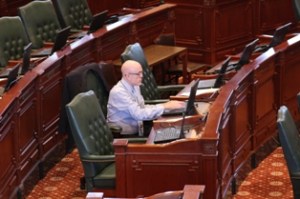
Rep. Greg Harris was the lone legislator on the floor before Friday's session began. Harris, who is gay and living with HIV, is the same-sex marriage bill's House sponsor.

Rep. Greg Harris was the lone legislator on the floor before Friday’s session began. Harris, who is gay, is the same-sex marriage bill’s chief sponsor in the House.

The bill’s sponsor, Rep. Greg Harris (D-Chicago), had told the Windy City Times he would “absolutely” call the bill to a vote before session ended May 31 and that it would pass. “When I put it up on the board, it’s going up to win,” he said.

Instead, an emotional Harris addressed the House chamber. “As chief sponsor of this legislation, decisions surrounding the legislation are mine and mine alone. Several of my colleagues have indicated they’d not be willing to cast a vote on this bill today.

“And I’ve never been sadder to accept this request, but I have to keep my eye, as we all must, on the ultimate prize. They’ve asked for time to go back to their districts, talk to their constituents and reach out to their minds and hearts and have told me they’ll return in November with their word that they’re prepared to support this legislation.”

The General Assembly will meet in Springfield in November for the fall veto session, where the bill could come up again. The Illinois Observer reported it could also be an issue this summer, due to a last-minute move by House Speaker Mike Madigan. The Speaker extended the bill’s deadline for approval to August 31, meaning it could be up for discussion if a special summer legislative session is called.

“A deadline extension by itself resolves none of the political problems associated with the bill’s opponents, but it may give advocates an incentive to work to resolve them before summer’s end,” the online paper reported. Read that story here.

Pastor Danny Holliday has been an active voice against same-sex marriage at the Capitol. Holliday, who leads Victory Baptist Church in Alton, prayed during a rally organized by the Illinois Family Institute in the Capitol rotunda Friday.

Pastor Danny Holliday has been an active voice against same-sex marriage at the Capitol. Holliday, who leads Victory Baptist Church in Alton, prayed during a rally organized by the Illinois Family Institute in the Capitol rotunda Friday.

On Friday, shouts of “Shame!” and “Justice delayed is justice denied” could be heard from the disappointed and angry gallery.

For months, Christians of different denominations, from all walks of life and different races, had banded together to stop what many believed was inevitable when the Senate approved the bill February 14. Then, the momentum seemed to be moving in a direction that would make Illinois the tenth state to legalize same-sex marriage.

But throughout the spring, religious and conservative groups stood firm for a traditional definition of marriage. The Chicago area African American Clergy Coalition used automated phone calls to urge voters around the state to contact their local representatives and tell them to vote no.

Following the non-vote, Bishop Larry Trotter, co-chairman of the coalition, told WFLD TV Fox Chicago, “Today our Lord and Savior Jesus Christ has won! We are so proud of the God fearing Black Caucus members who withstood the pressure of the LGBT forces.”

Sharee Langenstein, a lobbyist who has worked with conservative groups during the same-sex marriage debate in Illinois, told the Illinois Baptist, “The African American community is by and large socially conservative, and so it has been very important through this whole process, in fighting same-sex marriage, to make sure that we form alliances with our friends.

“And I think for too long we have unfortunately kind of assumed that the African American community, which does traditionally vote Democrat, would not be with us on some of our social issues. And we have all learned…that in fact we have a lot more in common than we ever thought, and God has really worked well through this whole process in helping us work together and form alliances that before we never had thought were possible.”

Southern Baptists in Illinois actively opposed the bill. IBSA Executive Director Nate Adams told the Illinois Baptist Friday night, “I was greatly encouraged by the majority of our state representatives who stood firm for traditional marriage today, in spite of tremendous political pressure. I believe the voices and prayers of Illinois Baptist churches and church members made a difference, and have helped defend churches and Christians throughout the state from pressures, requirements and litigation that would certainly have flowed from the proposed legislation, if it had passed.

“I’m sure the political pressure to pass same sex marriage legislation in Illinois will continue. But today helped demonstrate that it is not a fore drawn conclusion, and that the religious liberty implications tied to this issue are being increasingly recognized.”