Archives For November 30, 1999

COMMENTARY | Meredith Flynn

On some Wednesday evenings, if I listen really hard, I can still hear it:

Girls in action, girls in action, missions growing and mission action. Praying, giving money, so the world may know that Jesus loves…

The jaunty chorus bounced out of a third floor classroom at our church every Wednesday at 6:45 p.m., heralding the beginning of our weekly GA meeting. It was in GA’s – the aforementioned Girls in Action – that I first learned most of what I still understand about missions.

This year, as the organization created by Southern Baptist Woman’s Missionary Union celebrates its 100th birthday, I’ve been remembering the most important piece of information I received from GA’s: I could do missions.

Every week our teacher, Mrs. Briggs, led us through 45 minutes of good things: international snacks, missionary stories, and the occasional letter from an overseas pen pal. As we prayed and ate and learned and gave, missionaries became more real to us. They were our heroes, yes, but they were also normal people who even wrote us letters sometimes. So, as I grew up and became a normal person, I never questioned that if God so purposed, he could use me as a missionary.

That’s why missions education is still important, because we are far more likely to try the things we think we can do. We GA’s (and the RA’s in the boys’ class next door) heard week after week that there is always something we can do to support the advance of the Gospel. We lost the excuses of “I can’t,” or “The task is too big,” or “I’m just one person.” The ways Southern Baptists cooperate to reach the world are compelling, even to a third grader. And when we saw that we had a place within that cooperative system, the missions potential felt limitless.

Every Wednesday night now as I sit in my community group (where, sadly, we have not once had egg rolls or baklava), I’m reminded of the lessons I learned more than 20 years ago. Mrs. Briggs and her volunteers played a part in my decision to go on my first international mission trip this summer. And their counsel back then reminds me that I’m called and equipped to be on mission, here and now.

Meredith Flynn is managing editor of the Illinois Baptist newspaper.

Editor’s note: One in five Americans report experiencing a mental illness, but an honest discussion of mental health has long been absent from many churches. Read the Sept. 30 issue of the Illinois Baptist for more on the issue, and how two Southern Baptist leaders – Frank Page and Rick Warren – are speaking out to fight the stigma associated with mental illness.

I’m glad it’s out in the open – at least a bit more than it used to be.

When I served as managing editor for a pastors’ magazine, it seemed that every few years we published an article about clergy depression. Every time we received a slough of e-mails, and a few phone calls. I took those calls. “At least I know I’m not the only one,” pastors would say.

And after some of the longer, darker calls, I responded with my own story.

My mother, the choir director, committed suicide.

I rarely talk about it, even now, and only with those who really need to hear the story. I’ve never typed it, until now. It looks odd on the screen.

Twenty years have passed, but I still wonder how a Christian who spent her whole life in the church, a woman of faith who led me to faith in Christ, could reach such a point of hopelessness. But it happened. After decades-long illness, sometimes physical, sometimes emotional, she lost hope in earthly life.

About three years afterward, I was serving a church as pastor. A deacon took his life. He couldn’t cope with the death of his wife of 50 years; antidepressants couldn’t ease his pain; a shotgun did.

I told his daughter, who had sat with her parents about eight rows from the back for most of those 50 years, my story. We cried. We hugged. We wondered to each other how Christians can lose hope. And we wondered if it could happen to us. God forbid.

I had to preach that dear old deacon’s funeral. I told how he took us seminary students under wing and drove us to nursing homes to preach on Sunday afternoons, how he shared the love of Jesus with lost souls in their last days, and rejoiced when octogenarians finally came to Jesus. But I also had to speak about his own death. That was the first time I dealt publically with the issue of Christians and suicide.

And yes, I do believe that Christians who commit suicide still go to heaven. The doctrine of eternal security is very comforting. “No one can snatch them out of my hand,” Jesus said (John 10:28). I shared that with my congregation. And I tried to offer help as we all asked the inevitable question: “What could I have done?”

Be more willing to talk mental illness. That’s what we all can do. I’m so sorry that prominent Southern Baptist families, the Warrens and the Pages, are suffering the tragic loss of loved ones. But if they can use their national platforms to rescue hurting people, then some good will come from it.

-DER

Nates_column_0930COMMENTARY | Nate Adams

For several years now, my oldest son Caleb has been on a quest to climb the 58 tallest mountains in Colorado. They are known as “14ers,” because the summit of each one is at least 14,000 feet in elevation. I told him I would join him in this quest whenever I could, as long as my middle-aged legs and lungs hold out.

So this past summer, we were climbing again. And though I made it up and down six 14ers in about a week, only two of them were new conquests. Believe it or not, I chose to climb four of the mountains I had already climbed.

I know what you’re probably thinking. Why on earth climb the same mountains twice? The simple answer is that, this time, we wanted to take some new climbers with us. Caleb married Laura last January, and was eager to share his love for mountain climbing with her. And while my wife Beth has been supportive of our climbing efforts over the years, she had never climbed a 14er with us.

So we chose mountains that were familiar, and that we believed our understudies could climb too. On the hike itself, we went slower than we normally would, and stopped to rest more often. Of course it took longer. Yet there was a new kind of joy in the climb, and a new kind of satisfaction at the summit, even though we had been there before.

During that same week, I was finalizing IBSA’s proposed goals for 2014, goals that were to be approved by the IBSA Board at their September meeting. For months already, we had been talking about the vital importance of leadership development, both for pastors and for other church leaders. Instruction and training are valuable, we reasoned, but moving leaders to new levels of effectiveness will require deeper processes of personal growth and development.

As I worked on those goals, I reflected on our experiences climbing mountains. Many times before, Caleb and I had returned from a hike and described to others its unique challenges and what was required to make it to the top and back. Often we had urged others to come with us to those new heights, of course explaining what they would need to endure to get there. But none of that talk “about” hiking could compare with the experience of actually walking together, in relationship, up a mountain some of us had already climbed.

So one evening with tired legs at the bottom of a mountain, I drafted a new 2014 goal for IBSA about Leadership Development. The first part of the goal describes the more than 20,000 trainings IBSA delivers every year, in areas ranging from Sunday School to evangelism to worship leadership and student ministry. But the second half of our new Leadership Development goal says we will “engage at least 200 pastors, staff, church planters or leaders in spiritual, relational leadership development processes, striving for breakthrough growth in leaders that helps transform churches and their effectiveness.”

The IBSA Board unanimously embraced this new goal, along with its implications.  Helping church leaders grow and develop at deeper, more transformational levels will require new processes, new commitments, and perhaps even some new venues and facilities.  For example, we will be exploring the feasibility of how both IBSA camps and a possible new leadership retreat center in Springfield may contribute to the “spiritual, relational leadership development” of our churches’ leaders.

There are many pastors and leaders who have climbed their own mountains in ministry, and who can help other pastors and leaders up those mountains.  We believe enlisting them in a more intentional leadership development process may be just what is needed for the “breakthrough growth” that “helps transform churches and their effectiveness.” After all, as I learned again this summer, helping someone else up a mountain you’ve already climbed can be even more satisfying than simply climbing it yourself.

Nate Adams is executive director of the Illinois Baptist State Association.

The Bible, a book with edge

Meredith Flynn —  September 12, 2013

swordCOMMENTARY | Mark Coppenger

Back in the 1990s, I was involved in the launch of a new publication, and I attended a workshop in New York to be sure we were crossing our t’s and dotting our i’s. One of our teachers explained that we would need to decide first off if we were going to publish a magazine with “edge” (such as The Nation or National Review), or one that avoided provocative opinions on hot issues (such as Saturday Evening Post or Martha Stewart Living).

Of course, most publications offer mixed fare, but it’s useful to distinguish those which strive always to be amiable to the exclusion of conscious affronts to the general reader’s sensitivities, and those quite willing to sacrifice gentility (though not civility, one hopes) in the cause of truth.

We decided we would not shrink from applying edge to our pages, and it occurred to us that our reference point, the Bible was a book with considerable edge. While Scripture is full of comforting and gracious passages—regarding the Lord’s shepherding in Psalm 23; regarding the rest promised for those who labor and are “heavy laden” (Matthew 11:28); regarding “living water” in John 4; regarding the glories of heaven in Revelation 22—it also has great cutting power.

Indeed, the Bible speaks of itself in these terms. Hebrews 4:12 says that “the word of God is living and active, sharper than any two-edged sword, piercing to the division of soul and of spirit, of joints and of marrow, and discerning the thoughts and intentions of the heart.” And, as Jesus said in Matthew 10:34, “Do not think that I have come to bring peace to the earth. I have not come to bring peace, but a sword.”

In his memoir, “Thirty-Nine Years of Short-Term Memory Loss”, former “Saturday Night Live” regular, Tom Davis of Franken and Davis, chronicled a life of prodigious drug consumption. Not surprisingly, he befriended drug guru Timothy Leary. He recounted their times together, including a phone conversation where Leary asked him what books he was reading. When Davis said he was trying to read the Bible from cover to cover, Leary exclaimed, “Oh no—there goes another one.”

Davis urged him to relax: “You don’t have to worry about me. Maybe you’ll feel better if I read you something really good that I just found in it.” With Leary’s okay, he pressed on, reading 1 Timothy 1:9-11 in the old King James. It declared that the law was “not made for the righteous man.” Rather, it was made for “the ungodly and for the sinners, for the unholy and profane, for murderers of fathers and murderers of mothers, for manslayers. For whoremongers, for them that defile themselves with mankind, for menstealers, for liars, for perjured persons . . .”

Laughing, Leary exclaimed, “Whoa! That was wonderful! Thank you for that.”[1] Being two very laid-back fellows, they rolled their eyes at the “over the top” language, but they had to recognize that this was a book that didn’t fool around. It had edge. (And one suspects there was a touch of nervousness in their laughter.)

Though modern translations speak of the “sexually immoral” rather than the “whoremongers,” and the expression “slave traders” is less weird to the modern ear than “menstealers,” there’s no diluting the force of those verses. In fact, the newer versions can be more provocative, as when “them that defile themselves with mankind” are shown to be “men who practice homosexuality.”

The message to the church should be plain. While the Bible is a boundless source of blessing and encouragement, it is also a book whose words can sting and divide, and efforts to disguise this truth should embarrass those who presume to be ministers of the Word.

Mark Coppenger is professor of Christian apologetics at The Southern Baptist Theological Seminary and director of the Seminary’s Nashville extension. This column first appeared on the blog of BibleMesh, online at http://www.biblemesh.com/blog.

What churches do together

Meredith Flynn —  September 5, 2013

MIO_blogCOMMENTARY | Nate Adams

Editor’s note: This column is the third in a three-part series, interpreting IBSA’s 2013 state mission offering theme statement: Mission Illinois – Churches Together, Advancing the Gospel. Read Part 1 and Part 2 here.

When Beth and I were first married, she was a third grade teacher and I was director of marketing at a Christian magazine publisher. It was always easy for me to explain to others what my wife did for a living; everyone knows what a teacher does. But when people asked Beth what I did, exactly, at Christianity Today, she usually simplified my role quite a bit by saying “You know those annoying little cards that fall out of magazines when you open them? He makes those.”

Now to me, what I did for a living seemed much more important and complicated than that. But I had to admit that, in 20 words or less, Beth gave the average person a pretty clear picture of my job. It was to get subscribers to our magazines.

In fact, my task of creating those “blow-in cards” was very similar to the challenge Beth faced in quickly telling people what I did. In just a couple of square inches, we had to tell prospective subscribers why they should spend $20 or more on a magazine subscription. By the time you printed a picture of the magazine and gave the subscriber space to write their name and address, you only had a sentence or two to describe what the magazine could do for them. It’s not always easy to deliver an important or powerful message in just a few words.

As we looked for just a few words to describe what “Mission Illinois” is and why we should all support the Mission Illinois Offering, we chose the words “Churches Together, Advancing the Gospel.” In two previous columns I wrote about the significance of the words “churches” and “together.” Some churches tend to mind their own business and do their own thing. But Mission Illinois describes churches that believe the same core, biblical doctrines, and that choose to work together for both the fellowship and the effectiveness that cooperation brings. And the noble cause that our cooperation serves is the advancement of the Gospel, both here in Illinois and around the world.

There are lots of good phrases that could follow “Churches Together…” and that would be true heart cries of Illinois Baptists. With equal enthusiasm we could say, “Believing the Bible” or “Seeking the Kingdom” or “Making Disciples of Jesus” or “Growing Stronger and Multiplying.”

But in the phrase “Advancing the Gospel” we have identified, at least for now, the few words that best summarize why we as churches choose, even in our autonomy, to sacrificially work together. We want to see the good news of the Gospel delivered lovingly and effectively to every person in our home mission field of Illinois. We want to see Bible-believing, disciple-making congregations established in every community of our state. And we want devoted Christians from those churches to go boldly into all their Acts 1:8 mission fields. The “ripple effect” image of our third Mission Illinois icon symbolizes the advance of the Gospel from local churches, throughout Illinois, to the ends of the earth.

When we place “Mission Illinois” in front of that phrase, we declare who we are as an association of churches, and what we intend to do together. It is our five-word “blow-in card” to one another, and to the world. We are not independent churches; we are interdependent churches. We are not doing the Great Commission alone; we are doing it together. And even if we do a lot more than can be quickly communicated in a few words, we will seek to do these few words above all others.

We will advance the Gospel.

Nate Adams is executive director of the Illinois Baptist State Association.

pull quote_flynnIn the struggle to keep young people in church – or bring them back – are we simply choosing one trend over another?

COMMENTARY | Meredith Flynn

Blogger Rachel Held Evans sparked numerous online conversations this summer with her posts about young people and church. Evans, 32, is a lightning rod in the evangelical community, having already tackled evolution and gender roles in her books. Her columns this summer on CNN’s Belief blog about why millenials are leaving the church are probably less polarizing, but likely more important too.

The disconnect between young people and the church is a real, documented problem. And the news is bleak: Barna found 59% of young Christians will leave the church permanently or for an extended period of time at some point after they turn 15.

Evans posits that young Christians can see straight through the church’s attempts to keep them. She writes, “Many of us, myself included, are finding ourselves increasingly drawn to high church traditions – Catholicism, Eastern Orthodoxy, the Episcopal Church, etc. – precisely because the ancient forms of liturgy seem so unpretentious, so unconcerned with being ‘cool,’ and we find that refreshingly authentic.”

Young Christians, Evans says, don’t want a change in style; they want a change in substance.

Indeed, candles are cool again. And robes and vespers services and responsive readings. In fact, some churches have gotten so cool that those of us millenials who have grown accustomed to stopping by the coffee station before heading into the service are no longer cool enough. We’ve aged out of our own demographic.

That’s what happens when you emphasize style over substance. Style is divisive. So is substance, but we’re promised it will be if the church is focused on the Gospel.

Evans claims substance trumps style, but she’s still advocating for a change in the latter. The instruments of the ancient church have much deeper roots in church history than online giving and electric guitars, but they’re still accessories we use to “decorate” the corporate worship experience and draw people to participate.

None of those things are inherently right or wrong. But they are part of the overall style of a church, and hopefully not its substance.

I know the authentic, unpretentious church Evans writes about in her blog post. I grew up there, except mine was a Southern Baptist church that didn’t follow the contemporary wave of the early 1980s and 90s, but instead waved real palm branches on Palm Sunday. We dressed to the nines, sang along with a pipe organ, and recited the same prayer of contemplation every week. And in my small youth group, kids still struggled with their faith. Some even left the church.

Style may attract people to a church, but it won’t keep them in. No matter how old the style, or how young the people. The church needs something substantial, and fortunately, we have it.

Blogger and LifeWay editor Trevin Wax wrote that he mostly agrees with Evans’ style vs. substance thesis, but would tweak it this way: “What millennials really want from the church is substance. Not a change in substance, necessarily, just substance will do.”

And that never goes out of style.

Justin_KinderCOMMENTARY | Justin Kinder

A recent article in the Illinois Baptist newspaper caught my attention:

“The Presbyterian Church USA chose not to include the song, ’In Christ Alone,’ in their new hymnal all because the song mentions the ‘wrath of God.’ On Christiancentury.org, Mary Louis Bringle, chair of the committee who made the decision, wrote that the song propagates ‘the view that the cross is mainly about God’s need to assuage God’s anger and that view could be harmful to future generations of worshippers.’”

I guess I shouldn’t be surprised by such an article in today’s day and age. However, I did almost spit out the Cheerios I was having for breakfast as I read it.

We must understand what the Bible says about sin and about God and His wrath. When our first parents Adam and Eve fell in the Garden of Eden, they let sin enter into our world. We are all sons and daughters of Adam. In other words, we are all born into this world as sinners. Adam and Eve did not escape punishment for their sin either. They were going to die a physical death and they also died a spiritual death. The same holds true for us: we are all going to die someday and before we ever come to know Jesus Christ as Lord and Savior, we are spiritually dead in our trespasses and sins.

We must also understand that God, the God of the Bible, is a holy God. He cannot tolerate sin. In fact, He hates sin and He must judge sin. We deserve God’s wrath for sin but God in His mercy and grace sent Jesus Christ to be the perfect sacrifice to take away the punishment and penalty for our sin. When Jesus was on the cross, He endured God the Father’s wrath for sin for us. I believe that shows amazing love and grace by God!

There is also further proof from the Bible that Jesus Christ endured God’s wrath for sin while He was on the cross. When Jesus was in the Garden of Gethsemane remember that He prayed, “My Father, if it is possible, let this cup pass from Me; yet not as I will, but as You will.” The cup that Jesus was talking about is referring to the wrath of God. Remember that Jesus also said while He was on the cross, “My God, My God, why have you forsaken Me?” He was quoting a psalm of David but in reality what was happening is that Jesus Christ was experiencing the wrath of God the Father at that very moment.

In John 3:36 it says, “Whoever believes in the Son has eternal life, but whoever rejects the Son will not see life, for God’s wrath remains on them.” In that passage, there is good news and bad news all at the same time. The bad news is this:  if you reject the cross of Jesus Christ, then the wrath of God still abides on you, but you don’t have to remain in that condition.  You can be saved.  Saved from what specifically? The wrath of God. Here is the good news then: when you believe on Jesus Christ as Lord and Savior the wrath of God is taken away from you and you are given eternal life. You are no longer under condemnation but under God’s grace. My friends, we must not sugarcoat the Gospel. We must speak the truth in love and not be afraid to offend people with the truth of God’s Word.

Justin Kinder is pastor of Main Street Baptist Church in Braidwood, Ill.

Everything grows together

Meredith Flynn —  August 22, 2013

pull quote_ADAMS_NEWCOMMENTARY | Nate Adams

Editor’s note: This column is the second in a three-part series, interpreting IBSA’s 2013 state mission offering theme statement: Mission Illinois – Churches Together, Advancing the Gospel. Read Nate’s first column here.

Throughout September, and during the September 15-22 week of prayer in particular, churches across our state are joining together to focus on our Illinois mission field, where at least 8.2 million people don’t yet have a personal relationship with Jesus Christ. In addition to praying, most churches participate in the “Mission Illinois Offering,” all of which goes to work right here in our state to push back lostness, and to assist missionaries and churches in disciple-making evangelism and church planting.

The theme statement we’ve chosen to describe Mission Illinois is “Churches Together, Advancing the Gospel.”

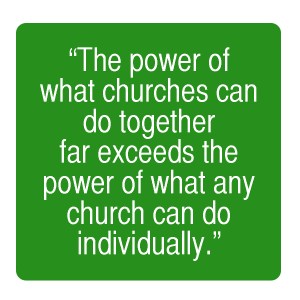
The second word of that theme – together – speaks of the multiplied strength, impact, and growth that happen when churches embrace cooperative missions. The power of what churches can do together far exceeds the power of what any church can do individually.

Individually, an Illinois church might work for years to help establish one new congregation somewhere else in the state. But last year, Illinois “churches together” started 28 new congregations.

Individually, an Illinois church might be too far away from a college campus to have a meaningful ministry, even to its own students there. But Illinois “churches together” provide Baptist collegiate ministries on dozens of college campuses.

Individually, an Illinois church might be able to equip a handful of its members to go on an annual mission trip or two. But Illinois “churches together” sent more than 27,000 missions volunteers last year, a 34% increase over the previous year.

Individually, an Illinois church might baptize five or ten new believers, or even a hundred if it were one of our larger churches. But Illinois “churches together” welcomed more than 5,000 new believers into the Kingdom of God last year.

Those kinds of results go beyond mere cumulative totals. They are the synergistic result of us believing together, praying together, giving together, and working together as a Baptist family of churches here in Illinois. But let me cite another noteworthy example, or rather examples, of what “together” means.

Individually, an Illinois church might be flooded, or lose its pastor, or be divided in conflict, or be confronted with a lawsuit. That church might simply not know how to respond to a crisis or traumatic event, or it might need help improving its Sunday School, or evaluating its facilities, or hosting its first Vacation Bible School in years.

Illinois “churches together” provide one another with our statewide staff and resources so that each church is only a phone call, e-mail, or visit away from getting whatever kind of assistance each one needs to remain strong, or in some cases, to survive.

One of the many catchy tunes embedded in my memory from childhood days of watching “Mister Rogers’ Neighborhood” is the song, “Everything Grows Together.”  Mr. Rogers taught us that: “Your toes grow as your feet grow as your legs grow as your fingers grow as your hands grow as your arms grow as your ears grow as your nose grows as the rest of you grows, because you’re all one piece.”

How does everything grow, even in the ministry of our churches? Together. Why?  Because we’re all one piece. We know the joys and benefits of interdependence. As you consider your gift to the Mission Illinois Offering this year, I hope it will be in part because you see the amazing value of what can only be done by churches together.

Nate Adams is executive director of the Illinois Baptist State Association. Respond to his column at IllinoisBaptist@IBSA.org.

pull quote_BRIDGES_augCOMMENTARY | Erich Bridges, from Baptist Press

The backlash against striving to be a “radical” follower of Jesus started earlier this year.

Giving your all for Christ – including your life – goes back to the earliest Christian disciples and has been one of the marks of true faith throughout church history.

“Radical” living, however, has a more specific meaning in this controversy, stoked by several articles in Christian publications. It refers to the commitment young evangelical leaders, particularly Southern Baptist pastor/author David Platt, have urged American Christians to make.

In a popular series of books and teachings beginning with “Radical: Taking Back Your Faith from the American Dream” (2010), Platt has challenged American believers to forsake the comfortable, materialistic, watered-down Christianity many of us practice. In its place, he calls for the kind of sacrifice and obedience that might lead some to give up possessions, go to risky places to proclaim the Gospel, maybe even suffer and die for Christ.

He’s been joined by evangelical voices such as Francis Chan (“Crazy Love”), Kyle Idleman (“Not a Fan”) and others calling for a faith that looks more like the one found in the New Testament than the one commonly seen in suburban American churches.  

Hold on, respond the critics. You’re setting up an elite category of super-sanctified commando Christians, leaving the rest of us feeling like inadequate, second-class believers. What about everyday folks who quietly go about their lives and provide for their families, while faithfully worshipping God and serving others? Are they failing the test of basic discipleship if they don’t leave their homes and families and do something “radical” for Christ?  

“The heroes of the radical movement are martyrs and missionaries whose stories truly inspire, along with families who make sacrifices to adopt children. Yet the radicals’ repeated portrait of faith underemphasizes the less spectacular, frequently boring, and overwhelmingly anonymous elements that make up much of the Christian life,” wrote Matthew Lee Anderson (founder of the influential Christian blog “Mere Orthodoxy”) in a March cover story for Christianity Today magazine.

“[T]here aren’t many narratives of men who rise at 4 a.m. six days a week to toil away in a factory to support their families. Or of single mothers who work 10 hours a day to care for their children. Judging by the tenor of their stories, being ‘radical’ is mainly for those who already have the upper-middle-class status to sacrifice,” Anderson wrote.

Anthony Bradley went a step further in a commentary for the Acton Institute, reprinted in WORLD Magazine in May. He called the push to be “radical” – and the “missional” church movement generally – manifestations of a “new legalism” among evangelicals.

Bradley, a well-known commentator and professor at The King’s College in New York, said he reached that conclusion after a long conversation with a Christian student struggling over what to do with his life.

“I continue to be amazed by the number of youth and young adults who are stressed and burnt out from the regular shaming and feelings of inadequacy if they happen to not be doing something unique and special,” Bradley wrote.

“Today’s millennial generation is being fed the message that if they don’t do something extraordinary in this life they are wasting their gifts and potential. The sad result is that many young adults feel ashamed if they ‘settle’ into ordinary jobs, get married early and start families, live in small towns, or as 1 Thessalonians 4:11 says, ‘aspire to live quietly, and to mind [their] affairs, and to work with [their] hands.’

“… The combination of anti-suburbanism with new categories like ‘missional’ and ‘radical’ has positioned a generation of youth and young adults to experience an intense amount of shame for simply being ordinary Christians who desire to love God and love their neighbors (Matthew 22:36-40)…,” Bradley wrote. “Why is Christ’s command to love God and neighbor not enough for these leaders?”

This supposed “shaming” of young Christians sure is news to me.

I seldom pass up a chance to challenge young people to get involved in local and international missions – and I’m regularly inspired by their responses.

Ask counselors who work with young missionary candidates and campus ministers who mentor students, and they’ll tell you the same thing: Millennial Christians want to make a difference in the world. They want to serve the poor and fight injustice. They want to act on Christ’s command to take the Gospel to the nations. Sometimes they get impatient with parents and other elders who try to hold them back. And they’re willing, even eager, to go to some of the toughest places on earth.

True, not everyone is equipped by God to go to such places. Those who do go need to demonstrate a clear calling from God; otherwise they’ll never make it when the going gets hard. But everyone can participate in the task through awareness, prayer, support and local church mobilization.

The old division between “regular” church folks and the special few who go to the mission field has been bridged by the vast new opportunities for participation afforded by modern travel, technology and networking – and the rediscovery of the biblical truth that reaching all peoples is the mission of the whole church and everyone in it.

The only non-negotiable requirement is obedience.

One of the young people profiled in Platt’s “Radical” is Genessa Wells. The Texas Baptist teacher lived and served in Egypt for two years – and died there at age 24. She wasn’t a martyr; she was killed in a bus accident in the Sinai just one day before the terror attacks of Sept. 11, 2001. I never met her, but I had the privilege of attending a memorial service for her a few days later in Cairo.

Wells, who had an angelic singing voice, had planned to pursue her study of music in seminary after she came home from Egypt. She never made it back, but she packed enough passion for several lifetimes into her brief life.

Shortly before she moved to the Middle East in 1999, she wrote: “I could give up (on overseas service) and get married and become a music teacher. All of this is very noble and to be quite honest, sounds good to me! But in my heart, I want to change my world – more than I want a husband and more than I want comfort. I need this opportunity to grow and to tell others about Jesus. One of my favorite praise songs says, ‘I will never be the same again, I can never return, I’ve closed the door.'”

Two years later, in her last email home, she quoted another praise song: “‘Open the eyes of my heart, Lord, open the eyes of my heart, I want to see you … shining in the light of your glory….’ It seems that everything we do comes down to one thing: His glory. I pray that all our lives reflect that…. It seems like a floodgate has been opened in my heart . I have a passion for it I never knew God had given me. He’s given it to me for His glory.”

She shared her passion for God with Egyptians, with Palestinians in refugee camps, with Bedouin in the desert. If she had lived, she might have gone home to Texas, gotten married, started a family, become a music teacher. Or she might have opted to serve long-term overseas. Either way, she had one grand purpose in life: to love God and praise Him wherever she went and in whatever she did.

Erich Bridges is an International Mission Board global correspondent. Visit Worldview Conversation, the blog related to this column.

pull quote_BURKCOMMENTARY | Denny Burk

Editor’s note: This column is reprinted with permission from www.dennyburk.com.

After the Presbyterian Church U.S.A decided to drop the hymn “In Christ Alone” from their hymnbook, I posted a note about the decision on my blog. Reports say that the song’s reference to “the wrath of God” was just too much for those making the decision. The songwriters refused to give permission to amend the language, so the PCUSA decided to leave it out.

I have to say that I have been quite surprised at the response to this short post – a response that is still ongoing. I am not surprised, however, that the topic still provokes strong responses from people – strong reactions on both sides of the issue.

In some ways, how one feels about the wrath of God reveals almost everything that’s most important about a person. How one feels about God’s wrath defines a person’s view of hell, of the nature of God, and even of the meaning of the cross itself. Thus to get God’s wrath wrong means to get almost everything else wrong as well.

On Sunday, I preached a sermon in my church about hell and the wrath of God. In this message, I make the case that every true Christian will one day lift up his voice in celebration when God bares His arm in judgment against His enemies (Rev. 18:20). In other words, your ability to rejoice in God’s wrath will one day define whether or not you know Him at all.

What we believe about God and about His Son Jesus is the most important thing about us. And yet countless people recoil at the God of the Bible and turn instead to a god of their own imagination. Any formulation of deity that excludes God’s justice and wrath against sin is not the God of the Bible.

A wrathless god shorn of His justice is no god worth worshipping. Nor is he a god able to convict and save sinners. When wrath is taken away, so is the gospel. And that is why this discussion matters.

Denny Burk is associate professor of biblical studies at Boyce College, the undergraduate arm of Southern Seminary in Louisville, Ky. Listen to his message on the wrath of God at www.kenwoodbaptistchurch.com.