Archives For November 30, 1999

COMMENTARY | Immediately after the Pew Forum released new findings about the current state of American Protestantism, writers and thinkers took to their blogs to warn us not to put too much stock in the so-called shift, at least not for the reasons we might think.

“…Many will likely trumpet this as a huge shift. It’s not. This is simply the natural progression of what is taking place in our context,” said LifeWay’s Ed Stetzer of the research, which states that for the first time in history, Protestants are not a majority in the United States. Rather, the 48% that claim to be Protestants are a plurality at the top of a list of choices that also includes Catholic (22%), Mormon (2%), Orthodox (2%) and “Other Faith” (6%). That means nearly 20% of Americans aren’t affiliated with any faith, the highest percentage ever in Pew Center polling.

“A big part of what is happening is that the ‘Nominals’…are shifting and becoming the ‘Nones,'” Stetzer wrote. “This makes sense, as the cultural currency (in other words, the value a society places on identifying as a Christian) is decreasing. And thus, we see a movement away from Christian identity as a cultural value.”

Stetzer identifies these three main points from the research:

1. “On a growing basis, identifying oneself as a Christian is not a means to societal advancement but can actually be a means to societal rejection.”

2. What he calls the “squishy middle,” or nominalism, is going away. Southern Seminary’s Russell Moore also blogged about this following the Pew Center’s research. “Most of the old-line Protestant denominations are captive to every theological fad that has blown through their divinity schools in the past thirty years-from crypto-Marxist liberation ideologies to sexual identity politics to a neo-pagan vision of God—complete with gender neutralized liturgies.

“What we should pay attention to instead may be the fresh wind of orthodox Christianity whistling through the leaves-especially throughout the third world, and in some unlikely places in North America, as well. Sometimes animists, Buddhists, and body-pierced Starbucks employees are more fertile ground for the gospel than the confirmed Episcopalian at the helm of the Rotary Club.”

3. “It is still a vast overstatement to see this as a collapse of the Christian faith in North America,” Stetzer wrote. “The reality is that evangelicals have been relatively steady as a percent of the population over the last few years, however there is still great cause for concern here – and for action.”

That action must take shape as a willingness to seize opportunities explain exactly what a Christian is, Stetzer said. “…As society moves away from Christian identification, let’s meet them on the road and say, ‘We did not believe in that expression of Christianity anyway. Let me tell you about Jesus and how he changes everything.'”

THE BRIEFING | Posted by Meredith Flynn

Targeting 163 new church plants in Chicagoland over the next five years, the Send North America planting strategy for Illinois’ largest metropolitan area launched Oct. 7-8 with a prayer gathering of local church leaders and a meeting of North American Mission Board trustees.

This visit by NAMB trustees marks the importance of Chicago in the Southern Baptist Convention’s plans to reach the central United States with the Gospel. “With nearly 9 million people in the Chicago metro area, it is our largest, most influential city in the Midwest,” said Steve Davis, NAMB’s vice president for the Midwest region. “The task of penetrating the lostness and conserving the harvest through church planting is enormous.”

Davis joined NAMB President Kevin Ezell, the trustees, leaders from the Illinois Baptist State Association, and a host of missionary planters and local pastors when the Send plans for Chicagoland were presented October 8.

Send North America is NAMB’s strategy to help churches and individuals become active in all regions of North America to lead people to faith in Jesus Christ and start new churches. Chicago is one of 30 highly influential urban centers throughout North America that NAMB is focusing the attention of Southern Baptists on through Send.

With 8.7 million people in the 10 Illinois counties surrounding the city, Chicago is behind only New York City and Los Angeles as the largest Send North America cities.

“Few cities have more impact than Chicago,” said Van Kicklighter, associate executive director for missions and church planting at IBSA. “This is certainly true for Illinois but equally true of Chicago’s impact nationally as well as globally.  Chicago is a wonderful place for Southern Baptists to cover with their intercessory prayer, engage with church partnerships, and spread their missionary wings by sending people who will plant their lives here for the sake of the Gospel.”

For more information on Send North America: Chicago, read the current issue of the Illinois Baptist online, or visit namb.net/Chicago.

Eric Reed is editorial consultant for Illinois Baptist media and reported this story with additional information from Tobin Perry of the North American Mission Board.

In other news:

Six-year-old Texan partners with IBSA for ministry in Haiti
IBSA’s Missions Team recently received a check for $516.20 from an unlikely source: 6-year-old Mackenzie Howell, a Texan who has been burdened for Haiti since she first learned of the devastating earthquake that rocked the country in 2010. “She was deeply touched and wanted to do something for the kids who, in her words, ‘lost their moms, their dads, their schools and their homes,’” wrote Mackenzie’s mom Allison Howell in a letter to IBSA. Mackenzie’s donation will be used to help purchase school supplies or books for children who wouldn’t have them otherwise. And the gift may also help a local Haitian church point people to the Gospel. The full story is on page 8 of the newest edition of the Illinois Baptist. Read it here.

Survey: Pastors reject pulpit endorsements
Nearly 90 percent of pastors believe they should not endorse candidates for public office from the pulpit, according to a survey by LifeWay Research. That marks an increase since 2010, when a similar LifeWay survey found 84% of pastors believed they shouldn’t endorse candidates from the pulpit. The new findings, released Oct. 1, also revealed that 44 percent of pastors personally endorsed candidates, but did so outside of their church role. Read more at Baptist Press.

Cooperative Program ends year 3% above budget; downturn may be reversing
The Cooperative Program ended its fiscal year 3 percent over budget and at 99.41 percent of last year’s contributions. Church giving hopefully has dipped as low as it will from the U.S. economic downturn and may be ready to stabilize or climb, Southern Baptist Convention Executive Committee President Frank Page said. “We finished 3 percent ahead of our budgeted goal and only slightly under last year’s CP total. This is hallelujah territory! To God be the glory.” Read the full story at Baptist Press.

Tyndale files suit against abortion mandate
Bible and Christian book publisher Tyndale House has filed suit against the Obama administration’s abortion/contraceptive mandate, asserting it is an unconstitutional violation of religious liberty to force the publisher to pay for drugs that violate its faith tenets. The mandate requires employers – with few exceptions – to carry employee health insurance plans that cover contraceptives and drugs that can cause chemical abortions. At least 30 lawsuits have been filed against the mandate. Go to BPNews.net for more.

HEARTLAND | Meredith Flynn

Editor’s note: Southern Baptists have been called to pray for 40 days or 40 hours prior to this fall’s election through the 40/40 Vigil. Today’s Heartland post is from Day (or Hour) 13. Go to 4040prayer.com to read more prayer prompts and to find out how to join the vigil.

Scripture for reflection and preparation

“In the beginning was the Word; and the Word was with God, and the Word was God. All things were created through Him, and apart from Him not one thing was created that has been created.” John 1:1, 3

“For all have sinned and fall short of the glory of God. They are justified freely by His grace through the redemption that is in Christ Jesus. God presented Him as a propitiation through faith in His blood, to demonstrate His righteousness, because in His restraint God passed over the sins previously committed.” Romans 3:23-25

“But He was pierced because of our transgressions, crushed because of our iniquities; punishment for our peace was on Him, and we are healed by His wounds. We all went astray like sheep; we all have turned to our own way; and the Lord has punished Him for the iniquity of us all.” Isaiah 53:5-6

REVIVAL ROOTED IN GOD – Revival begins when God’s people turn back to God.

PREPARATION

  • Praise God for who He is
  • Confess your sinfulness and need for cleansing
  • Allow His Spirit to draw you near
  • Listen as He speaks to you

ASK GOD TO…

  • Choose to send revival at this time
  • Help Christians regain their understanding of His holiness
  • Convict Christians that they are to be completely dependent on Him
  • Restore in Christians an understanding of the destructive power of sin
  • Remind Christians of His great love for them
  • Remind Christians of His great sacrifice on their behalf through Jesus
  • Raise up Spirit-filled leaders to call the church to holiness

THANKSGIVING

  • Thank God for hearing you
  • Trust that God is at work to accomplish His will

Editor’s note: Trevin Wax is managing editor for LifeWay’s “The Gospel Project.” This column is excerpted from Baptist Press.

COMMENTARY | Trevin Wax

It’s Wednesday night, and I’m helping our kids get their shoes on, jackets on, and Bibles ready as we’re about to rush to church. I hustle them out the door, tell my wife we’re waiting for her in the car, and then load them into the van.

Along the way, I tell Timothy (our 7-year-old): “Watch out for the puddle in the driveway. Zip up your jacket. Open the door for your sister.” He gives me the exasperated look that smacks of a bad attitude, and I ask him what his problem is.

He lets me know: “People tell me what to do all day long. Before school. During school. At lunch. During class. When I get home. I just get tired of everyone else being in charge.”

“So you want to be in charge?” I ask him.

“Yes. I want to be in charge and make my own decisions,” he tells me.

Thinking this might be a good time to wax philosophical, I say, “Well, son, that day is coming. But right now, other people are in charge, and the reason we’re in charge is because God has told us to be. God wants us to do our best to help shape you into the kind of person who can make wise, God-honoring choices on your own.”

He nods. He knows.

But I keep going.

“One day, you’ll leave home. You’ll go off to college, and no one is going to be telling you what to do every day. You’ll be on your own, making decisions. And I want you to be ready for that day.”

At this, the weariness of the day overcomes Timothy, and the vision of such independence overwhelms him. He wails. Big tears coming down.

“That makes me so sad! I don’t want to leave home!” He is hysterical. “Why do you say that? I don’t want to think about that.”

I sigh, put my hand to my head, and try not to smile. So much for waxing philosophical. Now, it’s time to reassure him.

“Timothy, that day is far away, and by the time you get there – trust me – you’ll want to be on your own, making those kinds of choices.” He is comforted. Crisis averted. I make a mental note: “Don’t bring up college again.”

Afterward, my wife and I were talking about that conversation, laughing about how the thought of independence overwhelmed our son. As adults, we can look ahead to his future and can envision him as an independent young man, mature in his faith, making wise choices.

As a child, our son wants to get there, but he can’t imagine what that would be like. The very thought of being an adult scares him. There are too many unknown variables.

And then, I realize why God doesn’t tell us everything about our future. He lays out the vision of who we will be – people walking in a manner worthy of Christ, bearing fruit in every good work, and increasing in the knowledge of God. But He doesn’t tell us everything this journey will entail. He doesn’t tell us everything we will accomplish along the way.

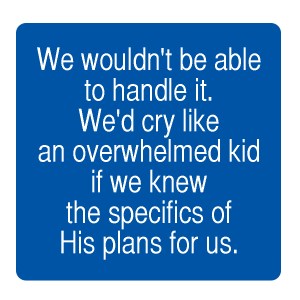
Sometimes I’ve wondered why God doesn’t reveal the specific plan He has for all of our lives. Now, I realize it’s a good thing He doesn’t.  We’d wonder how in the world He will manage to make us resemble Christ in so many surprising ways.

And the thought of the suffering, pain and responsibility it will take to get us there – to form us into that kind of person … well, if college is enough to overwhelm a 7-year-old, then maybe the specifics of how we will become more like Christ over a lifetime would be too much to handle.

Better instead to listen to the loving voice of our Father, who seals us with His Spirit and promises to renew our humanity day by day as He remakes us into the image of His Son.

Better instead to take our baby steps as we wobble down the journey of life, basking in our Father’s good pleasure, trusting in His Son’s sacrifice when we fall, and leaning on the power of the Spirit to pick us back up again and to help us continue the walk.

God gives us the big picture of our future. And it’s glorious!

But He chooses not to fill in all the details for us. And that’s a good thing.

THE BRIEFING | Posted by Meredith Flynn

It wasn’t a typical Sunday night at Tabernacle Baptist Church in Decatur. While Tabernacle Pastor Wes Feltner did occupy the worship center platform, he was joined by four panelists to whom he served as moderator.

Billed as the “Great Debate: Faith and Politics 2012,” the panelist were there to discuss, “How high the wall? Faith, Politics and the Public Square.”

One-issue voting proved to be a hot topic among the panelists, who came from a variety of perspectives.

“It’s not wrong, but I do have concerns with it,” said Shaun Lewis, who ministers to Illinois lawmakers through the Capitol Commission. “The problem being one issue voting tends to define the church by that one issue and it does a lot of damage to the image of the church. It shifts the identity of the church to elevating one issue more than it should be.”

Chad Brand, a professor of theology at Southern Seminary, added, “There are many issues we ought to be concerned about. We cannot help ourselves from reacting to certain issues. The church is gifted with diverse people. We can’t let ourselves be driven by gay rights and abortion. We must recognize there are other issues.”

James Estep, a dean at Lincoln Christian College and Seminary in Lincoln, Ill., said one solution is to train young thinkers to look critically at the issues. “It is essential to have a strong education system so you have intelligent voters to make informed decisions,” he said. “That one issue, 10, 20 years later might not be an important issue anymore.”

Reported by Lisa Sergent, contributing editor of the Illinois Baptist. Look for the full story in the October 8 issue, or read it online here.

In other news:

Gender-specific events banned by school district
A school district in Cranston, Rhode Island, has banned father-daughter dances and mother-son baseball outings, which are gender-specific and could be interpreted as going against state law. The decision came in response to a complaint from the ACLU on behalf of a single mother whose daughter could not attend a father-daughter dance because she did not have a father in her life. According to the Providence Journal, the Cranston School Committee soon will consider a resolution asking lawmakers to modify state law to preserve the father-daughter dances. Read more at BPNews.net.

Mohler on ‘Jesus’ wife’ claim
Al Mohler, president of Southern Baptist Theological Seminary, said a small fragment of papyrus said to mention Jesus’ “wife” is “sensationalism masquerading as scholarship.” After Harvard professor Karen King announced in mid-September the discovery of the tiny (smaller than a business card) document, Mohler blogged about the real meaning of the supposed discovery. “…Do not miss what all this really represents – an effort to replace biblical Christianity with an entirely new faith.” Read Mohler’s full blog post here.

Pakistani Christians victimized
As many as 600 families were forced to evacuate their neighborhood after a 14-year-old girl in Pakistan was accused of blasphemy. Rimsha Masih has since been released on bail and Khalid Chisti, the Muslim cleric who accused her, was arrested when witnesses alleged he framed the girl. Chisti reportedly had earlier called for the massacre of Christians in the neighborhood. The displaced families were assisted by Baptist Global Response partners, who helped by providing meals and praying with them. Read the full story at BPNews.net.

COMMENTARY | Thom Rainer

Editor’s note: In a column posted on Baptist Press, LifeWay Christian Resources President Thom Rainer listed 10 factors that threaten the church’s effectiveness. See his list below, and add your own in the comments section. And go to BPnews.net to read the full column.

1. Spiritual lethargy.
2. Growing inclusivism.
3. Growing disbelief in hell.
4. Busyness.
5. Fear of rejection.
6. A desire to be tolerant.
7. Losing the habit of witnessing.
8. Lack of accountability.
9. Failure to invite.
10. We go to churches that do not reach the unchurched.

THE BRIEFING | Meredith Flynn

The national fast food chain landed back in the frying pan in mid-September, when a Chicago alderman announced he had succeeded in changing the company’s mind concerning its support of same-sex marriage.

Joe Moreno, who sparked a national debate this summer when he threatened to block Chick-Fil-A from opening restaurants in his ward because of the company’s views, claimed the chain had promised to no longer give money to groups against same-sex marriage.

But others are calling foul on the alderman’s supposed victory.

“There continues to be erroneous implications in the media that Chick-Fil-A changed our practices and priorities in order to obtain permission for a new restaurant in Chicago. That is incorrect,” said Chick-Fil-A CEO Dan Cathy, via former Gov. Mike Huckabee’s website.

“Chick-Fil-A made no such concessions, and we remain true to who we are and who we have been.”

Two things seem to be Moreno’s main issues with Chick-Fil-A: The company’s contributions to organizations that support traditional marriage, like Focus on the Family; and an anti-discrimination policy that Moreno claims Chick-Fil-A has introduced in the aftermath of the summer controversy.

The alderman said Chick-Fil-A agreed to add language “opposing discrimination against gay, lesbian, bisexual and transgender people to the company’s employee handbook,” according to the Chicago Tribune.

But Chick-Fil-A’s “Who We Are” document, to which Moreno said the new language would be added, repeats the wording the company used this summer when defending its beliefs and practices. According to a Baptist Press report, Chick-Fil-A’s tradition is to “treat every person with honor, dignity and respect – regardless of their belief, race, creed, sexual orientation or gender.”

The Who We Are document also says Chick-fil-A “supports programs and marriage retreats to help strengthen and enrich marriages,” which more than 4,000 couples attend annually.

According to CNN, Moreno said Cathy”s statement “at the least, muddied the progress we had made with Chick-fil-A and, at the worst, contradicted the documents and promises Chick-fil-A made to me and the community earlier this month.”

The public continues to weigh in on Chick-Fil-A’s Facebook page, posting thousands of comments. Now, it’s your turn:

In your opinion, has Chick-Fil-A done a good job of navigating this summer’s debates over its leader’s views?

Other news:

Supreme Court justice predicts DOMA will appear before Court
Ruth Bader Ginsburg,
a Supreme Court justice since 1993, said in an address at the University of Colorado Law School that the Defense of Marriage Act is likely to go before the nation’s highest court by next year. “I think it’s most likely that we will have that issue before the court toward the end of the current term,” said Ginsburg, according to the Christian Post. Earlier this year, the First Circuit Court of Appeals overturned DOMA Section 3, which defines marriage in federal law in the traditional sense. Read more at ChristianPost.com.

WMU announces young women’s outreach
(From Baptist Press) National Woman’s Missionary Union is stepping up its ministry to younger women through myMISSION, a new, primarily web-based organization for young adult women engaging in missions. The new organization builds on the website mymissionfulfilled.com that WMU created in 2007 to provide missions discipleship resources to the next generation of young women. The site features missional Bible studies and products, interactive blogs from six young adult women in different stages of life, and articles on such topics as prayer, social justice, time management, money and relationships. Read more at BPNews.net.

LifeWay surveys churches’ Lord’s Supper practices
(From LifeWay Christian Resources) The majority of Southern Baptist churches permit anyone who has put their faith in Jesus Christ to participate in the Lord’s Supper, according to a survey by LifeWay Research. The survey of 1,066 SBC pastors found 96 percent of their churches allow individuals who are not members of that local church to participate in the Lord’s Supper. Only 4 percent restrict participation to local church members. The survey also revealed that 57 percent of SBC churches observe the Lord’s Supper quarterly. For more findings, go to lifewayresearch.com.

HEARTLAND | Meredith Flynn

My dad is a big fan of Southern Gospel music. We grew up listening to quartets like The Cathedrals on the way to school, and every single Christmas was highlighted by a viewing of the Gaithers’ Christmas Homecoming Celebration. (Just try to listen to “Come and see what’s happenin’ in the barn” without getting into the Christmas spirit. Dare ya.)

Gospel music tells great stories, and often lends itself to real-life stories of redemption. My dad’s favorite example of this has to do with a Gospel music queen, a fallen country superstar, and the song “Angel Band.” Here’s what happened, according to country music broadcaster Ralph Emery:

Singer George Jones had a serious, alcohol-related car accident in 1999. A long-time drinker, Jones was severely depressed in the days following his accident. As he struggled to recuperate from his injuries, no one could make him feel any better about anything, and he became more and more isolated. But he said he’d be willing to visit with his friend Vestal Goodman, the centerpiece of a group called The Happy Goodman Family, and owner of the most ground-shaking alto voice you’ve ever heard.

Emery helped connect Jones and Goodman, and sure enough, Jones started to take a turn for the better. In an interview about the meeting, Emery said, “As Vestal said, ‘I went out to George’s and ran the devil off.'” They later had a hit duet with the song “Angel Band” (Here’s a link to their performance of the song, but you have to promise me that you won’t make fun of anything when you watch it. Remember, country and Gospel music have their own rules when it comes to sound and fashion, and we need to let them have that.)

Here’s the lesson: Vestal didn’t have much to gain from a visit with George. He was down and out, and probably a pariah in the relatively straight-laced world of country music. And I’m certain he wasn’t any fun to talk to. But she went anyway, to “run the devil off” and remind him of God’s goodness, mercy, grace and forgiveness, and to bring him some hope. The fog of his depression lifted, and Jones was able to sing again. And I know you can’t read too much into the songs a singer sings, but check out these lyrics from “Angel Band”:

My latest sun is sinking fast,
My race is nearly won.
My strongest trails now have are passed,
And my triumph is begun

Oh come, angel band.
Come and around me stand.
Bear me away on your snow white wings,
To my immortal home.

It appears, at least in the song, that Vestal’s words hit their mark. Who has shared that kind of hope with you? And who in your life needs to hear of the lasting hope only Jesus can provide?


COMMENTARY | Nate Adams

A couple of days after the recent IBSA Board of Directors meeting, I traveled to Texas for a meeting with other State Executive Directors and leaders from the North American Mission Board. Our special speaker during that meeting was Dr. Jimmy Draper, past president of LifeWay Christian Resources and respected Baptist pastor and statesman for many decades.

Speaking primarily from John 17, Dr. Draper focused our thoughts on Jesus’ prayer for unity, and invited us to consider what might happen if we as Baptist leaders enjoyed the type of unity for which Jesus was praying. To be frank, relationships between many state conventions and NAMB have been strained for the past couple of years, as NAMB’s new strategies have reduced funding through state conventions.

During that same meeting, however, a committee of State Executive Directors that has been studying NAMB’s new direction and its impact on state conventions presented a very encouraging report. The committee and NAMB President Kevin Ezell then presented a new plan for state conventions and NAMB to move forward together that met with unanimous approval.

More important than the consensus being unanimous, however, was the fact that it was unifying. And there is a difference. As Dr. Draper shared with us later that evening, Jesus did not ask that everyone agree on everything (unanimity), or that everyone be the same (uniformity), or that everyone express themselves the same way (unison). In praying for our unity, Jesus was asking that our deep and resilient love for Him and for one another keep us together in spite of our differences, harmoniously moving toward a lost world in His name.

Listening to this teaching on unity, and watching it unfold in our Texas meeting, my mind returned to Illinois, and the IBSA board’s recent consideration of acquiring property for a leadership center in Springfield. You can read about that decision in the September 24 issue of the Illinois Baptist (online here), so I won’t recount the details in this post. But what pleased me most about the board’s action was that it also placed a high value on unity.

It’s challenging to know, sometimes, the common direction in which a thousand diverse Baptist churches from all over the state should go. Though most of the IBSA board and staff felt positively about the value and strategy of a Springfield leadership center, we decided to write a letter outlining the opportunity to all IBSA churches, in addition to the information provided in the Illinois Baptist and the IBSA website.

For the next two weeks, about 50 e-mails, phone calls, and personal conversations helped me “take the pulse” of Illinois Baptists on the subject. A majority of the feedback was positive toward the opportunity, but a significant minority expressed concerns or opposition.

The IBSA Advisory Committee and I, who had been studying the opportunity most closely, then faced a challenge. It appeared that both the decision to move forward with the acquisition and the decision to back away from it would be met with some disappointment. We prayed and discussed, and in the end we proposed an amended motion that we believed was a vote for unity, rather than for or against property.

The amended motion, adopted overwhelmingly by the full IBSA board, backs away from the property at the current price, and backs away from borrowing money. At the same time, it leaves the door slightly open for donors to step up with contributions, or for the seller to step down in price, though both of those scenarios are unlikely.

As I wrote earlier, it’s challenging to know, sometimes, the common direction in which a thousand diverse Baptist churches from all over the state should go. We can’t always count on unanimity, or uniformity, or unison. But we can explore new ideas, listen to one another, and make decisions that place a high value on unity, trusting God to keep moving us forward, together.

Nate Adams is executive director of the Illinois Baptist State Association.

THE BRIEFING | Meredith Flynn

Survey shines light on Scripture habits
A recent LifeWay Research study found few churchgoers are daily engaging in personal reading and study of Scripture. When asked how often they personally (not as part of a worship service) read the Bible, 19% of those surveyed said every day; 26% said a few times a week, 14% said once a week, 22% said once a month or a few times a month, and 18% said rarely/never.

“Bible engagement has an impact in just about every area of spiritual growth,” said Ed Stetzer, president of LifeWay Research. “You can follow Christ and see Christianity as your source of truth, but if that truth does not permeate your thoughts, aspirations and actions, you are not fully engaging the truth.

“God’s Word is truth, so it should come as no surprise that reading and studying the Bible are still the activities that have the most impact on growth in this attribute of spiritual maturity,” Stetzer said. “As basic as that is, there are still numerous churchgoers who are not reading the Bible regularly. You simply won’t grow if you don’t know God and spend time in God’s Word.”

Read more survey findings at LifeWayResearch.com.

Texas Baptists affirm marriage
The Southern Baptists of Texas Convention (SBTC) is promoting a petition that affirms the biblical definition of marriage and asks President Barack Obama to reconsider his support of gay marriage. In a recent chapel service at Southwestern Seminary, SBTC President Terry Turner urged professors and students to sign the petition, online at sbtexas.com/marriagepetition. Turner, an African American pastor, also rejected the notion that homosexuality is a civil rights issue.

“I saw what my ancestors went through, how they fought against the Jim Crow laws because of the color of their skin,” Turner said. “I saw how they fought to become citizens as black Americans through the civil rights movement. And it was about the color of the skin. It was about the way a person was really born. But I have got news for you today. God made us all male or female, regardless of the color of our skin. And when homosexuals try to jump on the civil rights movement, they are missing it. And it just burns me up, because sexual preference has never been a civil rights issue.” Read the Baptist Press story here.

Retailer files suit against mandate
Evangelical-owned Hobby Lobby has filed a lawsuit against the Obama administration’s contraceptive/abortion mandate, becoming the largest business yet to take action against the rule. Although Hobby Lobby’s insurance plans cover contraceptives that are preventative in nature, the company won’t cover anything that causes a chemical abortion, said founder and CEO David Green. “… We simply cannot abandon our religious beliefs to comply with this mandate.” Read the full story at Baptist Press.

Athletes share faith at iamsecond.com
NFL quarterbacks Sam Bradford and Colt McCoy speak candidly about their faith in Jesus Christ at iamsecond.com, a website that gives athletes, actors, musicians and non-celebrities a chance to say why they’re “second” in their lives (and why Christ is first). “The minute that you start to think that you’re first, and He’s second, and that what you think, and what you have planned in your mind, is more important than what He has planned for your life, that’s the minute your life starts to go the wrong way.” Watch more videos at iamsecond.com.