Archives For November 30, 1999

The example of the Proverbs 31 woman has been misused in the past, Trillia Newbell said. But there's wisdom to be found in her story too.

The Proverbs 31 woman was excellent not because of what she did, but who she adored, Trillia Newbell said.

NEWS | Meredith Flynn

Iconic TV moms June Cleaver and Clair Huxtable were products of their times – 1950’s idealism and 1980’s feminism. The matriarchs from “Leave it to Beaver” and “The Cosby Show” have been idolized by women and by culture as ideals of femininity and, basically, having it all together.

But idolizing those examples, or that of any other cultural icon, leads to condemnation, said Trillia Newbell. The Ethics and Religious Liberty Commission’s consultant for women’s initiatives spoke today on biblical womanhood to women gathered at the ERLC’s summit on the Gospel and sexuality.

The June’s and Clair’s of television might see their influence wane as the culture changes, or at least they’ll be replaced by other ideals. But what about the one many Christian women have heard about from the time they were old enough to find Proverbs in their Bibles?

“I already know that many people are tired of the Proverbs 31 woman,” Newbell said of Scripture’s ideal wife. “She too has been idolized. It hasn’t been helpful.

“But no worries,” she assured her audience, “I’m not merely going to be talking about how excellent she is.”

Instead, Newbell talked about why the Proverbs 31 woman is held up as an example of excellence in the ancient poem. It wasn’t because of what she did, but rather who she loved. Near the end of the chapter, we discover she fears the Lord.

“If the call to be a God-fearing woman completely freaks you out, God provides the grace for it,” Newbell said. For Sarai, who laughed when He made her a promise. For women throughout Scripture. Even for the woman in Proverbs 31.


 

An almost-Gospel is no match for the sexual revolution.”

Russell Moore, president of the Ethics and Religious Liberty Commission

A gentle and quiet spirit is not about volume.

“Woo-hoo! Otherwise, I’d be in trouble.

“It’s about a heart that fears and loves the Lord.”

Trillia Newbell, speaking on biblical womanhood

When I die, I want my children to be able to say that was the godliest man I ever met. And I want my wife to be able to say I would marry him all over again.”

Pastor Matt Carter, on his two life goals

“Satan would love for your children to be morally pure, as long as that’s not the fruit of the Gospel.

…With Satan, any path to self-righteousness, any path to self-exaltation is a good one. Satan doesn’t hate morality, he hates the cross.”

David Prince, on teaching your children about Gospel-centered sexuality

Our approach to teaching our children about Christian sexuality cannot be, ‘Just say no. Just don’t do it.’ That’s not a Christian sexual ethic. …We want them not to just have a right view about what to say no to, we want them to have a comprehensively Christ-centered, Christian view of sexuality.”

David Prince, pastor of Ashland Avenue Baptist in Lexington, Ky., at the ERLC summit on the Gospel and sexuality

You’re not defined by your temptations. You’re not predestined by your temptations. You’re not necessarily sinning by your temptations.

“We have to show people what it is to take up their cross and follow God.”

-ERLC President Russell Moore on exhorting people struggling with sexual temptation

NEWS | Meredith Flynn

Nashville, Tenn. | There are few things that make the Gospel more offensive and more out of sync with culture than what the Bible teaches about sex. But the church has to keep talking about it.

J.D. Greear, pastor of The Summit Church in Raleigh-Durham, N.C., told leaders gathered for the Ethics and Religious Liberty Commission’s summit on the Gospel and sexuality that the church can’t surrender the “high ground” in talking about sex, and also shouldn’t avoid hard topics like homosexuality. Greear also stressed that the root of sexual sin is idolatry, and the Gospel is powerful to deal with it.

“Our message cannot simply be, ‘Stop having sex.’ Our message has to be, ‘Behold, your God.'”

Encouraging leaders not to avoid hard topics, Greear said he had struggled two years ago with whether to speak publicly in favor of his state’s attempt to define marriage as between a man and a woman. He did and was met with harsh criticism, including one blogger who published the Greears’ home address.

For three weeks, Greear thought he and his leadership team might have made the wrong decision, he said. But now he has little doubt it was the right thing to do. Teaching his church to think “Christian-ly” about the issue was the goal; also, his church has seen several people come out of a homosexual lifestyle, accept Christ, and be baptized.

Greear’s message and the first day of the ERLC summit got a lot of attention on Twitter; by Monday evening, #erlcsummit was one of the social media site’s top trends. Posts from conference attendees were positive, but others watching from home or following the tweets expressed different views. The Twitter traffic seemed to increase when several leaders joined Greear on stage for a panel discussion on the Gospel and homosexuality.

There were light moments, like when Florida pastor Jimmy Scroggins told pastors to reject “redneck theology” when talking about homosexuality. No more “Adam and Steve” jokes, he said. But the conversation was serious when the panel talked about what pastors should do when gay people or couples want to join their church, or how to counsel a Christian who still feels attracted to members of his or her same sex.

“There are things that are broken because of the curse of sin that you becoming a believer doesn’t automatically fix,” Scroggins said. That’s why pastors have to preach the second coming of Christ, he said, and the transformation of all believers who are in Christ. “In some mysterious way that I can’t comprehend, He is going to put Humpty Dumpty back together again,” Scroggins said. Breaking into a grin, he added, “Can’t wait to see these tweets.”

Watch the ERLC Summit online at live.erlc.com.


ERLC_Summit_logoNEWS | Meredith Flynn

Nashville, Tenn. | The first Leadership Summit hosted by the Southern Baptist Ethics and Religious Liberty Commission kicked off this afternoon at the SBC building in Nashville. The meeting of 180 church leaders is focused on how the Gospel applies to human sexuality, especially in a culture that’s changing fast.

“So many of the questions that pastors grapple with today deal with situations that would not even have been possible a generation ago,” ERLC President Russell Moore said when the summit was announced a few months ago. “As technology advances and the culture changes, the questions that we have to grapple with are often increasingly complex.”

The meeting’s first speaker, Heath Lambert, tackled one of those digital age issues with a keynote address on pornography. Lambert, executive director of the Association of Certified Biblical Counselors and a professor at Southern Seminary, said porn is a “silent killer” in churches.

“I think that pornography represents the greatest moral crisis in the history of the church,” Lambert said. It is “something that evangelicals can do in a dark room behind a shut door after they’ve railed against homosexual marriage and talked about conservative theology.”

Redefining marriage is a threat to the church, he added, but “a greater threat to the church today is the Christian pastor, the Christian schoolteacher, the Christian Bible college and seminary student, who exalts sound theology, who points to the Bible, and then retreats to the basement computer to indulge in an hour or three of internet pornography.”

Using Proverbs 7 as a backdrop, Lambert likened pornography to the Scripture passage’s “forbidden woman.” The Bible gives strategies for dealing with sexual temptation, and the church should too, he said. But the first call is to cling to the Gospel.

“I’m pleading with the church to have practical strategies…but those behaviors won’t be enough if we are not teaching people to draw near to Jesus Christ,” Lambert said.

He closed his message with three charges to church leaders concerning pornography: First, pursue accountability. 75% of pastors are accountable to no one for their internet activity, Lambert said.

Second, address your people. “If your job is to preach the whole counsel of God, here it is,” Lambert said. “You’ve got to talk about it. If we do not share this, if we overlook it, it’s folly. It’s foolishness.”

And third, awaken the world to the problem. “Evangelicals have tenderly and tenaciously taken up many causes…I want to ask that together we would begin to take up this cause, that we would begin to say, ‘Enough is enough.'”

Marriage, purity, human trafficking, and pastoral care for sexual sin are among the topics the Leadership Summit will explore through large-group sessions, breakouts and panel discussions. Check back here for updates, and watch it at live.erlc.com.

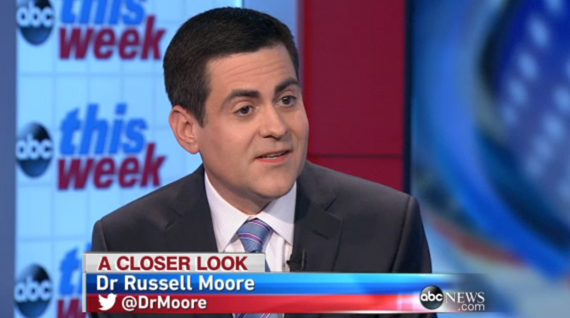
Russell Moore was joined on ABC's "The Week" by fellow panelists Franklin Graham, Ralph Reed and Cokie Roberts.

Russell Moore was joined on ABC’s “The Week” by fellow panelists Franklin Graham, Ralph Reed and Cokie Roberts. Photo from video on abcnews.go.com

NEWS | On Easter Sunday morning, ABC’s “This Week” featured a panel of guests discussing whether the influence of evangelicals is waning in the current culture. The group included Russell Moore, president of the Southern Baptist Ethics and Religious Liberty Commission, who said it is indeed a new day for Christians.

The percentage of people that are members of a church or synagogue has fallen from 70% in 1992 to 59% in 2013, said moderator Martha Raddatz, citing a Gallup statistic. She asked Moore if the numbers worry him, and what can be done about the decline.

“I’m not worried… because I think what we’re seeing is the collapse of a cultural, nominal form of Christianity,” Moore said. There was a time in America where in order to be a good person, to be seen as a good citizen, one had to nominally at least be a member of a church. Those days are over, and so we’re at a point now where Christianity is able to be authentic, and Christianity is able to be authentically strange.”

Moore pointed out that Christianity’s foundational beliefs are hard to grasp for the culture at large, but the disconnect isn’t unprecedented.

“Many people now when they hear about what Christians believe, what evangelical Christians believe, their response is to say, ‘That sounds freakish to me, that sounds odd and that sounds strange.’ Well, of course it does. We believe that a previously dead man is now the ruler of the universe and offers forgiveness of sins to anyone who will repent and believe.

“That’s the same sort of reaction that happened in the Greco-Roman empire when Christianity first emerged. So it offers an opportunity for the church to speak clearly, articulately, about what it is that we believe, to give a winsome and clear message about what the Gospel actually is.”

Raddatz asked Moore about his recent comment that “the illusion of a Moral Majority is no longer sustainable in this country.”

“Yes, it’s a different time,” Moore said on Sunday’s broadcast, “and that means that the way that we speak, we speak in a different way. We speak to people who don’t necessarily agree with us. There was a time in which we could assume that most Americans agreed with us on life, and on abortion, and on religious liberty and other issues. And we simply had to say, ‘We’re for the same things you’re for, join us.’

“It’s a different day. We have to speak to the rest of the culture and say, ‘Here’s why this is in your interest to value life, to value family, to value religious liberty.'”

The panel’s 10-minute conversation is available for viewing at the ABC News website.