


The choir from Broadview Missionary Baptist Church brought the Pastors’ Conference audience to their feet with their opening song, “I Came to Magnify the Lord.”

The choir from Broadview Missionary Baptist Church brought the Pastors’ Conference audience to their feet with their opening song, “I Came to Magnify the Lord.”

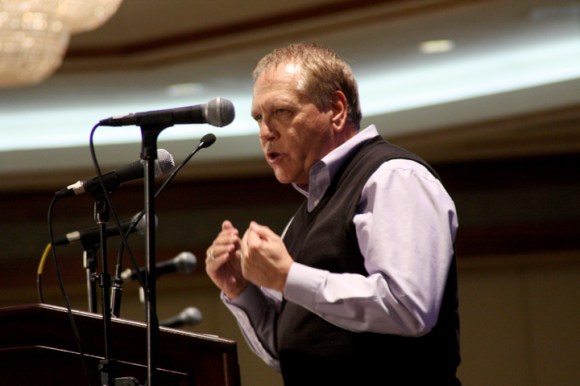
Larry Thompson, pastor of First Baptist Church in Ft. Lauderdale, Fla., is preaching at the IBSA Pastors’ Conference on the “seismic spiritual shift” described in Acts 10. Follow the Pastors’ Conference at Facebook.com/IllinoisBaptist.

God wants his people to trust in him and arise, said Pastor Marvin Parker, referencing the theme of the 2014 IBSA Pastor’s Conference. “Get up, get out, get going.”
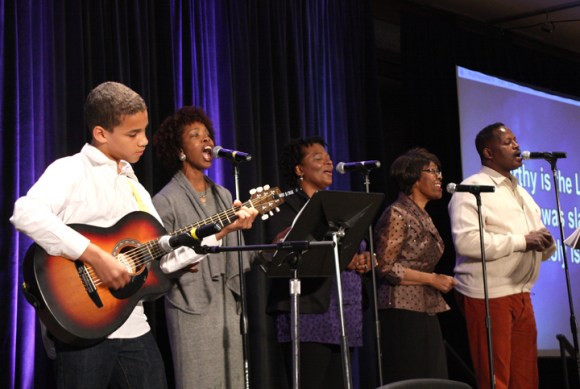
Musicians from Uptown Baptist Church in Chicago led in worship during the opening session of the IBSA Pastors’ Conference, which continues tonight in Springfield. Follow the conference and the IBSA Annual Meeting, beginning tomorrow at 1:30 p.m., at Facebook.com/IllinoisBaptist.
 THE BRIEFING | Meredith Flynn
The Illinois Baptist State Association’s Annual Meeting and Pastors’ Conference is in Springfield this week, beginning today at 1 p.m. Check our blog for coverage throughout the week, or at Facebook.com/IllinoisBaptist and Twitter.com/IllinoisBaptist.
“Parents, love your LGBT or same-sex attracted children and point them to a life of costly discipleship following Jesus,” Christopher Yuan told attendees at the Ethics and Religious Liberty Commission’s National Conference last week. The Moody Bible Institute professor’s journey out of a lifestyle of addiction, which included same-sex relationships, was shaped by the love of his Christian parents, The Christian Post reported.
After same-sex marriage became legal in their state Oct. 10, six magistrates in North Carolina stepped down rather than be required to preside over same-sex marriages, the Christian Examiner reported. “For me to do what the state said I had to do, under penalty of law, I would have to go against my convictions, and I was not willing to do that,” said Magistrate Gayle Myrick. “I want to honor what the Word says.”
Theologian R.C. Sproul said “the pervasive influence of humanism” is evident in a new survey produced by LifeWay Research and commissioned by Sproul’s Ligonier Ministries. The online survey of 3,000 Americans asked 43 questions about faith, covering topics from sin and salvation to the Bible and the afterlife.
It was announced last week that the network of 13 Mars Hill churches founded by recently resigned pastor Mark Driscoll will dissolve by the beginning of 2015. According to a Christianity Today report, the churches have three options: become independent, merge with an existing church, or disband.
Southern Baptist leader Russell Moore is one of the speakers set to address a Vatican colloquium on marriage and family later this month. The religious groups that will be represented certainly have their differences, Moore blogged, and the meeting won’t change that reality. “That said, I am willing to go anywhere, when asked, to bear witness to what we as evangelical Protestants believe about marriage and the gospel, especially in times in which marriage is culturally imperiled.”
HEARTLAND | Meredith Flynn
In two out of three Southern Baptist congregations, fewer than 100 people gather for worship on Sunday morning. Megachurches may get more attention, but small churches are the backbone of the SBC, Frank Page has said.
Illinois pastor Cliff Woodman is part of a new advisory council on small and bivocational churches.
Still, small church pastors often feel overlooked and marginalized, left out and under-resourced. A new advisory council assembled by Page, president of the SBC Executive Committee, exists to communicate the unique needs of these categories of churches with denominational leaders.
“I will not allow the Southern Baptist Convention to forget who we are,” said Page during the first meeting of the Bivocational and Small Church Advisory Council. “Part of my goal in this is to elevate the role of the small church pastor and the bivocational pastor, period. And that’s going to happen.”
Illinois pastor Cliff Woodman is part of the 21-member council, which will work over the next three years to develop a report on the statistics that define Southern Baptist churches. The group, one of several Page has brought together in his first four years as Executive Committee president, represents a large majority of Southern Baptist churches.
“Some would say 35,000 of our 46,000 churches, maybe more than that, are in the two categories of small church or bivocational,” Page said at the Sept. 11-12 meeting in Atlanta. For the council’s purposes, he defined a small church as one with 125 people or fewer in Sunday school attendance. The group also looked at research on the percentages of SBC churches by worship attendance. According to 2013 data, 68% of Southern Baptist churches have 100 or fewer people in worship, compared to 78% of IBSA churches and missions.
Woodman, now pastor of Emmanuel Baptist Church in Carlinville, spent more than 25 years as a bivocational pastor at Harmony Baptist Church in
Medora. He told the Illinois Baptist small church and bivocational pastors (most who also work a second job) often feel out-of-the-loop. Sunday school curriculum may feel tailored to larger churches with more people and more classroom space, for example, and large church pastors often are the ones invited to speak at meetings or conferences.
But non-megachurches can be effective churches. Woodman, whose Carlinville church reported an average worship attendance of 145 in their 2013 Annual Church Profile, is leading Emmanuel to look closely at what makes a congregation healthy. He referenced LifeWay President Thom Rainer’s 2013 book “I Am A Church Member,” which outlines members’ responsibilities to their congregation.
“If a church member’s not supposed to look at ‘what’s in it for me,’ then maybe churches ought to stop looking at ‘what’s in it for me,’” Woodman said. The better question is, “What can I do for the bigger body?”
Major shift toward bivocational
Page has used a “fault lines” analogy to describes areas of SBC life where there are rifts between different groups. One of those fault lines, he said in the Atlanta meeting, is related to church methodology, or how churches do church. The discussion centered on bivocational ministry, a strategy Page called “the wave of the future.” It’s also the wave of the past.
Southern Baptist churches have long relied on bivocational pastors to lead churches. Decades ago, many pastors were farmers; today, they also drive school buses, deliver the mail, and run small businesses.
“I’m convinced that in the 21st Century, the best stewardship model is bivocational,” Page said. “We’ve got a lot of students coming out of seminary now who have no intention of being full support.” In other words, they’re prepared to work more than one job to make ends meet.
That news was encouraging to Woodman. There was a day, he said, when “the underlying current was that the bivocational guy wasn’t good enough to have a full-time church.” Page shared with the group that some Christian universities are now training students to be pastors along with learning another vocation.
While there will always be churches that want their pastor to be full-time, Woodman said, bivocational ministry is imperative if Southern Baptists want to extend the reach of churches into more communities. “And we’re going to have to do a better job at it,” he said, and at preparing future leaders for it. Because bivocational pastoring is “a different game.”
Quit the comparison game
Small church pastor Job Dalomba posed a pointed question in an April blog post: “We have to ask ourselves an honest question: Do we want to see the glory of God shining from larger churches or do we just want their numbers, resources and notoriety to be our numbers, resources and notoriety?”
The SBC Voices post by Dalomba, pastor of a new, small church in Southaven, Mississippi, called for small church pastors to stop comparing themselves to men who lead larger congregations, and to pray for those big churches too.
It’s a strategy the congregation at Emmanuel has utilized this year. A church’s prayer requests are a good measure of its health, Pastor Woodman said. “Throw them up on the wall, and see what your prayer requests do. And when you get done, you begin to think about what does that tell you your view of God is.
“And in essence, you’ll find in most churches that he’s healer, a physician; he’s an employment agency; he’s Triple A. But what’s lacking is that he’s a savior.”
Woodman’s congregation was already praying by name for people who don’t know Christ when he arrived as pastor last year. To that focus, they’ve added regular prayer for sister churches in Macoupin Baptist Association. The prayers are scripted, with a focus on reaching people who don’t know Christ. Woodman is hopeful the strategy will help build a spirit of teamwork between his church and others in the community, he told SBC Life earlier this year.
“When we started praying for our sister churches, that helped us be healthier. If we as pastors and churches would take the same attitude, then we’d stop looking at what others were doing for us, and we’d start doing for others.”
With reporting by Baptist Press and SBC Life. Meredith Flynn is managing editor of the Illinois Baptist newspaper, online at http://ibonline.IBSA.org.
COMMENTARY | Chase Abner
Note: This article originally appeared on Collegiate Collective, a new resource that features articles, podcasts, and videos designed to equip leaders to advance the gospel on college campuses.
Okay. Here’s my qualification to talk about Halloween on campus: I served as a campus minister for seven years in Carbondale. Beginning in the 1980s, Carbondale became known for its raucous Halloween celebrations. In fact, most folks these days refer to them as “the riots.” Cars got turned over. Store windows were busted. Bottles were thrown at police. After a particularly violent weekend in 2000, city officials closed the bars on “the Strip” each Halloween in hopes that it would discourage the behavior. Instead, students just celebrated a week earlier in what is now infamously “Unofficial Halloween” (or simply “Unofficial” if you’re a cool kid).
Even this year, Unofficial got bonkers and police showed up in riot gear to mace and pepper spray the crowd after a car got turned over just blocks from campus.
 I never found an effective way to engage students during Unofficial outside of throwing my own tamer Halloween party. I can’t talk about that or I’ll draw the ire of my more fundamentalist friends. However, I can talk about what I think students’ fascination with Halloween reveals about culture on campus.
The Supernatural
Part of what makes haunted houses and scary movies enticing to people is the notion that there are malicious spirits that walk among us. In some ways, it’s a subtle rejection of the naturalistic worldview that can be common on campus, especially among those immersed in the physical sciences. Even as Dawkins-flavored atheists/agnostics become more vocal, research shows that the majority of Millennials believe in God with “absolute certainty.”
While it may be disconcerting to see students toy with the concept of evil spirits for the sake of entertainment, I encourage you to see it as a bridge to talk about Christ. Christians, of all people, should be ready to affirm the existence of a paranormal reality and to point others to the one who is ultimately victorious over evil.
Community
Research by the National Retail Federation predicts that 67.4% of 18-24-year-olds will spend money on Halloween costumes this year. These young adults predict that they’ll each spend about $40 on their costumes. I guarantee that these students aren’t going to shell out that much cash to get all dressed up and have nowhere to go.
The point of wearing a costume is to join the throngs of costumed students in the campus community – to see and be seen. Halloween reveals, almost as well as athletic events, that students want to be a part of a community rallying around a common purpose. Like all people, they have an innate desire to be a part of something bigger than themselves. They want to belong and they want to celebrate.
Our ministries have so much more to offer that desire than Halloween can provide. We can provide ongoing community that is centered around an eternal purpose realized in the mission of God.
Boredom
When I try to figure out what might motivate a college student to don a costume and go make mischief (like tipping a car over or assaulting police officers, cf. “Unofficial” above), one answer that comes to mind is boredom. I think a lot of the trouble students get into at Halloween stems from the extended adolescence that finds fertile ground during college. Without a clear path to make a difference in the world, many students will use their freedom from immediate parental guidance to indulge some of our basest desires simply for lack of something better to do.
One way that our ministries can serve students (even before they know Jesus) is to provide them with opportunities to make a positive impact in the surrounding community. These students may not ever be ready to teach Bible studies, but they can read to underprivileged children, clean up litter, or clean out gutters for the elderly. Imagine the Gospel-centered conversations that could occur between students as they do community projects together. Imagine the good that could be done for your city if you find a way to channel bored students’ talents and energy into a Kingdom-focused alternative.
The Gospel
I know some will accuse me of over-thinking things. “Can’t Halloween just be about fun, Chase?” Of course it can, but even the desire for fun reveals something about the human condition, no? We all chase various things in hopes of being satisfied. So whether students are seeking supernatural affirmation that there’s more to life than what they see…or a sense of belonging with others…or an escape from a routine, meaningless existence…the Gospel of the Kingdom offers more than they could dream.
So, this weekend, I’m not asking you to ruin anyone’s Halloween fun. But as you observe the celebration (and probably mischief) in your campus community, let it freshly awaken you to why you’re there and why collegiate ministry matters.
Chase Abner is collegiate evangelism strategist for the Illinois Baptist State Association.
THE BRIEFING | A Baptist professor who once taught at the convention’s most historic seminary is poised to publicly announce his shift on homosexuality at a national conference in November. Mercer University professor David Gushee, who taught at The Southern Baptist Theological Seminary from 1993-96, will reportedly tell the audience at a conference hosted by The Reformation Project that, “I will seek to stand in solidarity with you who have suffered the lash of countless Christian rejections.”
His proposed remarks, reported by Religious News Service, do not come as a surprise to Baptist leaders who have known Gushee and watched his theological path over the years, Baptist Press reports. “Gushee is not the future of evangelicalism,” blogged Boyce College professor Denny Burk. “He is the future of ex-evangelicalism. He joins a chorus of others who have left the faith once for all delivered to the saints (Jude 3) and who no longer represent what evangelical Christianity is all about.”
A week after Houston pastors were subpoenaed amid their involvement in a campaign to defeat a city ordinance, Southern Baptists leaders and others in Arkansas are working toward the repeal of a similar ordinance in Fayetteville. Adopted by the city council in August, the ordinance is part of an effort by the Human Rights Campaign to expand equality for the LGBT community in southern states, Baptist Press reports. But some pastors and Christian leaders say their religious liberty is at stake.
Southern Baptist Convention President Ronnie Floyd will take part in a Nov. 2 simulcast designed to show support for the five subpoenaed ministers in Houston. Sponsored in part by Family Research Council, “I Stand Sunday” also will feature former presidential candidate Mike Huckabee and Alan and Phil Robertson from TV’s “Duck Dynasty.”
“Life does not end when tragedy comes into your life,” says Travis Freeman, a one-time high school football player whose life changed drastically when an illness cost him his eyesight. The two-time graduate of Southern Baptist Theological Seminary is the subject of “23 Blast,” a new film released in Oct. 24. Read more about Freeman and the movie at BPNews.net.
In other movie news, Christian Bale says Moses was “barbaric” and “likely schizophrenic.” Bale portrays the biblical hero in the upcoming Ridley Scott film “Exodus: Gods and Kings.”
Having their credit card information stolen tops the list of crimes Americans worry about most, according to a poll by Gallup. 69% of people said they frequently or occasionally worry about computer hackers stealing the credit card info they use at stores, followed by 62% of Americans who worry about their computer or cell phone being hacked. Farther down the list: having your car stolen or broken into (42%), getting mugged (31%), and being a victim of terrorism (28%).
Winning baseball games isn’t the top priority for San Francisco Giants assistant general manager Bobby Evans. “You want your life to point people to Christ,” he told Baptist Press. “It starts for me with my own relationship with Christ. That’s going to direct and dictate what influence I have for Christ in my family, in my marriage and in the workplace.”
HEARTLAND | Eric Reed
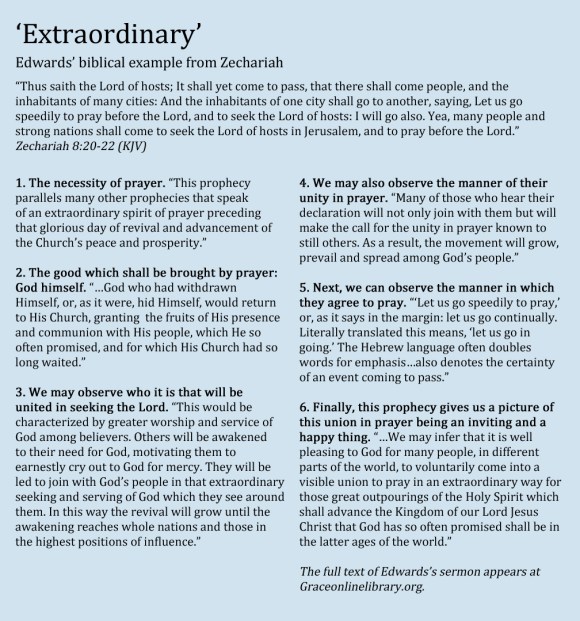
After his election as president of the Southern Baptist Convention, Arkansas pastor Ronnie Floyd has called Southern Baptists to prayer, but not just any prayer—extraordinary prayer. The phrase is not original to Floyd, as he stated from the start. It’s almost 300 years old.
Credit Jonathan Edwards, the Puritan preacher with poor eyesight who often read from a manuscript his most famous sermon, “Sinners in the Hands of an Angry God.”
Floyd adopted the term “extraordinary prayer” from a book by Edwards called “An Humble Attempt to Promote Explicit Agreement and Visible Union of God’s People, in Extraordinary
Prayer, for the Revival of Religion and the Advancement of Christ’s Kingdom on Earth, Pursuant to Scripture Promises and Prophecies Concerning the Last Time.” (Titling was not their strong suit in the 18th century.)
But what did he mean by extraordinary prayer?

Mission Illinois: A Concert of Prayer is the theme of the 2014 Annual Meeting of the Illinois Baptist State Association. For more information, go to IBSA.org/ibsa2014.
From Zechariah, Edwards drew a picture of prayer that would result first in revival of the church, then awakening and regeneration of lost people. “God’s people will be given a spirit of prayer,” Edwards wrote, “inspiring them to come together and pray in an extraordinary manner, that He would help his Church, show mercy to mankind in general, pour out his Spirit, revive His work, and advance His kingdom in the world as He promised.
“Moreover, such prayer would gradually spread and increase more and more, ushering in a revival of religion.”
Edwards offered an example he had witnessed personally. In 1744, a group of ministers in Scotland called on believers to engage in prayer. “They desired a true revival in all parts of Christendom, and to see nations delivered from their great and many calamities, and to bless them with the unspeakable benefits of the Kingdom of our glorious Redeemer, and to fill the whole earth with His glory.”
The group pledged to pray every Saturday evening, Sunday morning, and all day on the first Tuesday of each quarter—for two years.
During that time, many churches were renewed. In one town alone, 30 groups of young people formed and committed themselves to prayer for revival. Buoyed by the results, the ministers sent 500 letters to pastors in New England urging their own two-year commitment.
Edwards noted: “Those ministers in Boston said of this proposal: ‘The motion seems to come from above, and to be wonderfully spreading in Scotland, England, Wales, Ireland and North America.’”
And they extended the two-year pledge to seven years of prayer.
Edwards, who with George Whitefield and others, was at the heart of the First Great Awakening, cited prayer as vital to the movement of God’s spirit in the colonies.
 COMMENTARY | Eric Reed
With one week left in Pastor Appreciation Month, you may be wondering how to appreciate your pastor. What does he need? Or want?
Not a Bible. He has many Bibles on his shelves, and hundreds more on his phone.
Not a painting of Jesus, and certainly not on black velvet.
Maybe a suit, if only for funerals, but let him pick his own.
Not a trip. As a church member, I once gave a pastor and his family a gift certificate for a getaway weekend. The smile on his face said, “I’d rather have cash.”
As a pastor, the remembrances that blessed me most (in addition to the occasional love offering) were handwritten cards and letters. Once while I was on vacation, a deacon had the congregation fill a three-ring binder with thank-you notes. And another time, as the children’s classes presented me with a three-foot tall card they had drawn, a young woman in the choir loft exclaimed, “He’s gonna cry!” I did.
Ted Traylor of Olive Baptist Church in Pensacola, Florida, told a story that still chokes me up. Many years ago during a stormy season in his ministry, Traylor arrived home one night to find three deacons sitting on the curb. “Oh, no,” he thought. “Here it comes.”
“Pastor, remember when you preached on the mighty men of David?” one of them said, “How when David longed for water from home, they snuck across the battle lines and brought it to him?”
Traylor nodded.
“Well, we went to your hometown today and we talked with your parents.” It was a twelve-hour round trip.
The pastor was astonished to learn they had brought him a sapling native to North Alabama to remind him of home, even as he served hundreds of miles away. They fetched a jar of water from the clear mountain springs to remind him of the living water of Christ. And they delivered two large stones from the hillside ledge where as a teenager Traylor was called by God to the ministry. The men instructed him to place the rocks in his own garden and whenever he felt unsure of himself or his calling, to stand on them as a reminder that he stands on the Rock.
And the three mighty men pledged their personal support of their pastor and his ministry, whenever and wherever he needed them, “unless you do something illegal, immoral, or unethical—then we’ll take you out ourselves,” he remembered, smiling.
That’s what pastors want.
Eric Reed is editor of the Illinois Baptist and IBSA’s associate executive director, Church Communications team.


 iB2 News