Archives For November 30, 1999

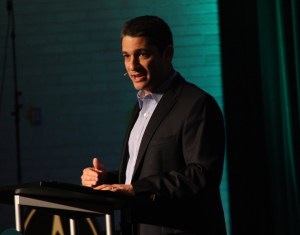
Afshin_Ziafat_2NEWS | It was an English tutor who first showed the gospel to Afshin Ziafat.

As a first grader, Ziafat, who now pastors Providence Church in Frisco, Texas, moved to the United States with his family from Iran. It was 1979, a bad year to be Iranian in America, Ziafat told his listeners at the Ethics and Religious Liberty Commission’s summit on racial reconciliation and the gospel.

Ziafat’s family left Iran during the Islamic Revolution. “We had no idea what kind of unrest we were about to walk into,” he said.

The ongoing hostage crisis involving American victims meant Ziafat’s new home—Houston, Texas—was a hostile place. Radio stations played a new version of the Beach Boys’ song about Barbara Ann: “Bomb, bomb, bomb…bomb, bomb Iran…”

Rocks were thrown at his family’s home, and his parents’ tires were slashed. Ziafat and his brother were threatened at school.

And when he was in second grade, his tutor—who had taught him English by reading him books—gave him a small New Testament.

“You’re not going to understand this today, Afshin, but promise me you’ll hold on to it and read it when you’re older,” she told him.

Ten years later, Ziafat accepted Christ.

“Had any other American given me that New Testament, I would have thrown it away,” Ziafat said in Nashville today. “Because I didn’t trust them.

“You want to win a Muslim for Christ, I believe you have to earn the right to be heard. And she did it by the way she was loving me.”

“There are many more Afshin Ziafat’s today than there were back then, in your neighborhoods,” he said, “and God is calling us to step out. Listen to me folks— especially at a time when it is expected for us to distrust and maybe even hate Muslims.”

Ziafat ended his testimony with the story of the prophet Jonah, who knew that God was calling him to go preach to Assyrians who were not only his enemies, but also would conquer his people. Jonah’s book ends with a question from God about the people the prophet was called to go to, Ziafat noted:

“Should I not pity them?”

“You never get the answer from Jonah,” Ziafat said. “You know why? Because I think that questions goes out for us today….And I’m telling you, friends, we answer that question with the way we live our lives.

“The gospel calls me to step out of my comfort zone and go out to people who don’t look like me, who don’t dress like me, who are not of my skin color, but on top of that, especially those who are my enemies. Who I am expected to hate? When I show them love, the gospel is revealed.”

Tony_EvansNashville, Tenn. | “Jesus reversed over 800 years of racial discord in 24 hours,” Tony Evans preached this afternoon at the ERLC’s Summit on the gospel and racial reconciliation.

Walking his listeners through John’s account of Jesus’ encounter with the Samaritan woman at the well, Evans, pastor of Oak Cliff Bible Fellowship in Dallas, made application to modern times:

Jesus met the woman on common ground, at Jacob’s well (John 4:6). “Jews didn’t like Samaritans, Samaritans didn’t like Jews, but since they both loved Jacob, that’s where he stopped,” Evans said. The Old Testament patriarch was viewed as the father of both Orthodox Jews, and the pariah Samaritans.

He didn’t hide who He was. The woman at the well knew Jesus was Jewish (John 4:9), even though he didn’t say it. But though he looked and talked like a Jewish man, Evans noted, he didn’t act like one to the woman, who other Jews would have viewed as an outcast. Nor did he try to be something he wasn’t.

God is not asking you to stop being different than you are to reach somebody different than you are, Evans said. He doesn’t want white people to be black or vice versa. “He’s asking both to be biblical.”

Jesus earned the right to deepen the conversation. “Because he was willing to drink out of her cup” at the well, Evans said, “he has now earned the right to take a normal discussion about water and turn it into a discussion about eternal life” (John 4:13-14).

Jesus was about his father’s business. Father God plays an integral role in the story of the woman at the well. The conversation changed when the Samaritan woman brought Him up, trying to change the subject when Jesus reveals he knows her current situation (John 4:19-20).

Jesus uses the opportunity to show her what she’s always known to be true about her history, her background, and her identity isn’t, in fact, true. Jesus’ words apply to the racial absolutes we live by too, Evans inferred.

“Black is only beautiful when it’s biblical, and white is only right when it conforms with holy writ,” he said.

Many more Samaritans believed in Jesus because of the woman’s testimony, John writes. How can the reversal detailed in the story happen in just 24 hours, Evans asked. Because Jesus was about his father’s business.

Watch the Summit online at live.erlc.com.

Nashville, Tenn. | Racial reconciliation is the main topic of the Ethics and Religious Liberty Commission’s 2015 Leadership Summit, which starts today at 1 p.m. The Illinois Baptist is in Nashville covering the event, which today includes plenary sessions on:

  • Why racial reconciliation is a gospel issue
  • Ferguson, Eric Garner, and your community
  • Key issues in racial reconciliation: Poverty, fatherlessness, criminal justice and urban ministry

Tonight, ERLC President Russell Moore will interview civil rights leader John Perkins, and speakers Danny Akin and H.B. Charles will explore how racial reconciliation is shaped by the gospel and the Great Commission. The evening session will conclude with a panel discussion on the church and multi-ethnic ministry.

The Summit was originally scheduled to focus on pro-life issues, but unrest in Ferguson, Mo., and other U.S. cities caused ERLC leaders to change the topic. “Racism and injustice are not just social ills; they are sins against God,” Moore said last year.

“This summit will help equip us to tear down carnal divisions, to bring about peace, so that churches reflect the kingdom of God.”

LifeWay Research has found that while 86% of Protestant senior pastors have congregations with one predominant racial group, only 40% of American churchgoers believe their church needs to become more ethnically diverse.

Check back here for news from the Summit, and in the next issue of the Illinois Baptist.

THE BRIEFING | Meredith Flynn

Amid continuing tension in Ferguson, Mo., church members will engage in a block-by-block outreach initiative to promote relationships–and healing–in the St. Louis suburb rocked by violence and protests since the shooting of teenager Michael Brown last August.

The_BriefingJose Aguayo, a Ferguson pastor and chaplain with the Billy Graham Evangelistic Association, will lead the effort to send out teams of church members tasked with getting to know residents on their assigned block. Eventually, Aguayo told Baptist Press, ministries resulting from the outreach could include “sports teams, community outings and study assistance for children and adults.”

First Baptist Church in Ferguson, led by Pastor Stoney Shaw, is one of the churches participating. He told The Pathway newspaper in Missouri, “We want to join with other churches and minister. Walking the streets and praying is a simple yet powerful plan.” Read more at BPNews.net.


In other news from Ferguson, Christianity Today reports on a dialogue between Franklin Graham and other Christian leaders. Graham, CEO of Samaritan’s Purse and the Billy Graham Evangelistic Association, posted March 12 on his Facebook page, “Most police shootings can be avoided. It comes down to respect for authority and obedience.” (Read the entire post here.) But according to a group of 31 Christian leaders who wrote an open letter to Graham, the issue is often more complicated.


Family is the most central factor in how Americans identify themselves, Barna found in a new study, followed by being an American at #2, and their religious faith at #3. But the answers change, depending on how old you are.


On the day marking the Iranian New Year, President Obama issued a statement calling for the release of Pastor Saeed Abedini, who has arrested in the country in 2012. “Saeed Abedini of Boise, Idaho has spent two and a half years detained in Iran on charges related to his religious beliefs,” Obama said. “He must be returned to his wife and two young children, who needlessly continue to grow up without their father.” Read more at ChristianityToday.com.


Texas Senator Ted Cruz spoke about Christianity and liberty at Liberty University in Lynchburg, Va., where he also announced he will run for President in 2016. Jerry Falwell, Jr., president of the Christian university, introduced Cruz but was careful to note Liberty was giving the candidate a platform rather than endorsing him, The Christian Post reported.


More than $2.5 billion is wagered on the annual March Madness basketball tournament, according to the FBI. But Christians would be wise not to throw any money in the pot, says Barrett Duke, a vice president for the Ethics and Religious Liberty Commission. Read the full story at BPNews.net.

COMMENTARY | Nick Rynerson

“Pop culture” is often treated like a dirty word in the church—thought to consist of mostly irredeemable entertainment produced to make money off the masses. A common approach is to avoid secular music, films, art, and television, or at least to not admit to consuming it all that much.

But that isn’t often what our real lives look like. Most of us are at least closet pop culture consumers—we indulge in one or two sitcoms, a favorite secular radio station, or a superhero movie every now and then.

And maybe that’s okay.

Nick_Rynerson_March15Popular culture is not the enemy; first and foremost, pop culture is a place for storytellers to, well, tell stories. Moral discretion is important. (And biblical! See 1 Corinthians 8:7-9.) But we miss a wealth of spiritual and theological depth if we chalk up all entertainment created by non-Christians as irredeemable and misguided; we also miss out on the opportunity to identify and empathize from a distinctly Christian perspective (Acts 17:28).

Stories offer us insights into our culture’s longings, revealing God’s truth in the world around us. In his excellent book “The Stories We Tell,” Kentucky pastor Mike Cosper reminds us that a story is never just a story—it’s a window into our culture’s imagination and longings (see Romans 2:12-15).

“Storytelling—be it literature, theater, opera, film, or reality TV—doesn’t aim at our rational mind . . . It aims at the imagination, a much more mysterious and sneaky part of us, ruled by love, desire, and hope,” Cosper writes. “When people, against their better judgment, find themselves hooked on a show, we can trace the line back to find the hook in their imagination.”

Stories, according to Cosper, can reveal much more about a person, people group, or culture than a strictly informative presentation or a list of facts. Stories communicate what people truly desire.

Take, for example, a certain Best Picture nominee from last year. The movie contains some strong language, an ambiguous ending, and other elements that might lead some Christians to believe that it has nothing to offer spiritually (and for some to wisely not engage the film). However, if we look closer, we can clearly see some distinct things the storytellers—the director, writer, characters, etc.—believe about God, life, and themselves.

Without spoiling the film, which centers on the relationship between a talented young jazz drummer and his demanding/abusive instructor, the characters have a very human desire: to be great. The devotion of the characters to the pursuit of greatness, and its sway over their future happiness, is deeply identifiable. Like the Tower of Babel in Genesis 11, the characters sacrifice their life for the pursuit of self-glory, predictably leaving themselves and others miserable.

Ever since the Fall, man has been trying to claw his way back to perfection. Everybody longs for his or her flaws to be taken away, and many of us think that if we just work hard enough, we will reach the promised land of perfection.

As Christians, we know this is vanity (Romans 3:23), but the characters in the film sacrifice their lives and their sanity to meet every iota of their own personal law. This pursuit is hardwired into us and until we find personal and entire perfection in Christ, we will always fall short.

That’s serious, biblical truth, communicated (probably unknowingly) in a 2-hour movie produced with a secular audience in mind. The next time a movie, song, or TV show comes on that you are tempted to write off as irredeemable, consider if it might have something to teach us about God, the creator of all things.

In Acts 17:22-27, Paul not only quotes Greek poetry, but also alludes to the radical truth that we’re put where we were (i.e., in our cultural context) to speak eternal truth into subjective cultural contexts. In his book, Cosper uses this example to illustrate a distinctly Christian way of story-listening.

“As Christians living in the midst of these stories, we have an opportunity to both learn and bear witness. Stories teach us a lot about ourselves and our neighbors, and they provide windows into how our world is wrestling with the effects of the fall.

“They also present opportunities to respond with the truth.”

Nick Rynerson is a staff writer for Christ and Pop Culture and works for Crossway in Wheaton.

THE BRIEFING | Meredith Flynn

After two police officers were shot March 12 in Ferguson, Mo., chaplains from the Billy Graham Rapid Response Team were back in the community where they served six weeks last year.

“It is not possible to solve a community’s deep-rooted problems with a team of chaplains deployed for six weeks, and we knew that before we started,” Billy Graham Association President Franklin Graham said then, according to a story on billygraham.org. “But God used the chaplains to touch many hearts and to plant fruitful seeds in the community.”


The_BriefingLawmakers in Tennessee proposed legislation in February that would make the Bible the official state book. Not surprisingly, some opponents say such an action is unconstitutional. But Rep. Jerry Sexton (R-Bean Station), who introduced the bill in the House, said the action recognizes the Bible’s “historical importance.”

“The Bible has certainly had a pivotal role in the history of our state as well as our nation,” Sexton told the Baptist & Reflector newspaper. “The Bible also plays a significantly important role in our state today with several companies in Nashville being responsible for publishing more Bibles than possibly any other city in the world.”


68% of evangelicals say Congress should act on immigration reform this year, according to a new survey by LifeWay Research. Other findings: 86% say reform should secure U.S. borders, and 61% say it should include a path to citizenship for undocumented immigrants.


The Christian Post reports San Francisco’s largest evangelical megachurch will no longer require celibacy from gay people desiring to be members of the church. “We will no longer discriminate based on sexual orientation and demand lifelong celibacy as a precondition for joining,” Senior Pastor Fred Harrell wrote in a letter on behalf of the church’s elder board. “For all members, regardless of sexual orientation, we will continue to expect chastity in singleness until marriage.”


In honor of today, check out this 2009 post from Russell Moore on “what evangelicals can learn from St. Patrick.”


COMMENTARY | Lisa Sergent

Recently, I’ve had several opportunities to talk in IBSA meetings about “modern families” in our communities. I often ask the group I’m speaking to if they know anyone who is gay. Some say no, but others, especially younger people, begin to tick off a list.

And a fair number choose to say nothing. They appear uncomfortable. But then, aren’t we all?

When we hear about a florist being sued for declining to provide services for a same-sex wedding, or former megachurch pastor Rob Bell telling Oprah the church is just “moments away” from accepting gay marriage, our heads spin. We’ve come a long way from the early 80s when we were trying to figure out if singer Boy George was indeed a boy.

As I share how the Illinois Baptist newspaper has covered the rapidly changing marriage culture in Illinois, I tell how I’ve met same-sex couples at the Capitol eager to be married. I mention a former high school classmate who came out on his Facebook page. In my own extended family, a second cousin recently married his longtime companion/partner.

After the presentation, there are always a few people who come up and share with me in hushed tones about a family member or friend who has announced he or she is gay. They whisper how they are struggling with this knowledge. They want to minister to these loved ones but don’t know how. And they’re afraid to bring it up at church. They’re worried about how they will be looked at by fellow church members. On some level, there is a fear of guilt by association.

As the culture changes around us, we have to seek guidance from God’s Word, and be Christ-like in our actions. People are trapped in sin and are hurting, even if they don’t recognize it themselves. As a result, people in our churches are hurting for these friends and relatives.

But they keep silent.

We need not only to minister to homosexuals, but also to the friends and family members who love them. Figuring out how to minister to people who hurt, whatever the source, can’t be avoided.

While the church is trying to balance Christ-like outreach to people who are gay with biblical truth about their lifestyle, we can’t forget the Christian aunts, cousins, grandmothers and parents who are wrestling with the same tension. We need to create an environment in church where the relatives are free to talk about their struggle and receive biblical, loving counsel, so that they can in turn minister to their loved ones.

We’re way past the time for keeping quiet.

Lisa Sergent is director of communications for the Illinois Baptist State Association, and contributing editor of the Illinois Baptist newspaper.

NEWS | Eric Reed

Admittedly, the numbers are not great. But the tally of the 2014 Annual Church Profiles filed by IBSA churches shows the need in Illinois is growing, and the recent call to prayer for spiritual awakening is on target.

“The job is getting harder, the climb is getting steeper, the leaders are getting fewer—but the challenge is no less important,” said IBSA Executive Director Nate Adams prior to the report presented to the IBSA Board in its March meeting. In fact, the challenge grows, as does Illinois Baptists’ responsibility in our large and significant mission field.

The 2014 ACPs, completed by 95% of IBSA churches, showed declines in several areas including worship attendance (-10.5%), baptisms (-11%) and Sunday school/Bible study participation (-1.5%).

Adams expressed concern about the declines, especially in baptisms, which had increased in recent years. “The actual decline is about 3.4%” when comparing churches that reported in both 2014 and 2013. Several churches that reported baptisms in 2013 were “non-cooperating” in 2014, therefore their tallies were not included in the ACP tally.

Despite wintry weather, the IBSA Board met March 3 in Springfield, where Sandy Barnard (below) was honored for 30 years at IBSA.

Despite wintry weather, the IBSA Board met March 3
in Springfield, where Sandy Barnard (below) was honored for 30 years at IBSA.

Sandy_Barnard_0316

While total missions giving through the Cooperative Program was down slightly year-to-year, from $6.34 million to $6.1 million, the average percentage of undesignated offerings given by Illinois churches held steady from 2013 to 2014 at 6.8%. The national average was 5.5% in 2013, up from 5.4% the year before and marking the first upward tick in over 30 years.

The Board approved a plan to draft the 2016 IBSA budget based on projected CP giving of $6.4 million, and to hold the Illinois/national SBC split on Cooperative Program offerings at 56.75/43.25%. Gifts above the hoped-for goal will be shared evenly by IBSA and the national SBC at 50/50.

Four goals for 2016 were recommended by the board’s strategic planning committee and approved. They will guide planning for IBSA’s work next
year, with a focus on the development of leaders who grow healthy, evangelistic, reproducing congregations. Some goals may seem beyond our capability, said committee chairman Larry Wells, “but God can do it all through his people who pray and who work diligently for the kingdom.”

Adams explained the new focus on leadership development in his report to the Board, citing attendance of more than 300 Illinois church leaders at the January 20-22 Midwest Leadership Summit in Springfield as evidence of interest in, and hunger for, training and coaching. “I think we have such a long way to go in true, deep leadership development,” Adams said. “We’ve come a long way, but we have much more to do.”

Adams pointed to deployment of eight part-time zone consultants across the state and the work of the new Church Resources Team creating new conferencing opportunities and learning cohorts as ways IBSA is focusing on growing effective church leaders.

Board members braved a winter storm to attend the March 3 meeting, with some traveling icy roads in Central Illinois to handle state association business. That raised the question whether such meetings can be joined by telephone or over the internet. With 27 members present, a quorum was easily reached, so the meeting proceeded. A similar question about long-distance electronic participation in board and committee meetings was raised at the IBSA Annual Meeting in November. Board chairman Chip Faulkner reported the issue is presently under consideration.

The Board welcomed seven new members: Steve Hardin of Roland Manor Church in Washington, Curt Lipe of Faith Church in Galesburg, Scott Nichols of Crossroads Church in Carol Stream, Jay Simala of New Song Church in Zion, Sammy Simmons of Immanuel Church in Benton, and Daniel Wilson of Grace Church in Granite City.

For 30 years of service to Illinois Baptists, Executive Administrative Assistant Sandy Barnard was honored with a standing ovation, a gift, flowers, and cake. (Later, she was seen cleaning up after the party.)

Cathy Waters was recognized for 10 years’ service. She was recently promoted to the position of Ministry Coordinator for the Church Resources Team, organizing large events and conferences.

Eric Reed is editor of the Illinois Baptist newspaper and IBSA’s associate executive director for the Church Communications Team.

THE BRIEFING | Meredith Flynn

While 30% of the Millennial generation say going to church isn’t important at all, 30% also say church attendance is very important. And 40% are in the middle. The reasons why vary, as detailed in research by Barna Group. Among all Millennials, the researchers found, 66% say American churchgoers are judgmental, and 44% believe it seems like an exclusive club.

Better news: 65% say church is a place to find answers to live a meaningful life.


A Peoria, Ill., woman committed to wear a traditional Muslim head covering during Lent in order to “remember what it feels like to be an outsider.” “People end up grouping all Muslims with extremists. I want to remember that people are individuals, and so by doing this I’m remembering to welcome and include people no matter what they look like,” Jessey Eagen told The Christian Post.


Phyllis Sortor, a missionary with the American Free Methodist Church who was kidnapped in Nigeria in February, has been released, The Christian Post reports. “It appears she was kidnapped by a criminal gang, and there is no evidence this event is associated with terrorism or religion,” said David W. Kendall in a news release from the denomination’s Board of Bishops.

Sortor’s kidnappers originally demanded $300,000 for her release, the details of which will not be discussed publicly, Kendall said.


Franklin Graham, son of famed evangelist Billy Graham and president and CEO of the Billy Graham Evangelistic Association, told Fox News on Sunday, “I believe we’re going to see persecution in this country. We’ve already seen many laws that have been passed that restrict our freedom as Christians.”


The Washington florist who came under fire for refusing to provide services for a same-sex wedding said she would hug her accuser if he walked into her shop. “The same faith that tells me that I can’t be a part of Rob’s wedding is the same faith that tells me to love him as Christ does,”

Barronelle Stutzman told Baptist Press. The 70-year-old Southern Baptist church member was found guilty last month of violating her state’s non-discrimination law. She is appealing the verdict.


Fanny_CrosbyHEARTLAND | Steve Hamrick

February marked the 100th anniversary of the death of one of America’s greatest hymn writers and poets, Fanny J. Crosby. Frances Jane van Alstyne (née Crosby), lived nearly 95 years, from March 24, 1820, to February 12, 1915.

At six weeks old, young Francis developed an inflammation in her eyes that was treated with a mustard poultice, a common treatment of the 19th century. Whether because of the mustard or a congenital condition, blindness resulted. But it rarely affected her attitude. She was known in early years as the “happy little blind girl.”

Her first attempt at verse at age eight shows her outlook.

Oh, what a happy child I am,
Although I cannot see
I am resolved that in this world
Contented I will be

The attitude of God’s gratefulness continued as a theme throughout her life. “When I get to heaven,” she once said, “the first face that shall ever gladden my sight will be that of my Savior.”

It is estimated that Crosby wrote more than 8,000 hymns, with over 100,000,000 (that’s one hundred million) copies in print. Many of her hymns include references to sight and light. Notice the insight of one of her most well known songs, “Blessed Assurance”:

Perfect submission, perfect delight,
Visions of rapture now burst on my sight;
Angels descending bring from above
Echoes of mercy, whispers of love.

In addition to her hymns, Crosby published more than 1,000 secular poems, four books of poetry and two best-selling autobiographies. Most don’t know that she also wrote a number of popular and patriotic songs of her day.

During her long life she had the honor of reading her works in front of the U.S. Senate, Congress, and before many U.S. presidents, including John Q. Adams and James Polk; she also was dear friends with Grover Cleveland.

Despite being one of the most popular personalities of the 19th century, Crosby’s most rewarding work during her lifetime was her service to rescue missions. She dedicated her life in serving the poor, immigrants and less fortunate. During her years as a mission worker she wrote, “Pass Me not O Gentle Savior,” “More Like Jesus,” and “Rescue the Perishing.”

Her songs are still sung by churches around the world. Thousands of arrangements have been set for choirs, orchestras and praise teams. The band Caedmon’s Call recently recorded “Draw Me Nearer” (I am Thine O Lord) using one of Mrs. Crosby’s best texts. The words tell her story well:

I am thine, O Lord, I have heard thy voice,
And it told thy love to me;
But I long to rise in the arms of faith
And be closer drawn to thee.

Steve Hamrick is IBSA’s director of worship and technology.