Archives For November 30, 1999

THE BRIEFING | Meredith Flynn

After an unarmed man was shot and killed by a South Carolina police officer, urban ministry strategist D.A. Horton advocated “radical righteousness” instead of retaliation.

The_Briefing“Radical righteousness is lived out when we work to see a criminal receive proper punishment, instead of private revenge; public order instead of personal retaliation; and respond with practical righteousness in place of our personal rights,” said Horton during a chapel service at Charleston Southern University April 8. The North American Mission Board’s national coordinator for urban student missions said the church must pursue the “radical righteousness” Jesus prescribed in Matthew 5:38-42, according to Diana Chandler’s report for Baptist Press.

“I was not present for Mike Brown [in Ferguson, Mo.], for Tamir Rice [in Cleveland, Ohio], for Eric Garner [in New York City], for Ezell Ford [in Los Angeles] and for the multitude of names that have been going down. I wasn’t there when the officers got gunned down in Brooklyn,” Horton said.

“… But what I do know as a believer, there was a real world with real hurt. There [are] real issues going on out there. And if believers cannot look to the words of Christ, and be words of comfort and clarity to our culture, then we don’t need to be claiming to be the church.”


The American Humanist Association has dropped its lawsuit against a New Jersey school district, allowing students to continue saying “under God” during the Pledge of Allegiance. Read the full story at ChristianPost.com.


A prayer written by Southern Baptist pastor Jack Graham will be read around the country on May 7, the National Day of Prayer. Graham is a former president of the Southern Baptist Convention and current pastor of Prestonwood Baptist Church in the Dallas metro area.

“We repent of our sins and ask for Your grace and power to save us,” says Graham’s prayer, which will be read at Day of Prayer celebrations. “Hear our cry, oh God, and pour out Your Spirit upon us that we may walk in obedience to Your Word. We are desperate for Your tender mercies. We are broken and humbled before You.”


The Ethics and Religious Liberty Commission is urging Christians to promote an April prayer emphasis with the hashtag #PrayforMarriage. Last week, the Southern Baptist ethics entity issued a challenge to pray at 10 a.m. (Eastern time) on April 28, the morning the Supreme Court is scheduled to hear oral arguments in several same-sex marriage cases. The web page ERLC.com/article/prayformarriage includes a sample prayer guide.


A majority of Americans believe politics would be more civil and effective if politicians read the Bible more. Read more in Christianity Today’s report on the 2015 State of the Bible study from the American BIble Society.


More news from the State of Bible report: Of the nearly 7,000 languages used as first languages, more than half lack a completed Bible translation. At the same time, 72% of Americans believe the Bible is available in all the world’s languages. Read more at Barna.com.


By the year 2050, Pew Research has forecasted, 38% of the world’s Christians will live in Sub-Saharan Africa. Meanwhile, Europe’s share of the global Christian population will continue to decline, from 66% in 1910, to 26% in 2010, to 16% projected for 2050.

Rochelle_recovery_1

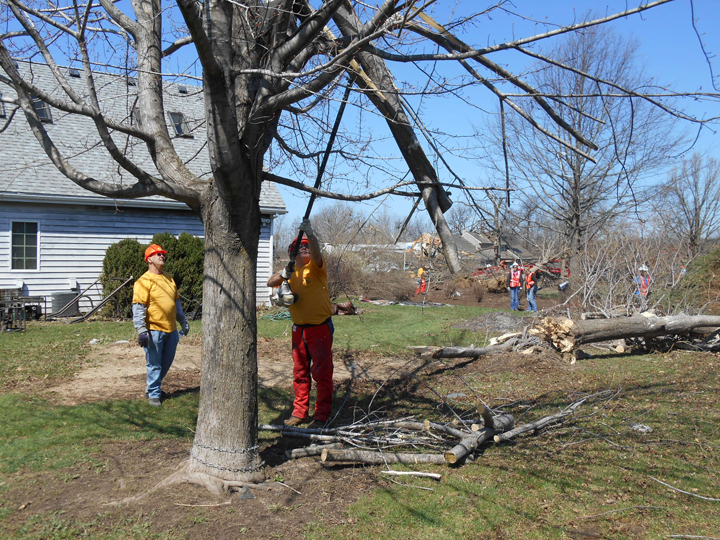
Illinois Baptist Disaster Relief volunteers worked over the weekend at three homes in Rochelle, Ill., one of the northern Illinois communities hit by a tornado April 9.

By Lisa Sergent

Rochelle, Ill. | Illinois Baptist Disaster Relief volunteers were busy Saturday removing trees and limbs downed by last week’s tornadoes in northern Illinois.

Chainsaw teams from four associations of churches—Fox Valley, Quad Cities, Sinnissippi, and Three Rivers—worked at three homes in the town of Rochelle, where 45-50 homes were damaged April 9.

Rex Alexander, Disaster Relief Coordinator for the Illinois Baptist State Association, said the response to the disaster was “almost overwhelming.”

“Streets were clogged with the cars of volunteers and the owners of damaged homes were inundated with volunteers and disaster relief teams from all over the state, as well as from other states. One home across the street from our team had over 50 volunteers working with them,” he noted.

Alexander said the town of Fairdale has not yet been opened to volunteers, but he is continuing to monitor the situation for future opportunities. However, he doesn’t expect there to be much work for IBSA volunteers to do. “If your house has been downed and is gone, you don’t go cut up trees.” The EF-4 tornado that hit Fairdale reportedly affected every home or structure in the unincorporated community—40 to 50 buildings. Two people were killed during the storm.

Rochelle_recovery_2For the response in Rochelle, Alexander wanted to publicly acknowledge the assistance of Brad Pittman, pastor of Grace Fellowship Church in Davis Junction. “He gave us most of his day on Friday and introduced us to homeowners he knows in the area that we were able to go in and help.”

Many recent disaster relief callouts have been in the southern part of the state. Alexander said this callout “was a good opportunity for northern teams to work in their own backyard.”

The Illinois teams finished their work Saturday afternoon.

A disaster relief training weekend is scheduled this Friday and Saturday, April 17-18, at Streator Baptist Camp. Online registration is closed, but anyone interested in participating can call Alexander’s ministry assistant, Alexis Dumire, to register over at (217) 391-3142.

The Illinois Baptist State Association has nearly 1,000 Southern Baptist member churches and missions in Illinois. IBSA’s main office is in Springfield and it was established in 1907. Southern Baptists operate the nation’s third-largest disaster relief organization, behind only the Red Cross and Salvation Army. To learn more about IBSA Disaster Relief, visit http://www.IBSA.org/dr.

Rochelle_recovery_3

Diana_Davis_blog_calloutEditor’s note: Diana Davis is an author, columnist and minister’s wife. This column appeared in the April 6 Illinois Baptist. Visit Diana’s website at http://www.dianadavis.org.

HEARTLAND | Diana Davis

When a first-time guest completes a guest registration card at your church, what happens next? The most common answer to that question: absolutely nothing. No, it’s not an intentional oversight, but without an ongoing, immediate follow-up plan, your church may miss the opportunity to reach guests for Christ and include them in your church family.

Need fresh ideas? Tweak some of these to fit your unique church:

First-time guest online survey. People love to give an opinion! Create a brief survey on your church’s website. (See a sample survey at dianadavis.org) Carefully study survey responses.

Same-day contact. A specially trained volunteer makes a brief phone call to each guest on Sunday afternoon after they visit your church.

E-mail and/or snail mail. Assign volunteers to send a swift, personal email or card to each first-time guest.

Small group personal invitation. Provide contact info to an appropriate small group or Sunday School class for each family member. A member of that small group may offer to meet the guest at a specific door to escort them to class the next time they visit.

Coffee, anyone? An Indiana church delivers three coupons for a free drink in their coffee area, encouraging the guest to return for three consecutive Sundays. In a different church, volunteers deliver a church coffee mug to the guest’s door before they get home from church.

Pastor’s letter. Many pastors prepare a warm letter or e-mail to welcome first-time guests; some even jot a handwritten note. Pastor Ted Traylor at Olive Baptist, Pensacola, often texts or phones first-time guests on Saturdays, inviting them to come back on Sunday.

Notice that church members—not just ministry staff—accomplish the majority of follow-up. Newcomers want to hear what you love about your church. They desire relationships, and relationships provide evangelistic opportunities.

When God brings a first-time guest to your church this Sunday and they complete a guest registration card, what will happen next?

“The harvest is abundant…pray to the Lord of the harvest to send out workers into His harvest” (Luke 10:2).

COMMENTARY | Mark Coppenger

Mark_CoppengerIn late February, I was in St. Louis for a meeting of the American Philosophical Association, a trip connected with my work as an apologetics prof at Southern Seminary. I figured that since I was in the area, I would visit the suburb of Ferguson, recently aflame on international news.

I was surprised at a number of things: that the city had not been reduced to Beirut, but that the vast majority of buildings were unscathed, and business alive; that the Indians who ran the store Michael Brown robbed would speak freely of the incident; that a chain fence with hundreds of inscribed streamers spoke promise more than anger, e.g., “The sky’s the limit.”

But my big Ferguson moment came at the downtown meeting, where the philosophers devoted a three-hour session to the riots. After attending presentations of other papers, I was able to make the last hour of the panel discussion. There I heard unrelenting disdain for the city and police and an unbroken strain of lament for the victimhood of Brown. And the moderator was fielding audience jeremiads without rebuttal.

When one of the panelists asked what philosophers might bring to the table, I raised my hand to suggest that we could use more Socratic give-and-take instead of the “groupthink” I was hearing. I also said that I could tell my grandson (who is white) in an affluent suburb of Nashville to expect very bad things to happen to him if he ever shoplifted, manhandled the clerk, or menaced a policeman who confronted him. My comments were not well received.

Look, anybody whose been the victim of a speed trap or addressed with gratuitous surliness by a cop has had at least a small taste of what blacks were protesting in Ferguson. The Department of Justice report pictured a sorry system of fine-doubling and a virtual debtor’s prison for some, policies that fell particularly hard upon poor blacks.

Of course, there’s a school of thought that says I have no right to speak a word of judgment on Brown or the rioters since I’ve not suffered the indignities of systemic racism, etc. But we face that sort of argument all the time in ethics. During the Vietnam War, they told us we had no right to judge Lt. Calley for the My Lai massacre since we hadn’t shared the horrors of infantry combat in Quang Ngai Province.

Similarly, we’re told we guys have no business telling a woman she has to carry a child to term since we never have to endure unwanted pregnancy. On it goes, whether you’re trying to bring a biblical word to bear on divorce and remarriage, homosexuality, or tithing. Of course, this makes ethics a joke, since feelings and testimonies of victimhood can trump standards at every turn.

One side says you really can’t make the call until you’re in their shoes. The other side says that “in their shoes” is often a bad place to make the call, since you may well be addled by the hurly burley of trials and emotions. This turns into a game of self-serving story telling, a war of anecdotes, when what we need is dispassionate moral clarity.

It is far better to sort things out, Bible in hand in your armchair or prayer closet, before descending into the chaos.

Reflecting on Ferguson, I’ve returned to Galatians 3:28: “There is neither Jew nor Greek, there is neither bond nor free, there is neither male nor female: for ye are all one in Christ Jesus.” This is essentially a salvation passage, one that feminists have tried to press into service against male leadership in the church and home. I hope I’m not joining the ranks of Scripture twisters in quoting it to stand up for universal standards of Christian morality, where all are subject to biblical guidelines, no matter how exalted or degraded their circumstances may be.

In Amos 7, God hangs moral plumb line beside the culture, and I think that color-blind Galatians 3:28 does the same thing.

Mark Coppenger is professor of apologetics at Southern Baptist Theological Seminary. He was formerly president of Midwestern Seminary in Kansas City, and founding pastor of Evanston (IL) Baptist Church.

THE BRIEFING | Meredith Flynn

The uproar over Indiana’s Religious Freedom Restoration Act continued as lawmakers introduced changes to the bill that opponents say put business owners at risk to be forced to compromise their beliefs.

The original RFRA, signed into law March 26 by Gov. Mike Pence, came under national fire from corporations, celebrities, and others who said it would allow discrimination against gay people. Supporters of the law said it would protect the religious liberty of business owners by shielding them from government action if they refused to provide services for same-sex weddings.

The_BriefingThe changes to the law, signed by Pence one week after he approved the original RFRA, say “no member of the public may be refused services by a private business based on sexual orientation or gender identity,” Baptist Press reports.

The controversy, wrote Philip Bethancourt of the Ethics and Religious Liberty Commission, has served to make religious liberty “a new culture war wedge issue.”

“One indication of this change is the frequent use of ‘religious freedom’ in scare quotes, suggesting that it is merely a cover for something more malicious,” Bethancourt wrote on ERLC.com. “Danger arises when our first freedom becomes a second-class culture war issue.”


Christians in Kenya grieved on Easter Sunday for 148 people killed at a university last week by terror group al-Shabaab. The Associated Press reported on the Easter service at Our Lady of Consolation Church in Garissa, where Bishop Joseph Allessandro said, “We join the sufferings of the relatives and the victims with the sufferings of Jesus. The victims will rise again with Christ.”

During the April 2 terror attack at Garissa University College, the shooters separated Christian students from Muslims and killed the Christians, AP reported.


What do Americans believe about Jesus? According to new research by Barna, most say he was a real person, a little over half believe he was God, and 62% say they have made a personal commitment to him that is still important in their life today.


And what about the church? LifeWay Research found that while 55% of Americans say the church in America is declining, 65% believe attendance is admirable.


More interesting research: Pew says current trends forecast that Muslims will almost equal Christians in number by 2050, and the global percentage of “nones” who have no religious affiliation will actually decrease.


“We’ve got a long way to go” on race relations, said Ethics and Religious Liberty Commission President Russell Moore at a March summit on racial reconciliation and the gospel. “Our sin keeps wanting us to divide up. But to the faithful, Jesus promises, ‘You will be called overcomers.’” Read the Illinois Baptist‘s coverage of the summit here at ib2news.org.


Did you catch the premiere episode of “A.D.: The Bible Continues” on Sunday? Christianity Today is recapping each installment of the new miniseries produced by Mark Burnett and Roma Downey, which details the history of the early church following Jesus’ death and resurrection.

Editor’s note: This is part 2 of the Illinois Baptist’s coverage of a recent summit hosted by the Ethics and Religious Liberty Commission on racial reconciliation and the gospel. Read part 1 here.

Layout 1

Read the April 6 edition of the Illinois Baptist at http://ibonline.IBSA.org.

NEWS | If Southern Baptists are to be serious about Jesus’ Great Commission to make disciples of all peoples, said historian Matt Hall, they need to honestly think through where they’ve come from. Hall, Southern Seminary’s vice president for academic services, spoke in a video message about the SBC’s history with slavery, racism, and segregation during a March summit hosted by the Ethics and Religious Liberty Commission on racial reconciliation and the gospel. (The Convention was formed over a divide between Baptists in the North and those in the South who wanted to continue owning slaves.)

Hall also led one of the summit’s panel discussions, joined onstage by Moore, Philadelphia pastor K. Marshall Williams, SBC Executive Committee President Frank Page, and past SBC President Fred Luter.

Understanding the SBC’s past ought to inform how we address racial issues now, Moore said. The divide over slavery “really was a justification for evil and for wickedness,” he said.

“Which, to me, ought to cause us not so much to look back and say, ‘Weren’t they evil and weren’t they wrong?’ as much as it ought to cause us to look back and to say, ‘Look at these people who knew their Bibles, and who were preaching their Bibles, and who were trying to gather up money for world missions, and yet were not able to see this glaring and wicked sin and unrighteousness and injustice that they were part of.’

“That ought to not give us a sense of our superiority to them; it ought to give us a sense of humility to say, ‘If these people who knew their Bibles like this, could get this that wrong on an issue that is so basic to what Scripture is teaching, then we need the mercy and the power of God.’”

IBSA African American Church Planting Strategist Ed Jones has faced the obstacle of the SBC’s history, he said. Some African Americans have told him, “I don’t necessarily want to be part of the Southern Baptist Convention because of its past,” he told the Illinois Baptist during the summit. The Nashville meeting was an opportunity to tackle those issues head-on and bring things into the open.

Luter said the Convention’s history resulted in one question asked by every person who interviewed him in the months before his election: Why would a black man want to be president of the SBC? Frankly, he didn’t know much about the Convention’s history when he went from street preacher to pastoring New Orleans’ Franklin Avenue Baptist Church almost 30 years ago. A couple of years into his pastorate, several of his older church members suggested Franklin Avenue leave the SBC.

“…There’s nothing we can do about our past,” was Luter’s response. “But there’s a whole lot we can do about our future.”

Luter was on the SBC Resolutions Committee that in 1995 proposed a resolution adopted by Convention messengers apologizing “to all African-Americans for condoning and/or perpetuating individual and systemic racism in our lifetime,” and repenting “of racism of which we have been guilty, whether consciously or unconsciously.”

The applause and tears that accompanied his election as SBC president made June 19, 2012, “one of the greatest hours in the life of the Southern Baptist Convention,” Luter said as people in the Nashville auditorium clapped too. “My only concern is that hopefully it’s not the last time.”

“That’s where the real test is,” said Moore. “We’ve got the pictures of the presidents of the Southern Baptist Convention over there. Let’s come back in 20 years and if Fred Luter is an island in a sea of middle-aged white guys, that’s means that we have not been where we need to be.”

Can we keep the ‘beast feast’?
H.B. Charles was in the middle of a potential church merger when he was asked that question about a long-held tradition. Charles’ largely African-American church, Shiloh Metropolitan Baptist in Jacksonville, Fla., was considering combining with largely Anglo church across town. One member of that congregation was most concerned with whether Charles as pastor would let them keep their annual wild game dinner and evangelistic outreach, known as the “beast feast.”

“He looked at me and said, ‘Pastor, I know you’ll agree with me, that if one redneck comes to Jesus, it’s worth it all.’ And in that moment,” Charles said, “I just had a feeling everything was going to be all right.”

The summit’s lightest and most practical moments came when practitioners like Charles explained what racial reconciliation looks like in a church setting. Josh Smith, pastor of MacArthur Boulevard Baptist Church in Irving, Tex., experienced a similar would-be culture clash when a woman at his increasingly diverse church brought a tambourine to play during worship, and during his sermon.

Smith and his team decided the next day they would allow the tambourine playing during the worship, but not during the message. He explained their thoughts to the woman, who’s still at the church six years later. “It was a lot of those hard conversations,” Smith said of the church’s transition to be more diverse, “and I just felt like it was not as much from the pulpit as interpersonal conversations.”

Sometimes, unity is a matter to preach about, as Adron Robinson found when he became pastor of Hillcrest Baptist Church in Country Club Hills. Robinson, who attended the ERLC summit, said his first sermon series was on forgiveness, because the church had recently experienced a difficult time in its history when he arrived almost six years ago.

Hillcrest’s community is largely African American, Robinson said, and his church currently reflects their neighborhood. But during the summit, he said he was wrestling with one of the conversations happening onstage: Is it best for churches to reflect their communities, even if those communities are predominantly one ethnicity?

“I’m good with the fact that our church reflects our community, but I’m also wondering, Is that enough? Does a church need to look more like heaven?

“There’s some ease…some accomplishment in the fact that we look like our community, but I also think that there’s more for us to do, that the church needs to be more multi-cultural, more multi-ethnic,” Robinson said. He also sees a need for more unity between churches.

“We’re cordial and we speak, but there’s not really true fellowship,” Robinson said of some African-American and Anglo Southern Baptist congregations. “So, that’s been an issue, and I think it’s an issue on both sides. [I don’t think] that I’ve done everything that I can do to encourage that either.

“This conference has helped me see the need for communication, for us to sit down, share a meal, and actually build a better relationship, so that we can be the family that God has called us to be.”

COMMENTARY | Meredith Flynn

PrintOne of the major stories out of last year’s Leadership Summit hosted by the Ethics and Religious Liberty Commission was the negative reaction on social media. In fact, the “Reporter’s Notebook” column space in the following issues of the Illinois Baptist was devoted to “angry birds” who spoke out on Twitter about the speaker line-up, the subject matter, and the opinions expressed.
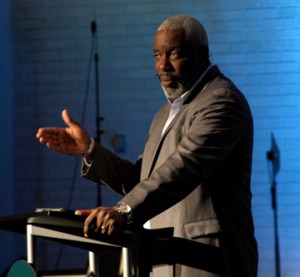
It seemed like almost everything that was said (or tweeted or blogged) at last year’s meeting made somebody mad.

This year, not so much. Yes, there was some chatter, according to tweets after the event, about Baptists having an agenda for tackling this year’s topic, racial reconciliation. At least one poster noted the Southern Baptist Convention should be honest about its past in regards to slavery and racial division. (One whole panel discussion and pieces of other messages were devoted to the topic.)

But most of the Twitter feedback was positive. Maybe it was because much of it came from inside the summit. Racial reconciliation may not have drawn the same large online audience as last year’s topic: sexuality. Or, there’s this possibility: At its core, the summit was a meeting about a problem that every Christian can identify with, and one for which even those outside the church see the need for a solution.

Divisions exist around racial identity, and in recent days, they have been especially ugly, violent, frightening and real.

Leaders at the summit seemed to view racism as a common enemy. And, for Christians, as sin. There are some things you don’t do anymore once you have a relationship with Christ, said recent Southern Baptist Convention President Fred Luter.

“Don’t tell me you’re saved and still lying like a rug. Don’t tell me you’re saved and still cussing like a sailor. Don’t tell me you’re saved and still mean as a pit bull. Don’t tell me you’re saved and still don’t like someone because of the color of their skin.”

From the podium in Nashville, summit speakers talked about racial division as a universal problem, and a universal responsibility. Thabiti Anyabwile compared having skewed ideas about racial identity to walking into a cafeteria and seeing one table of diners that look like you, and one that doesn’t. You immediately think the table that looks like you has something in common with you, and is therefore safe for you.

“The mind is a relentless stereotyper,” Anyabwile said. No matter who you are. At the ERLC Summit, speakers and attenders were unified by that knowledge, and in the belief that the gospel is the only thing that has the power to reconcile people to God and to one another.

And the angry birds, for the most part, stayed away.

Meredith Flynn is managing editor for the Illinois Baptist newspaper.

Editor’s note: This is part 1 of the Illinois Baptist’s coverage of a recent summit hosted by the Ethics and Religious Liberty Commission on racial reconciliation and the gospel. Read part 2 next week here at ib2news.org.

NEWS | Meredith Flynn

Weeks of riots in Ferguson, Missouri, following the police shooting of a young black man, Michael Brown. More protests in major cities after the death of another African American, Eric Garner, during an arrest. And with the shooting death of 12-year-old Tamir Rice in Cleveland, the culmination of a summer of racial unrest in America. And it was only the beginning.

Chants of “Hands up, don’t shoot” in the streets gave way to “Black lives matter,” and in personal conversations, the question has become “Why now?” and “I thought we had made so much progress on race relations in the U.S.”

A sad and challenging summer, followed by a new round of unrest in Ferguson after a condemning report from the U.S. Department of Justice, leaves many thinking, “Apparently not.”

And the church wonders, What can we do? And in some corners Christians have asked, What does the gospel require us to do?

“How do we as people formed by Christ start to have those conversations out in the world?” said Ethics and Religious Liberty Commission President Russell Moore at a March summit in Nashville. “It starts if we’re in the same body, gathered around the same table, praying with one another, praying for another, serving one another, being led by one another, and then we will stand up for and speak up for one another.”

The state of race relations in America, from Ferguson to New York, and coast to coast, is demanding fresh thinking and producing new preaching on race in all kinds of churches—including here in Illinois.

More than 500 current and future church leaders gathered at LifeWay Christian Resources last month to address racial reconciliation and the gospel. The second-annual Leadership Summit hosted by the Ethics and Religious Liberty Commission brought together nearly 40 speakers who presented on a wide range of topics: multi-ethnic ministry, Islam, the SBC’s history on racial issues, pop culture, and more.

In each message and panel, the summit’s key theme was clear: Racial reconciliation is a gospel issue. The gospel reconciles people to God and to one another, but sin is still at work in the world, causing tension, division, strife and violence.

The solution, leaders said at the summit, is for the church to preach and live out the gospel on matters of race. To examine itself for any lingering race-related sin of pride, and to work together to fight the common enemy of racism.

“We’ve got a long way to go,” Moore said in his opening address. “Our sin keeps wanting us to divide up. But to the faithful, Jesus promises, ‘You will be called overcomers.’ And we shall overcome.”

Summit attenders gathered in the aisles and at the altar to pray together at the start of a March meeting on racial reconciliation and the gospel.

Summit attenders gathered in the aisles and at the altar to pray
together at the start of a March meeting on racial reconciliation and the gospel.


Learning how to see each other
“All creatures of our God and King; lift up your voice and with us sing…”

The first hymn led by band Norton Hall and worship leader Jimmy McNeal took on extra significance as the words reverberated around the auditorium. All creatures, lifting up their voices, together. African American, Anglo, Hispanic; male and female; young and old. At the summit, mostly young.

The picture painted in “All Creatures of Our God and King” isn’t possible when people are left to their own devices, summit speakers said. The gospel is central to racial reconciliation. In perhaps one of the few times the Good News has been compared to mayonnaise, Dallas pastor Tony Evans said it acts as an “emulsifier,” like the eggs that helps combine the ingredients in his favorite sandwich condiment.

“Grabbing a black Christian and a white Christian, a red Christian and a yellow Christian, a Baptist and a Methodist, Pentecostal,” Evans preached as the crowd clapped and agreed with Amen’s. “He’s able to pull them together when you understand that the gospel can change an environment, and can do anything.”

Thabiti_Anyabwile_blogThe mission of reconciliation can be seen in the Bible from the very beginning, said Washington, D.C., pastor Thabiti Anyabwile (right). Preaching from the book of Genesis, he urged his listeners to consider how they look at people different from themselves, in light of the fact that everyone is made in the image of God.

“Every person we have ever looked at, smiled at, greeted, encouraged, insulted, slandered, touched, is a person bearing the marks of divine likeness, the ‘imago dei.’ So, racial reconciliation must begin with our learning the habit of seeing each other as together made in the image of God, and therefore possessing inestimable, unfathomable dignity and worth and preciousness.”

But seeing other people is such a commonplace occurrence, Anyabwile continued, and then there’s the problem of sin. That’s why true reconciliation requires a constant renewing of the mind. How a Christian treats people of different ethnicities is such a key part of living out one’s faith that it ought to be a category of discipleship, the pastor said.

“That [racism has] moved so rapidly to be a despised thing is wonderful,” he said. “But along the way, I think many Christians have been so afraid of the label, so afraid of the discussion, and so afraid of the implications, that they don’t even want to have the conversation.”

Working out the reconciliation that Christ has achieved for us is one of the most underdeveloped areas in Christian discipleship in the U.S., he said. A believer can live his whole life without someone sitting down with them to explore their identity in Christ.

And so, Anyabwile said, “We’re weak when the Fergusons erupt around us, we’re weak when we watch Eric Garner choke to death on a city sidewalk. We feel incompetent when we see a Tamir Rice shot in Cleveland.

“We don’t know quite what to say or what to do, when the (Department of Justice) reports come out, whether it’s telling us that ‘hands up don’t shoot’ isn’t true, or whether it’s telling us that, man, this police department is shot through with racist practice….It immobilizes us, because we’re not discipled, because we don’t have this as a category in what it means to mature as a Christian, as a follower of Christ.”

THE BRIEFING | Meredith Flynn

Brighton Presbyterian Church in Rochester, N.Y., is the first church to leave the Presbyterian Church (USA) after a majority of the denomination’s districts voted to change its definition of marriage. The amendment to the group’s constitution, which will become official this summer, alters the marriage definition from “a man and a woman” to “two people, traditionally a man and a woman.”

The_Briefing“Our reason for leaving is centered on the status of biblical interpretation within the PC(USA),” Brighton spokeswoman Kerry Luddy told The Christian Post. “We believe that Scripture’s meaning and intent should not be altered to fit a current culture.”


“Heaven visitation resources” like Don Piper’s book “90 Minutes in Heaven” are no longer available from LifeWay Christian Resources. Spokesman Marty King told Baptist Press LifeWay stopped ordering “experiential testimonies about heaven” last summer, and has pulled the remaining products from stores and its website.

LifeWay’s decision followed the adoption of a resolution on “the sufficiency of Scripture regarding the afterlife” by messengers to the Southern Baptist Convention’s annual meeting last summer.


Legislators introduced this month a bill that would allow adoption and foster care agencies to operate within their religious convictions concerning placing children with same-sex couples. “This commonsense bill simply ensures that these child welfare providers can keep doing what they do best and are treated the same as the rest,” said Rep. Mike Kelly (R-Pa.), according to a WORLD News Service report.

Illinois is one of four states where agencies have discontinued adoption and foster care services because they would have been required to place children with same-sex couples.


More than 83,000 Bibles were shipped to Cuba this month through a partnership between Southern Baptist agencies, churches and individual donors. The Eastern Cuba Baptist Convention, which will receive 32,000 Bibles, reported more than 29,000 professions of faith last year, said Kurt Urbanek, International Mission Board strategy leader for Cuba. “The growth is so incredible, that’s why Bibles are so important.”


“If it wasn’t for the Baptists, I don’t know what I would do,” said one homeowner whose basement was repaired after severe flood damage wrought by Hurricane Sandy. More than two years after the storm devastated parts of New York and New Jersey, volunteers working through Southern Baptist Disaster Relief are still rebuilding and repairing homes in the region.


PriorityHEARTLAND | Living a life with intention is the theme of this year’s IBSA Women’s Resource Conference April 24-25 at Tabernacle Baptist Church in Decatur.

The two-day Priority Women’s Resource Conference is designed to equip leaders serving in the local church. The conference will include worship and large group sessions led by nationally known speakers, 40 breakout offerings on a variety of topics, a luncheon for ministers’ wives, exhibit area with ministry resources, and a 5K walk/run.

A screening of “War Room,” a new film from the creators of “Fireproof” and “Courageous,” will follow the Friday evening session.

Priority begins Friday at 1 p.m. with a missions celebration featuring North American and International Mission Board missionaries and Tajuan McCarty, founder of The WellHouse ministry that seeks to rescue victims of human trafficking. Clella Lee, a leadership consultant for National Woman’s Missionary Union (WMU), will also speak during the opening session.

Lee directs WMU’s Christian Women’s Leadership Center, which engages women in discovering and implementing leadership gifts in their churches and workplaces. Women desiring to express those gifts are sometimes hampered by demands on their time, or by other factors.

“I think women are hesitant sometimes; they don’t want to come across as too aggressive,” Lee said. “And so I think sometimes they aren’t always as apt to take a hold of those leadership skills they have…they have a sense of call or a sense of need, and recognize some of those gifts, but sometimes they’re hesitant.”

Lee will speak about the Christian Women’s Leadership Center, and also will lead three breakout sessions during the conference on the dynamics of a ministry family, the private spiritual life of a leader, and creative approached to missions in a church plant.

Rachel Lovingood will continue the leadership theme in the Friday evening session. The author, pastor’s wife, and speaker at LifeWay events will delve into how women can develop into the leaders God has created them to be. She also will unpack specific topics in several breakout sessions.

The Friday evening session also will feature author and missions advocate Kimberly Sowell, and worship led by Pastor Chad Ozee of Journey Church in Bourbonnais.

Saturday begins early with a 5K fun run or walk, and concludes with an afternoon session featuring Lori McDaniel, an International Mission Board global mission catalyst and church planter wife from Arkansas. Ministers’ wives also are invited to a luncheon with Kathy Litton, the North American Mission Board’s consultant for ministers’ wives ministry.

Cost is $25 for attenders who are part of an IBSA church, and $30 for all others. Conference information and registration is online now at www.IBSA.org/womensmissions. A block of rooms has been reserved at the Decatur Conference Center and Hotel (across the street from Tabernacle Baptist Church). Contact the hotel at (217) 422-8800.