Archives For November 30, 1999

THE BRIEFING | Meredith Flynn

Barna’s most recent list of the country’s most unchurched cities is dotted with Illinois metro areas, but only two have populations that rank above the national unchurched percentage: 38%. (Barna defines “unchurched” as those who haven’t attended a church service in the last six months, except for a holiday or special occasion.)

The_BriefingThe metro area composed of Davenport, Iowa, and Rock Island and Moline in Illinois ranked 27th on Barna’s list of most unchurched cities, with an unchurched population of 42%. Chicago is a few places down the list, at No. 32 with 39% of the population unchurched.

Other familiar cities: St. Louis is 45th, Champaign/Springfield/Decatur is 53rd, and Harrisburg and Mt. Vernon (along with Paducah, Ky., and Cap Girardeau, Mo.) are 80th.


Does young = pacifist? Maybe not necessarily, according to a Harvard poll of young Americans that found nearly 60% approve of sending ground troops to fight ISIS.


Imprisoned pastor urges prayer | Saeed Abedini’s 35th birthday coincides May 7 with the National Day of Prayer in the U.S., which is the focus of a letter he wrote from prison in Iran. “As Ezra cried out to God in repentance and the Israelites joined him in weeping bitterly and turning from their sin, I would like to ask you to join me in repenting and praying for revival,” Abedini wrote. This story from The Christian Post also reports on the political chaos swirling around the pastor’s captivity and the fight for his release.


New nominees for persecuted countries list | The U.S. Commission on International Religious Freedom has recommended the State Department add eight countries to a list of the “world’s worst violators of religious liberty,” Baptist Press reports. The Central African Republic, Egypt, Iraq, Nigeria, Pakistan, Syria, Tajikistan and Vietnam all were nominated for the list of CPC’s (countries of particular concern), along with nine nations already on the list.


10 questions from Court’s marriage arguments | Transcripts of last week’s U.S. Supreme Court oral arguments on same-sex marriage are available online, as is this guide–provided by the Ethics and Religious Liberty Commission–to the 10 most important questions asked by the justices. For example, would it be unwise for the Court to redefine an institution as ancient as marriage? And would redefining marriage impose on institutions’ religious liberty, like the loss of tax-exempt status?

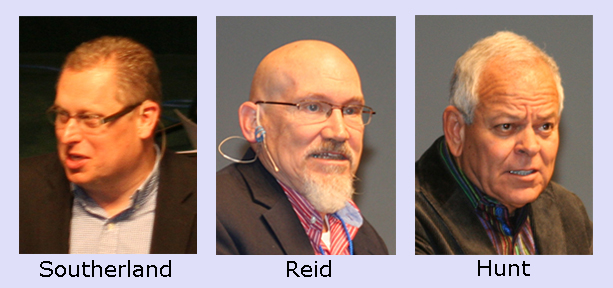
Evangelistic_churches_3HEARTLAND | The average Southern Baptist church in the Midwest has 54 people in worship on Sunday mornings, and baptized three last year. But a North American Mission Board study found the top evangelistic churches in the region are charting a different course, said Joel Southerland, NAMB’s executive director of evangelism strategies.

The Midwest’s top evangelistic churches with less than 250 in worship attendance averaged 119 in worship and had 23 baptisms. Churches with more than 250 in worship averaged 71 baptisms.

Southerland shared findings from the NAMB study of the top 20 evangelizing churches in every U.S. state at the Illinois Baptist State Association’s Evangelism Conference in March, and in a breakout session at the Midwest Leadership Summit earlier this year. The study resulted in a list of “7 Secrets of Top Evangelistic Churches in the SBC.”

  1. It has a lot to do with the pastor. NAMB studied the pastors of top evangelistic churches and found that the majority described their leadership style as “charismatic” or “transformational,” outranking innovative, command and control, servant, situational, laissez-faire and pace setter.

The pastors they studied were at the churches 10-plus years on average, Southerland said, and 70% of them preach a sermon series on evangelism every year. More than half (55%) put more emphasis on evangelism than discipleship, and 90% share the gospel outside the church at least once a month.

  1. Top evangelistic churches are really good at the Sunday morning experience. Of the pastors surveyed, 93% described their worship as lively and celebratory, 95% were contemporary or blended in worship style, and 96% said they intentionally cultivate a guest-friendly atmosphere. And 70% give an invitation at the end of the service.

Southerland outlined several worship takeaways: make church exciting, work on the quality, be intentionally evangelistic on Sunday morning, and aim for something better than “friendly.” People aren’t looking for friendly, he said, they’re looking for friends.

  1. These churches are actively engaged and serving the community, no matter the size of the congregation. Of the pastors surveyed, 88% said they were well engaged in the community. Of mid-sized top evangelistic churches, 30% attempt service-based ministry efforts to share the gospel regularly, as do 37% of large churches.

It’s OK to start small with community engagement, Southerland counseled, just start somewhere. And preferably not in a vacuum. Talk to community leaders about the needs are, and how your church can help. Involve non-Christians, using the service as an opportunity to share the gospel with them.

  1. Top evangelistic churches communicate well, internally and externally. The average pastor makes too many assumptions about how much people know, Southerland said. They assume the congregation knows the church’s vision, that members are as passionate about reaching people as the pastor, and that they don’t need constant motivation.

But all of those things—and more—need to be communicated. Luckily, more avenues for communication exist now than ever before. Of the top evangelistic church pastors surveyed, 97% use a church Facebook account regularly, Southerland cited. Half of pastors and staff intentionally “friend” guests on Facebook.

  1. Virtually all top evangelistic churches make a big deal out of baptisms—97%, the NAMB survey reported. And 79% of pastors of churches in the mid-size church category preach a yearly sermon on baptism, as do 74% of large-church pastors.

The takeaways, Southerland said, are to preach at least once on baptism every year, provide a forum for people to give their own, recorded testimonies, help baptismal candidates invite family and friends to the service, and train your church to celebrate new spiritual life.

  1. They treat guests really well. In non-evangelistic churches, Southerland said, the service is for the members and guests just happen to be there. Evangelistic churches are the opposite; of the congregations NAMB surveyed 67% of mid-size churches and 85% of large churches had a person responsible for “first impressions” ministry targeted to visitors.

A large majority (70%) emailed, called and sent written mail to a guest within seven days of their visit.

  1. Top evangelistic churches emphasize inviting and personal evangelism. The pastors of the churches NAMB studied were very busy mobilizing their church members to be a witness in the community; 50% offered evangelism training, and 70% of their guests came to church as a result of a personal invitation from a member. Among mid-sized churches, 62% have visitation or organized outreach at least once a month, and 58% of large churches do the same.

Churches that train members in personal evangelism, Southerland said, baptize two-and-a-half times more people than those that don’t.

The value of a verbal witness cannot be underestimated, he said during a message at the IBSA conference. Especially when most people are broken and looking for a solution to their problems.

“We are far too timid when it comes to sharing the gospel. We are too scared of the culture.” But, “The culture is not near as bad as it could be or will be someday. We’re to take the gospel to the culture and change the culture with Jesus Christ.”

COMMENTARY | Chase Abner

Chase_Abner_callout_April15Recently, I was at an event for church leaders that focused on the state of marriage in America. There were audible gasps and shaking heads as speakers shared statistics indicating the declining support for a traditional view of marriage.

My first reaction was, “How is this news surprising to anyone?” Perhaps I was being a little smug. I forgot that not everyone
has had my experience peering into the worldviews of college students for more than a decade.

And from my days as an undergraduate until now, I’ve witnessed a steady, quickening march towards a new definition of sexual morality, and, yes, marriage.

My experiences as a student, campus minister, and IBSA’s collegiate evangelism strategist have given me a unique perspective on how attitudes and ideas on campus are very predictive of where public opinion is heading. By the time a hot-button issue hits the heartland, it’s already been debated and settled by the opinion makers on campus.

As Christians, and as church leaders, we can’t afford to ignore the fact that worldviews are formed on college campuses. Simply put, recent college graduates are extremely influential in our communities and they, most likely, have been steeping in a culture where Jesus is not honored as king and the Bible is not respected. And relativism isn’t the only obstacle to the gospel. There are absolute truths found on campus—even sacred ones—but they aren’t necessarily truths that Christians can embrace.

Students who are graduating from our colleges and universities go on to lead influential lives. They’re teaching in our schools. They’re being elected to lead our governments. They are lawyers, doctors, and more. They are getting married and raising children.

Campuses are where young, energetic, gifted people are figuring out how they will leave their mark on the world. They are mission fields where the nations are gathering to formulate their worldviews, and training grounds for the next generation of great church leaders.

Shouldn’t reaching college students be a central component of our churches’ mission strategy?

It is nearly impossible to overstate the church’s opportunity to change the world through college ministry. In Illinois, we have more than 200 campuses representing over 900,000 college students. And 43,000 of those are international students.

What potential!

Chase Abner directed the Baptist Collegiate Ministry at Southern Illinois University before moving to Springfield to serve as IBSA’s collegiate evangelism strategist.

Letty and Luis Olmos of Iglesia Principe de Paz, Springfield, worship alongside other New Awakening Evangelism Conference attenders in Decatur.

Letty and Luis Olmos of Iglesia Principe de Paz, Springfield, worship
alongside other New Awakening Evangelism Conference attenders in Decatur.


Decatur, Ill. |
“I’ve seen God move,” said Baptist evangelism specialist Joel Southerland, “but I haven’t seen a movement of God in my lifetime.”

Spiritual revival and awakening—the kind of movement only God can bring—was the focus of IBSA’s New Awakening Evangelism Conference March 27-28 at Tabernacle Baptist Church in Decatur.

At a time when baptisms and worship attendance are in decline in many churches, and culture seems to be moving farther from God, the need for awakening is real. A church—the Church—cannot revive itself, speakers emphasized during the conference. But some responsibility for revival does fall on Christians—to prepare for a movement of God, to be desperate for it, and to provide a verbal witness for the hope they have in him.

“Revival changes God’s people,” said Southeastern Seminary professor Alvin Reid. “When God shows up you are not the same.”
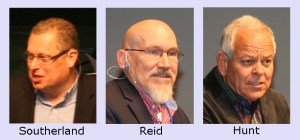
Evangelism_speakersOne of the major issues New Awakening speakers addressed is the declining number of young people Southern Baptist churches are reaching with the gospel. In 1972, there were 137,000 youth baptisms in Baptist churches, Reid said in a breakout on next generation ministry. Today, there are 70,000 or fewer per year.

“The real problem with that is that there are more teens today on the planet than there were in 1972,” said IBSA Evangelism Director Tim Sadler. “So, we’re reaching less, and there’s more of them.”

We haven’t seen a movement that touched young people since the “Jesus people” movement of the early 1970s, Reid said at the conference. That period of awakening was characterized by the Holy Spirit’s activity in and among churches—he was the main character in revival, just as he was in the Book of Acts.

“What about your ministry can only be explained as a Holy Spirit movement?” Reid asked. One man in the audience replied, “Yeah, git ‘er done!”

The same Holy Spirit that drew people in Acts 2 and in 1972 still draws people to God today, Sadler said. The gospel is the same, and the vehicle for communicating the message—the church—is the same. The issue is like someone once said, Sadler told the Illinois Baptist: “We don’t have a strategy problem, we have a sharing problem.”

But sharing the gospel is the calling of every Christian. “If you really know Jesus and He’s really changed you, try not to witness for ten years,” Reid challenged his breakout session audience in Decatur. “If you’re successful, come back and tell me what kind of Jesus you know.”

Make us desperate, Lord
If Christians haven’t seen a movement of God in their lifetimes, will they recognize it when it happens? In other words, when we talk about revival and awakening, what are looking for?

Sadler defines it this way:

“For me, a movement of God would be an extended period where the people of God are so moved by the presence and power of God, that they leave the confines of the church building, and they impact the city in such a way that God’s Spirit draws unbelievers to faith.”

It’s pervasive, he added, a turning of the spiritual tide. Undeniable. So why haven’t we seen it? Speakers at the New Awakening Conference outlined two possible reasons: “skill fade” in the area of evangelism, and a lack of desperation for revival.

Joel Southerland compared many church members and leaders to pilots who have lost their skills after relying too heavily for too long on autopilot. “Pilots are accustomed to watching things happen and reacting, instead of becoming proactive,” said Southerland, executive director for evangelism strategies at the North American Mission Board.

The church has fallen victim to the same phenomenon. “We have put our churches on autopilot” when it comes to evangelism, he said.

Dennis Nunn, founder of Every Believer a Witness Ministries, differentiated between the “come and see” evangelism model of the Old Testament, and the “go and tell” model in the New Testament.

“I believe we have come to accept what our church members will not do in evangelism because we have accepted the Old Testament approach,” said Nunn. Our witness will become less and less effective, he continued, because we think simply inviting people to church is evangelism.

And then there’s the matter of how much we want revival. The reason the Great Commission probably won’t be realized in our lifetime, Pastor Johnny Hunt said during the conference, is because we live for pleasure, not for the Word of God.

“Lord, forgive us,” said a conference attender from the Chicago suburbs, in response to Hunt’s words.

He continued, referencing Isaiah’s encounter in the temple: “It is not until you see God for who he is that you will see yourself for who you are and others for who they are,” and thus their need for God.

“We don’t witness because we haven’t seen God,” Hunt said. “We have not experienced revival because the church is not even close to desperate.”

Lord, forgive us.

God’s people are desperate for revival, Sadler said, when nothing but God will do; when we stop compartmentalizing our lives into church and work and family and hobbies, and let God be God over all of it.

“We need God to superintend every aspect of our lives,” he said. “It’s like Ephesians 3, where Paul prays that they would experience the fullness of Christ [and] be filled with his presence, so that it spills over into every aspect of our lives. So that we see our neighborhood differently.

“It’s our mission field.”

Reported by Lisa Sergent and Eric Reed for the Illinois Baptist newspaper

THE BRIEFING | Meredith Flynn

In the wake of Saturday’s massive earthquake near Kathmandu, Nepal, Christian workers asked for prayer for the devastated country:

• Pray for basic shelter, water and food. These necessities are a high priority right now since no one is allowed back in their homes.

• Pray for God’s people to deeply know His comfort and peace during this time. Pray they will share Him with people around them.

• Pray for people in Nepal and surrounding areas during the continuing aftershocks and aftermath of this disaster. Southern Baptist assessment teams will began the damage Monday to find the best ways to respond.


Potential presidential candidate Dr. Ben Carson will not address the Southern Baptist Pastors’ Conference this summer as scheduled, Baptist Press reports. Several Baptists, including the Baptist 21 group of younger SBC leaders and pastors, had expressed concern about Carson’s membership in a Seventh-day Adventist Church, and that his appearance at the conference could look like a political endorsement.


Three years after the death of Prison Fellowship founder Charles Colson, Russell Moore reflects on media coverage surrounding the Watergate conspirator’s life and eventual conversion to Christianity. For those who were cynical about Colson’s transformation, writes the president of the Ethics and Religious Liberty Commission, “…we shouldn’t be angered by those who don’t get the full measure of the man. We should instead hear in some of this cynicism the cry of every human heart, a disbelief that there can be any such thing as final and total forgiveness of sin.”


Zondervan announced last week Charles Colson’s last book, “My Final Word: Holding Tight to the Issues that Matter Most,” will be released Aug. 4. Topics in the collection of writings will include “the rise of Islam, same-sex marriage, the persecution of Christians, crime and punishment, and natural law,” The Christian Post reports.


Atlanta-area pastor Andy Stanley says local churches should be the “safest place on the planet for students to talk about anything, including same-sex attraction.”

“We just need to decide, regardless of what you think about this topic–no more students are going to feel like they have to leave the local church because they’re same-sex attracted or because they’re gay,” said Stanley, pastor of North Point Community Church, at the Catalyst West conference April 17. Read the full story at ChristianPost.com.

A controversial Houston ordinance is now in effect, following a judge’s ruling on a petition drive led in part by some pastors in the city. HERO, or Houston Equal Rights Ordinance, made headlines last year when the city subpoenaed the sermons and other communications of five pastors who were against the ordinance. (The subpoenas were later withdrawn.)


Religious leaders are encouraging President Barack Obama to appoint a special envoy to monitor religious freedom in the Middle East and parts of Asia. The special envoy position has been vacant since it was created last year in the Near East and South Central Asia Religious Freedom Act, Baptist Press reports.


Are you one of the many football fans bent out of shape since Tim Tebow’s exit from the NFL? Good news: A Philadelphia pretzel company has created a way to celebrate his return. The “Tebowing” pretzel, shaped like the quarterback kneeling in his famous praying pose, started as a publicity stunt but soon went viral. The New York Daily News reports the Philly Pretzel Factory plans to donate proceeds from the pretzels to a charity involving Tebow, who has signed a one-year contract with the Philadelphia Eagles.


Haiti, at last

Meredith Flynn —  April 24, 2015

Texas youngster visits the school she —and Illinois mission teams—helped build

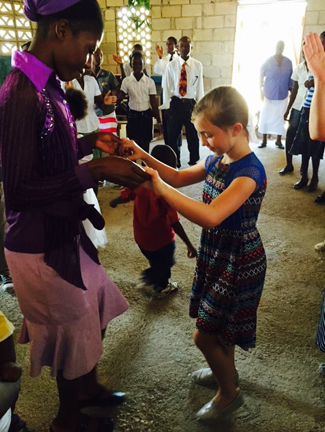
After four years of prayer and giving, it was all hugs and smiles as Mackenzie (right) visited a community school in Bigarade that her missions giving helped build.

After four years of prayer and giving, it was all hugs and smiles as Mackenzie (right) visited a community school in Bigarade that her missions giving helped build. Photo by Bob Elmore

Bigarade, Haiti | Several years ago, this community in Port-au-Prince was just a flood plain. Now, more than a hundred
homes dot the landscape, and children run down the dirt roads to their very own school.

Recently, there was a new face at the school, though one who’s very familiar with its story. At nine years old, Mackenzie Howell has been working to renew hope in Haiti since 2011, when she saw a documentary about the devastating earthquake that rocked the country the previous year.

Four years after she started raising money to help kids and families there, Mackenzie visited Bigarade and the school she helped build. “Seeing the kids” was what she looked forward to most before the trip, and was also her favorite part of being in Haiti, she told the Illinois Baptist.

“She really does care about this,” said Mackenzie’s mom, Alison, who also went along on the trip led by IBSA’s Bob Elmore. The Howells, who are from Nederland, Texas, met Elmore through International Mission Board missionaries working in Haiti
after the earthquake. Mackenzie sent her first donation—$1,400 raised through a coin drive at her preschool and a bake sale at church—to the missionaries to help with construction projects. They connected her with Elmore, who facilitates IBSA’s short-term mission teams in Haiti.

First she had a bake sale. Then, in 2013, the Texas girl wrote a book to help children in Haiti. File photo

In 2013, Mackenzie wrote a book to help children in Haiti. File photo

Since her first project, Mackenzie has raised more money with several other initiatives, including sales of “Leila’s Big Difference,” the book she wrote and published in 2013. Elmore, several teams of volunteers, and Haitian workers have turned Mackenzie’s gifts, along with other donations and resources, into a school for more than 100 children in Bigarade.

Instant community
The school property was vacant in November of 2011, when Elmore first saw it. “It was a goat field then…we just kind of wrote it off,” he said.

When he returned the next spring, a local Christian man named Thomas had gotten permission to put up a tarp and bamboo school on the site. People on Elmore’s mission team were asking, “What can we do?”

That fall, after receiving an anonymous donation to purchase the land, Elmore took a team to Bigarade to start construction on the school. At least eight Illinois churches and associations helped with the project. The facility now doubles as Gosen Church.

Bigarade is an “instant community,” Elmore said, a product of the earthquake that drove people from where they were and forced them into new living situations. Before the school was built, kids were either walking to another community or not going to school at all.

Mackenzie's mission team prepared lunch for kids at the school in Bigarade.

Mackenzie’s mission team prepared lunch for kids at the school in Bigarade.

Working in the school was one of the main objectives for Mackenzie and her team. They came prepared to do a two-hour
lesson each day with crafts, and to provide lunch for the kids on three days.

“Our ultimate goal is to start a feeding program where the kids can have lunch every day,” Alison said a few days before her
team left for Haiti. It just seems like something God would want them to do, she said, to feed his children. The team took with them enough money to start construction on a kitchen for the school, and also a classroom for the youngest students.

Thomas, who put the early school on the property, is now headmaster, and students arrive every morning in blue and white uniforms. Once a goat pasture, the school now employs seven teachers, and has 114 students. The feeding program will employ two or three cooks and purchase food from local sources, Elmore said.

On a recent mission trip to Haiti, Mackenzie Howell, 9, worshiped in the church she helped build after a massive earthquake.

On a recent mission trip to Haiti, Mackenzie Howell, 9, worshiped in the church she helped build after a massive earthquake. Photo by Mary Russell

Complete God
“Why don’t we dance at church, Mom?” That was Mackenzie’s question after her first Haitian church service, where lively singing and dancing was a big part of the worship experience. (Alison’s response: “I don’t know; why don’t you talk to the pastor about that one?”)

“…It was such a blessing to watch her,” Alison said of her daughter during the trip. “She really grew throughout the week.” And Mackenzie’s not finished with Haiti, not by a long shot. She wants to go back—soon. And she’s planning a second book.

“It’s going to be about Leila [meeting] a white girl that came from the U.S. to visit her school and help out with the school and do crafts and stuff, kind of like how I did.”

Recently, she shared about Haiti with kids in her church’s Awana program. Mackenzie’s grandmother, who also was part of the March trip, came out of the room crying, Alison remembered.

“Whatever you do, don’t practice with her,” was the grandmother’s advice for Mackenzie’s future speaking engagements. “…She had them laughing and crying,” Alison said. “It’s because it really does come from her heart.”

In Haiti, Mackenzie taught her new friends a dance she had choreographed in honor of their country to a song with special meaning there, “I Am Not Forgotten.” Watching, Alison said, “It was just such a beautiful picture of how complete God is.”

“So many times, we give to missions or do this and that…but we don’t always get to see the fruits. I just continuously thank God that’s he’s allowed us to see so much of the fruit of his work.”

Reported by Meredith Flynn for the Illinois Baptist newspaper, online at http://ibonline.IBSA.org

Click through the slideshow below for more photos from Mackenzie’s trip to Haiti. Photos are by Bob Elmore and Mary Russell, Mackenzie’s grandmother.

This slideshow requires JavaScript.

Illinois_map_AprilCOMMENTARY | Lisa Sergent

Just outside my office door, there is a large map of Illinois with each county outlined and labeled. Every county has been shaded in to represent the percentage of the population who are Southern Baptist.

When I heard about the April 9 tornado outbreak and where it occurred, my thoughts immediately went to the map. The northern part—the region most affected by the storms—has counties in white (no IBSA churches), dark green (one IBSA church), and a particular shade of orange denoting that just 0.5 to 0.99% of the population belongs to an IBSA church.

Disaster Relief spring callouts like the one in northern Illinois after the tornadoes are nothing unusual. In April 2013, chaplains and mudout teams responded to the Peoria area after widespread flooding. March 2012 saw a tornado strike Harrisburg, destroying homes and businesses. Chaplains and chainsaw teams were called in to comfort and to clear debris.

But this ministry opportunity is different. The previous spring callouts in our state have served areas with a much higher ratio of IBSA churches. These most recent tornadoes touched the northern part of Illinois, the part with little Southern Baptist or other evangelical presence.

In Ogle County, where the town of Rochelle is located, there is just one IBSA church to serve the county’s 52,000 people. In DeKalb County, home to the Fairdale community that was devastated April 9, there are just three IBSA churches with fewer than 300 resident members. DeKalb’s total population is 105,000.

Illinois Baptists now have an opportunity to reach out to the unreached in new ways. Chainsaw teams from four associations of churches—Fox Valley, Quad Cities, Sinnissippi, and Three Rivers—worked in Rochelle the weekend after the storms. Disaster Relief coordinators monitored the situation in Fairdale, but found it was completely destroyed, leaving nothing large enough for chainsaw crews to remove.

Not only were IBSA Disaster Relief teams at work, but teams from other evangelical denominations also were on the scene. Their presence is something new for an area that consists mainly of Catholic and mainline Protestant churches.

Illinois Baptists have a unique opportunity to share Christ’s love in a unique time of need. My prayer is that we take this opportunity to minister to the peoples in these and surrounding communities, sharing Christ—perhaps, as never before—in this region of our state.

Lisa Sergent is director of communications for the Illinois Baptist State Association and contributing editor of the Illinois Baptist newspaper.

THE BRIEFING | Meredith Flynn

People with gay or lesbian friends are almost twice as likely to say same-sex marriage should be legal, according to a survey by LifeWay Research. Half of all Americans overall believe gay marriage should be legalized, but the percentage jumps to 60% for people who have gay or lesbian friends (and decreases to 33% for those who don’t).

From LifeWayResearch.com

From LifeWayResearch.com

An additional LifeWay survey found 30% of Americans believe homosexual behavior is a sin, down from 44% in 2011.

On April 28, the U.S. Supreme Court is scheduled to hear oral arguments in several same-sex marriage cases.


Thirty Ethiopian Christians were killed in two attacks by ISIS in Libya, according to a video released by the terrorist group April 19. “That these terrorists killed these men solely because of their faith lays bare the terrorists’ vicious, senseless brutality,” said U.S. National Security Council spokesperson Bernadette Meehan.

Back in February, Ethics and Religious Liberty Commission President Russell Moore asked in a blog post, “Should we pray for the defeat of ISIS, of their conversion?”


Southern Baptist Convention President Ronnie Floyd has designated the Tuesday evening session of this summer’s SBC Annual Meeting as a “National Call for Prayer.” Floyd has recruited 11 pastors to help lead the prayer meeting, including Paul Kim, pastor emeritus of Antioch Baptist in Cambridge, Mass., K. Marshall Williams, president of the National African American Fellowship, and Timmy Chavis, chairman of the SBC Multi-Ethnic Advisory Council.

“One of the unique moments of the evening will be when we embrace and celebrate our ethnic diversity, which may also involve moments of repentance and reconciliation,” Floyd said in a blog post about the service.


Baptist pastors and leaders will share the stage with a potential presidential candidate at the 2015 SBC Pastors’ Conference in Columbus, Ohio, June 14-15. Dr. Ben Carson, a neurosurgeon and author, will speak during the Sunday evening session. Earlier this month, he said on his Facebook page that on May 4, he will announce whether or not he will run for President.


Which missions job is right for you? Take this interactive quiz from the International Mission Board.

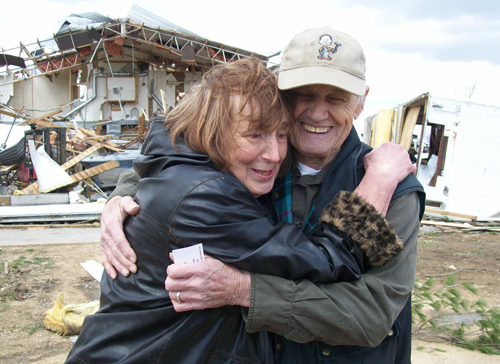
Raymond and Betty Kramer hug each other after being interviewed by the media about their experience in a Rochelle, IL restaurant's storm cellar while a tornado was on the ground above them. This photo was taken during and interview  in the town of Fairdale, IL, which was completely destroyed by tornado April 9.

Raymond and Betty Kramer hug each other after being interviewed by the media about their experience in a Rochelle, IL restaurant’s storm cellar while a tornado was on the ground above them. This photo was taken n the town of Fairdale, IL, which was completely destroyed by tornado April 9.

HEARTLAND | Lisa Sergent

Raymond Kramer and his wife, Betty, were driving home from Rockford, Ill.,

when it started to hail. As the icy stones got larger and came down harder, they started to look for shelter. Then, to his west, Kramer saw a funnel cloud on the ground.

The funnel cloud was part of a tornado outbreak that hit northern Illinois April 9. It caused destruction in town of Rochelle and completely destroyed the small community of Fairdale, where two people died.

The Kramers, members of Grace Fellowship in Ashton, took shelter in Grubsteakers Restaurant, where “the owner herded us through the kitchen, out the door, and we made a u-turn down into a good old-fashioned storm cellar,” Kramer told the Illinois Baptist.

When the tornado had passed, they tried to open the cellar doors, but found them blocked by debris. The back dining room and pantry walls had fallen on top of the doors. And the restaurant owner’s SUV had been lifted up by the tornado and was sitting on top of the walls.

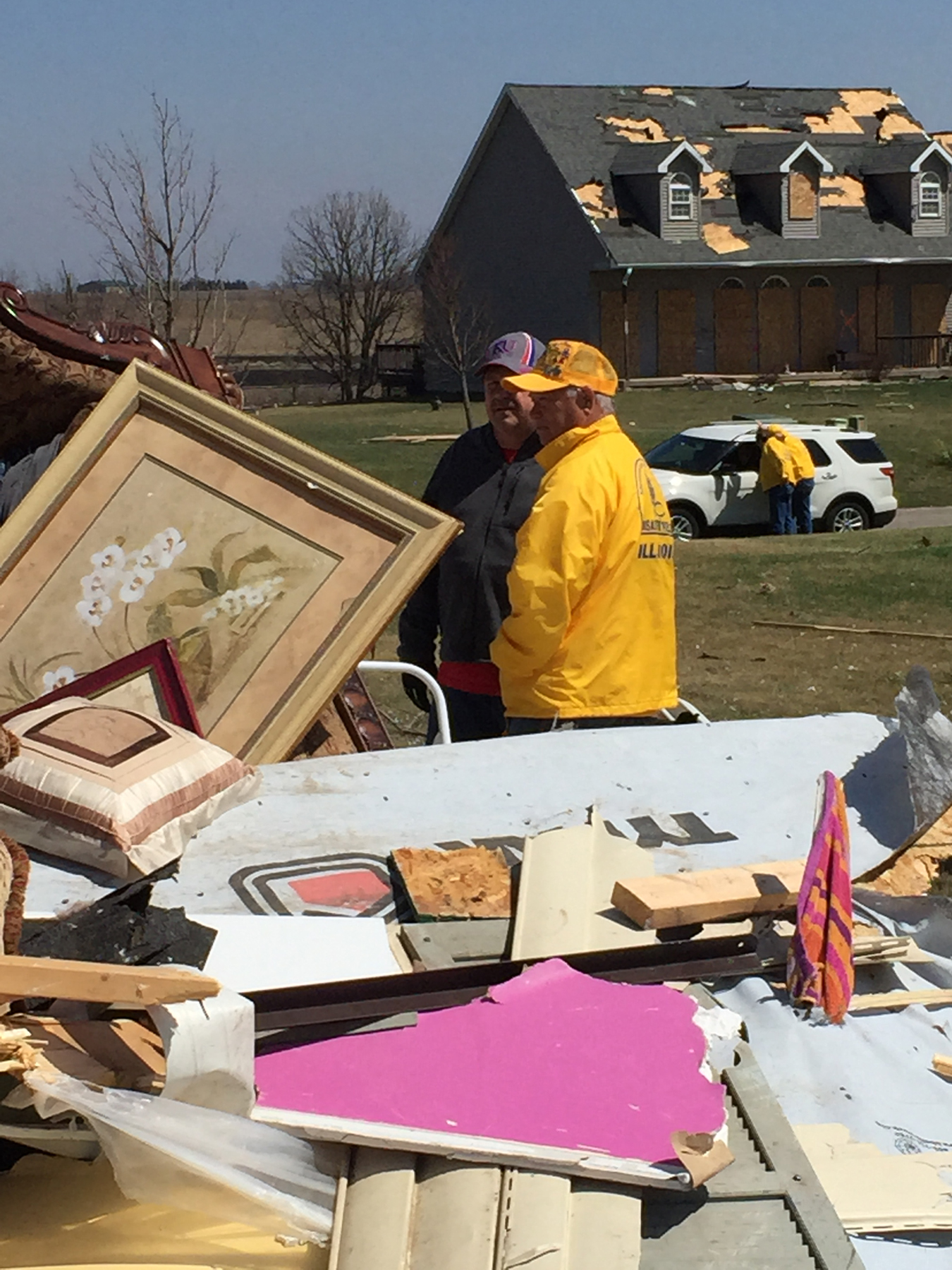
Illinois Baptist Disaster Relief workers survey damage after a tornado outbreak in northern Illinois April 9.

Illinois Baptist Disaster Relief chainsaw teams were on the scene two days after a tornado outbreak in northern Illinois April 9.

The Kramers prayed with 10 fellow survivors as they waited for first responders to arrive, which they did in 30 minutes. However, it took two hours for responders to free them. Sitting in the dark with only cellphone flash lights and, later, a light passed down by the responders, the Kramers prayed with the group.

One woman was crying, and as his wife comforted her, Kramer prayed. “I pray aloud in situations like this,” he said.

To help everyone relax, Kramer said he started singing, “’I’ll be there to pick you up in the wheel barrow honey, after about a quarter past eight….’ Then, I sang, ‘Que Sera, Sera, whatever will be will be…’”

Since the tornado, Kramer has been interviewed by local and national media who have called the 81-year-old and his wife heroes. “We’re not heroes,” he said. “We’re just servants of the Lord Jesus Christ…I had the joy of the Lord down there. I prayed to my God and I knew He would protect us.”

IBSA Disaster Relief participated in clean-up efforts after the tornado outbreak. Chainsaw teams from four associations of churches—Fox Valley, Quad Cities, Sinnissippi, and Three Rivers—worked at three homes in Rochelle.

Rex Alexander, Disaster Relief Coordinator said the callout “was a good opportunity for northern teams to work in their own backyard.”

To learn more about Disaster Relief ministry, go to www.IBSA.org/dr or call (217) 391-3142.

Editor’s note: The following Trevin Wax column from BPNews.net first appeared on his Kingdom People blog, hosted at thegospelcoalition.org.

COMMENTARY | Trevin Wax

Summer is for vacations and, for many pastors, denominational gatherings. The Southern Baptist Convention is no exception. This year, we’re meeting in Columbus, Ohio, the 15th largest city in the U.S., one that is well outside of the Southeast where most of our churches are based.

Trevin_WaxIn the past decade, though the attendance at the annual meeting has risen and fallen in conjunction with the location and the major topic of conversation (or controversy), the overall trend has been a dwindling of messengers. This isn’t surprising, considering the loosening of denominational loyalty and the variety of good conferences a pastor can attend.

But Columbus might buck the decline. Here are three reasons I’m particularly excited about this year’s annual meeting.

1. The annual meeting is trending younger.

In Baltimore last year, we saw a 10-year high of younger messengers involved in the convention proceedings. Baptist Press has reported that “nearly one-fourth (24.68 percent) of attendees were younger than age 40. That surpassed by more than 4 percentage points the previous best for the age group, recorded in 2013.”

My first visit to a Southern Baptist Convention was in San Antonio in 2007 as a 25-year-old associate pastor. I remember my initial shock at the small number of young people present. Recent years have seen an upswing in younger Southern Baptist engagement, a reality that is especially surprising when considered alongside the millennial generation’s diminishing enthusiasm for institutions in general. What this tells me is that the annual meeting is beginning to show signs of becoming a vibrant network, not just a report on denominational infrastructure.

2. The schedule of the annual meeting has been reworked in order to highlight the things we are most passionate about.

Few people get excited about a business meeting. Most messengers admit they come to network and see friends, not sit through every session of the SBC. But this year will be different, thanks to a reworking of the schedule under the leadership of the SBC’s president, Ronnie Floyd. For example, all the missions entities will present on Wednesday morning, and it won’t just be a time of reports, but also commissioning of missionaries.

The Send North America conference, slated by the North American Mission Board for this summer in Nashville, already has drawn more than 7,000 registrants, a staggering figure when you consider the fact that only one Convention since 2010 has come close to that number.

What does this tell us? Southern Baptists are hungry for a meeting that casts vision and rallies our people around a great cause. They’re not necessarily there, first and foremost, to vote on resolutions.

But resolutions matter. And so does our business. As Southern Baptists, we should care about the annual meeting, and we should care about this meeting because we care about the Kingdom of God. Business meetings come and go, with their moments of boredom and hilarity, awkwardness and quiet power, and yet in these moments, decisions are made, courses are set that define our cooperative work the rest of the year. It’s not glamorous, but the work of the Kingdom rarely is. This year, however, features a streamlined schedule that emphasizes what we’re there for.

3. We will pray for God to awaken His church to the opportunities before us.

The Tuesday evening meeting will be time of prayer and worship, a pleading with God to revive His people and empower our witness. It is easy to bemoan the moral decay of our culture, the encroaching limits to religious liberties and the difficulty of evangelism in a relativistic society.

But we shouldn’t miss the opportunity here. By cherishing once-common things, such as marriage between a man and woman for life, and core Christian doctrines, such as the exclusivity of Christ for salvation, we have the opportunity for our ordinary obedience to shine even brighter in a pluralistic world that bows to Aphrodite. The annual meeting gives us the opportunity to lay aside our differences, unite around our common confession and lock arms for the cause of Christ and His Kingdom.

Trevin Wax is managing editor of The Gospel Project, a Gospel-centered small group curriculum for all ages published by LifeWay Christian Resources.