Archives For November 30, 1999

Learning how to learn

Lisa Misner —  January 7, 2016

LeadershipIf you have been in a leadership role for very long, you have experienced organizational insanity! It can be described as doing what you have always done, the way you have always done it and expecting different results. We chuckle when we hear that because we know how easily it can happen.

It would be nice if annually articulating a clear vision based on the Great Commission, creating a strategy based on the five functions of the church, and then providing training for our staffs and volunteers were all it took to be effective in ministry. Unfortunately, it is not. In addition to these important leadership activities, we must help the churches we lead become learning organizations to prevent drifting off mission.

A church that is a learning organization will stay responsive to its ministry environment. It will learn better ways to meet the needs of its community and create new on-ramps for the gospel.

We see the principle of being a learning organization in Acts 6:1-7. When the early church had success in reaching Greek people with gospel, the need for reorganization and new staffing to meet the growing ministry needs became evident. These believers learned what needed realignment by looking at the ineffectiveness of their food distribution system and were able to transform their ministry structure, resulting in greater disciple-making capacity.

We live in a time when there is a lot of talk about church revitalization and church planting. I am for both. Let me suggest that when churches need revitalization, often it is because they have quit learning. They no longer know how to make adjustments to their mission efforts because they are not learning from their field efforts. They might not even think that it is necessary to learn from their results in the field. I contend that after we have done our theological homework, the next source for vital organizational learning is the mission field we are trying to reach.

Here are three ways churches can stop the insanity and become learning organizations.

1. Establish a supportive learning environment. Create opportunities for staff or volunteers to express their thoughts about the work they are currently doing without fear of being belittled. Help people become aware of opposing ideas that are present. Help them move beyond fixing problems to creating novel solutions. I have found asking these four questions about how things are going is a helpful place to start:

  • What is right about our methods and results?
  • What is confusing about our methods and results?
  • What is missing from our methods and results?
  • What is wrong about our methods and results?

2. Create helpful learning processes and practices. In order for an organization to learn, helpful facts and information must be gathered, processed, interpreted, shared and acted on. Probably the best known example of this approach is the U.S. Army’s After Action Review. It is a systematic debriefing after every mission:

  • What did we set out to do?
  • What actually happened?
  • Why did it happen?
  • What will we do next time?

3. Model learning at the senior leadership level. Senior leaders who model learning:

  • Invite input from peers and subordinates in critical discussions.
  • Ask probing questions.
  • Listen attentively.
  • Encourage multiple viewpoints.
  • Provide time, resources and venues for reflecting and improving past performance and for identifying challenges.

Remember, you will lead the organization that you allow or the one that you create.

Bob Bumgarner is executive pastor at Chets Creek Church in Jacksonville, Fla. He will be the featured speaker at the Illinois Leadership Summit, January 26-27, 2016. Reprinted by permission from the Florida Baptist Witness.


 

The BriefingInterVarsity backs #BlackLivesMatter at Urbana 15
InterVarsity Christian Fellowship (InterVarsity) devoted an evening at its Urbana missions conference to the group Black Lives Matter and called on the 16,000 students present to support the movement. InterVarsity’s support for the group caused controversy in part because of the  speaker’s anti-police rhetoric and comments which were seen as critical of the pro-life movement. InterVarsity has since issued a clarification.


Scalia: Presidents Honoring God Is Constitutional
Supreme Court Justice Antonin Scalia said the U.S. Constitution doesn’t prohibit presidents from honoring God or the government from placing religion above secularism, though added that one denomination cannot be favored over another. Scalia, told the audience at Archbishop Rummel High School in New Orleans that there is no reason to believe the Constitution dictates state neutrality between religion and its absence.


Catholic school ordered to hire gay employees
A Massachusetts state court ruled in mid-December that a Catholic school may not deny employment to a homosexual. Fontbonne Academy offered Matthew Barrett a job as a food service director in 2013. But when Barrett filled out a new employee form and listed his “husband” as an emergency contact, school administrators rescinded the offer, citing Catholic belief that marriage is between a man and woman.


NC pastor disarms man during service
A man carrying a semi-automatic assault rifle walked into the New Year Year’s Eve service at Heal the Land Outreach Ministries in Fayetteville, NC. “I asked him, ‘Can I help you?'” Bishop Larry Wright shared. “He said, ‘Can you pray for me?'” Wright disarmed the man and began to pray.


Billy Graham makes ‘Most Admired’ list for 59th time
Gallup released it list of most admired people in 2015 with Billy Graham rounding out the top ten. It is the 59th year Graham has been named to the top ten list.  According to Gallup, “Graham has been among the top 10 most admired men every year since 1955 except for 1962, in addition to 1976 when Gallup did not ask the question.”

Sources: Baptist Press, Billy Graham Evangelical Association, Christian Post, Christianity Today, Gallup, NBC News, and Religious News Service.

Disaster_Relief_logo_ILBy Meredith Flynn

Illinois Baptist Disaster Relief volunteers began working today to assist homeowners in the wake of flooding across the state and the Midwest.

Capital City Baptist Association, headquartered in Springfield, mobilized a team of volunteers to serve in Kincaid, where 35 homes were directly affected by flooding and others needed assistance following heavy rainfall, reported Director of Missions David Howard.

The team will work is expected to work in Kincaid through the week and possibly next, said IBSA Disaster Relief Coordinator Rex Alexander.

“We have assessors today working in Alexander County near Olive Branch, Illinois,” Alexander continued. “Williamson Association is preparing to go to that location on Wednesday of this week. But if we find out today that the water has not receded enough, then they will have to wait.”

In addition, a team from First Baptist Church, Galatia, is scheduled to leave Thursday to help in Alexander County or the St. Louis area. Volunteers from First Baptist Church, Harrisburg, and Metro East Association are scheduled to serve next week, likely in Alexander County, he said.

“We will learn this week more about the work needed in Alexander County and possibly other places in the state.”

Illinois Baptists have 1,600 trained disaster relief volunteers belonging to 37 teams based around the state. The teams include kitchen, childcare, chaplaincy, chainsaw, flood recovery, laundry and shower units along with a disaster relief command and communications trailer, and a search and rescue unit. To learn more about IBSA Disaster Relief, visit www.IBSA.org/dr.

Leadership Summit 2016 logoAbout 250 leaders from IBSA churches will gather in Springfield January 26-27 for the Illinois Leadership Summit. As a follow-up to the Midwest Leadership Summit last January, which brings together leaders from 10 state conventions every three years, this Illinois-focused conference is expected to build on the momentum of the large regional event.

“I believe this is the first of its kind training that we have designed specifically for individual leaders,” said Mark Emerson, associate executive director of IBSA’s Church Resources team. “IBSA often holds training that focuses on church positions or ministry skills, but this training is unique in that it focuses on the individual leader.”

The Illinois Leadership Summit is part of IBSA’s ongoing leadership development plan. The conference will feature 27 speakers in 32 breakout sessions, including some Illinois pastors who will share experiences from their churches. Among the speakers are Heath Tibbetts of First Baptist Church of Machesney Park, Michael Nave of Cornerstone Church in Marion, Sammy Simmons of Immanuel Baptist Church of Benton, Adron Robinson of Hillcrest Baptist Church in Country Club Hills (metro Chicago), and Doug Munton of FBC O’Fallon. (The full list is here.)

Keynote speaker for the event is Bob Bumgarner, executive pastor of Chets Creek Baptist Church in Jacksonville, Florida. He is a leadership expert who formerly served with the Florida Baptist Convention.

Bumgarner will teach IBSA’s four-phase leadership development process: leading self, leading followers, leading leaders, and leading the organization.

“This training is important for pastors because it is common in the ministry to reach a leadership lid,” Emerson said.

“Some of us are dealing with barriers to growth in our church that are out of our control—buildings, parking, location. But growing as leaders is something that all of us can do this year. If we grow as leaders, the church also grows.”

Seating is limited. Register online at IBSA.org/summit.


Editor’s note: After an often tearful year, the Christian’s counterattack is hope.  The enemy may use the events of last year to strike chords of fear, but in reporting them, we offer notes of hope for 2016. God is in control of this world, and whatever happens, this history being made before our eyes will turn people toward him. He is our hope.
This is our certainty as we anticipate the new year, our hope.

Steeples-squareBy Meredith Flynn| In late 2015, Southern Baptist Convention President Ronnie Floyd wrote a blog post titled “Why we are where we are.”

It could well have been the slogan so far for Floyd’s year-and-a-half as SBC president. The Arkansas pastor has used his platform and his online presence to paint a picture for Southern Baptists of the state of things, and how to move forward together.

Throughout his presidency, Floyd has identified pressing issues for Baptists. He has written about how to think and pray on global issues like immigration and terrorism. Within the Convention, he has highlighted the need to pray for spiritual awakening, culminating in a corporate prayer meeting last summer in Columbus, facilitated by Floyd.

He also has championed the Cooperative Program, calling for it to be “the financial priority of each of our churches” after the International Mission Board announced a plan to cut personnel in light of budgetary shortfalls.

“If you are concerned about some of our missionaries having to come home and the decrease of our missionary forces,” Floyd wrote, “the greatest thing your church can do to help turn it around is increase your giving through the Cooperative Program. It helps build our base of support financially, which in turn will increase our ability to reach the world.”

Looking ahead: Giving through the Cooperative Program was up 1.39% for the 2014-15 fiscal year, an encouraging increase following several years of calls from SBC leaders for churches to increase their giving. In 2016, look for more information about “Great Commission Advance,” an initiative introduced at the Convention in Columbus. It’s set to run through 2025, the 100th anniversary of the Cooperative Program.

When Southern Baptists elect a new president in St. Louis this summer, the “Floyd factor” likely will be in play, as the denomination looks for another leader able to bring Baptists together around key issues inside and outside the Convention.

Editor’s note: After an often tearful year, the Christian’s counterattack is hope.  The enemy may use the events of last year to strike chords of fear, but in reporting them, we offer notes of hope for 2016. God is in control of this world, and whatever happens, this history being made before our eyes will turn people toward him. He is our hope.
This is our certainty as we anticipate the new year, our hope.

Missionaries-squareBy Meredith Flynn | The tone was set at the 2015 Southern Baptist Convention: If we’re going to continue sending missionaries to people groups who haven’t heard the gospel, the missions paradigm has to change.

“Churches almost unknowingly begin to farm out missions to missions organizations,” International Mission Board President David Platt said during the missionary commissioning service that coincided with the Convention.

“But this is not how God designed it.”

Instead, said the leader of the world’s largest evangelical missions organization, local churches must play a greater role in sending missionaries to the ends of the earth, like the first-century church at Antioch did.

Two months later, Platt announced 600-800 missionaries and staff would end their service with the IMB through a voluntary retirement incentive and subsequent hand-raising opportunity. And the local church was still central to the conversation.

IMB released a list of ways churches can support returning missions personnel. Many, including Illinois pastor Doug Munton, publicly encouraged local congregations to consider hiring returning missionaries to fill vacant staff positions.

At their September meeting, the SBC Executive Committee adopting a resolution encouraging churches to give to the Cooperative Program—Southern Baptists’ main method of funding missions—“more than ever before” in light of the IMB cuts.

Since Platt was named president in 2014, he has prioritized the responsibility of local churches and everyday Christians to leverage what they have so that more people around the world might hear and respond to the gospel. And not just through monetary gifts.

“Even if our income from churches were to double over the next year…we would still have a cap on our ability to send a certain number of full-time, fully supported church planters,” Platt said when he announced the personnel plan in August. The solution: “Consider all of the different avenues that God created in His sovereign grace for multitudes more people to go.”

What it means for churches: Those avenues may find business people, college students and retirees in your church leaving their lives in the U.S. to take the gospel to people who have never heard it. Local congregations have an opportunity to expand the ways they think about missions, and encourage “regular” people in the pews to do the same.

Editor’s note: After an often tearful year, the Christian’s counterattack is hope.  The enemy may use the events of last year to strike chords of fear, but in reporting them, we offer notes of hope for 2016. God is in control of this world, and whatever happens, this history being made before our eyes will turn people toward him. He is our hope.
This is our certainty as we anticipate the new year, our hope.

Torch-squareBy Lisa Sergent | When did we become the enemy?
In just a handful of years, we have come to understand what it means to be in the minority and to have our rights challenged. The Supreme Court ruling legalizing same-sex marriage in all 50 states may serve as the line in the sand. Crossing that line happened quickly—not that Christians have moved, but the culture moved sharply to the left, putting followers of Christ on the defensive. Over half of all Americans approved of same-sex marriage, and the divide is even greater among younger people.

And so it was that in 2015 religious liberty really became an issue. Same-sex marriage may have been the flashpoint, but now the First Amendment rights of believers, pastors, and churches are on everyone’s minds. As never before, churches are asking legal, constitutional questions: Are we still protected? If so, how long will it last?

The growing divide between Christians and majority public opinion has led to increased concerns about religious freedom. In 2012, Barna Research found 33% of Americans believed “religious freedom in the U.S. has grown worse in the past 10 years.” In just three years that number grew to 41%. Among evangelicals that number is 77%, up from 60% in 2012.

Complicated response: A 17th-century Baptist stance that the government should stay out of all religious issues is a more tenable position in the 21st century than the “God and country” approach of the Moral Majority years, when evangelicals’ morals were in the majority. Today, Baptist leaders are having to advocate from a different posture.

When Kentucky court clerk Kim Davis was arrested in September for refusing to issue marriage licenses to same-sex couples, not all Christians agreed with her refusal based on her faith.

Fellow Kentuckian Al Mohler, president of Southern Seminary, framed the larger issue: “What this story reveals beyond the headlines is that the moral revolution on marriage and human sexuality will leave nothing as it was before… A legion of Christians struggle to be faithful in their own situations, responsibilities, and callings, and our churches will struggle to find a new relationship with an increasingly hostile government and society.”

Higher resolution

Lisa Misner —  December 31, 2015

Higher resolutionWe have a new TV at our house. It was probably overdue, because our previous TV was 15 years old, square, and only showed about two-thirds of the information that now seems to scroll continuously along the bottom of the screen.

But that outdated, misshapen, low resolution, antiquated TV simply would not die on its own, though I would occasionally toss the dog a ball in its direction, hoping something would happen. The old TV was still functional, and so year after year, we kept settling for that increasingly dated picture of our world.

As we now enter a new year, I feel the need for higher resolution in my spiritual life as well. Perhaps you do too. I don’t want to keep settling for an old picture of how things are, or how they should be, while the rest of the world is so quickly changing around me. I want my life and my church to have a sharp, accurate new picture of our purpose and mission in the world.

What does that mean? Well first, I think I need a new, higher-resolution picture of lost people. I need to stop seeing those around me who don’t know Christ as satisfied, self-sufficient neighbors who deserve their privacy. I need to see them clearly as hollow souls, spiritually dead on the inside, who are living life with quiet, inward desperation until someone finds a way to break through with the good news about Jesus.

I also need a higher resolution picture of what it actually takes for me and my church to deliver this good news. I can’t keep seeing the routine weekly schedule of my church as an adequate witness in my community. I need to see clearly what behaviors and changes are needed to actually share the gospel with people, and welcome them into the family of disciples that we call church.

I wrote recently about five actions that, statistically speaking, most often result in people coming to faith in Christ. They are an evangelistic prayer strategy, Vacation Bible School, witness training, outreach events, and starting intentional new groups. If my church and I don’t at least embrace those proven actions, we’re probably not seeing clearly at all.

Finally, I also need a higher resolution on what people, organizations, and partners are actually advancing the gospel, and most deserving of my time and resources. A couple of years ago, my wife and I updated our estate plan, and it made us think carefully about where we want the resources of our life to go. Sadly, in just a short time, some of those organizations or people have changed or drifted enough that we feel a need to rethink our plan. We want to generously give our best, but with a clear, current picture of where our investment brings the greatest Kingdom return. I’m happy to say that our cooperative missions work here in Illinois is still on the top of that list.

You should see our new TV. It’s not only larger than the old one, the picture is incredibly sharp, it’s relatively lightweight, and because it’s a “smart” TV, we can now access all kinds of new features through the Internet. It’s amazing. Yet it cost less than half of what we paid for its antique predecessor 15 years ago.

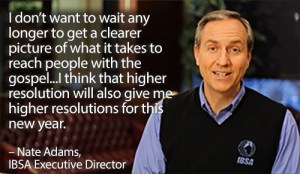
I can see things so much more clearly now. It makes me wonder why I waited so long to get a better picture. I don’t want to wait any longer to get a clearer picture of what it takes to reach people with the gospel either. I think that higher resolution will also give me higher resolutions for this new year.

Nate Adams is executive director of the Illinois Baptist State Association. Respond at IllinoisBaptist@IBSA.org. This column appears in the 1/4/16 issue of the Illinois Baptist.

Editor’s note: After an often tearful year, the Christian’s counterattack is hope.  The enemy may use the events of last year to strike chords of fear, but in reporting them, we offer notes of hope for 2016. God is in control of this world, and whatever happens, this history being made before our eyes will turn people toward him. He is our hope.
This is our certainty as we anticipate the new year, our hope.

Gender-squareBy Lisa Sergent | The U.S. Supreme Court ruling in June declaring same-sex marriage to be a constitutional right in all 50 states seemed to open a floodgate.

Olympic hero Bruce Jenner was named Woman of the Year by Glamour magazine after he reimagined himself as “Caitlyn.” Then, almost immediately, transgender issues multiplied, even reaching Illinois.

Consider what happened when Township High School District 211 tried to fight the federal government. A transgender boy wanted to use the girls’ locker room at Palatine High School. He was denied access by school officials. The student, who is still anatomically male, took the demand to the Department of Education. After several meetings, the suburban Chicago school board acquiesced to the demands and submitted to monitoring by the OCR through 2017.

Andrew Walker of the SBC’s Ethics and Religious Liberty Commission wrote, “By taking the action it has, the federal government is endorsing a worldview of expressive individualism—a worldview that shuns limits, endorses controversial gender ideology, and opens up society to ever-evolving standards of sexual morality.”

So far, only Texans are successfully standing against the transgender advance. After a citywide “rights ordinance” was defeated 62% to 38% in November, Second Baptist Houston’s pastor Ed Young said, “I think there are enough people in the city who still have and will vote godly principles. A lot of people did some soul searching and said ‘This is enough.’”

What can pastors do? Ahead of these developments, Russell Moore told Baptist editors in February that transgenderism is likely to come first to the church youth department as adolescents copy the blurring of male and female identities in the larger culture. Be ready.

For pastors, the call in 2016 is to preach Genesis 1-2 descriptive of the sexes and the whole of Scripture as prescriptive of marriage, family life, and sexual identity and behavior. Have we ever before needed sermons saying “boys will be boys” is no excuse for sin, but instead a plea for gender sanctity?

Meanwhile, the blurring continues—literally. Pantone Color Institute chose two hues as 2016 Color of the Year. They’re blending pink and blue to demonstrate “gender fluidity.” Pantone calls it “a color snapshot of what we see taking place in our culture that serves as an expression of a mood and an attitude.”

Editor’s note: After an often tearful year, the Christian’s counterattack is hope.  The enemy may use the events of last year to strike chords of fear, but in reporting them, we offer notes of hope for 2016. God is in control of this world, and whatever happens, this history being made before our eyes will turn people toward him. He is our hope.
This is our certainty as we anticipate the new year, our hope.

Jesus-squareBy Eric Reed | The killing of 14 people at a social services facility in San Bernardino, California came only two weeks after the fatal shootings of 192 people in Paris in November. At first, the California attack seemed different from the Paris massacre: far fewer fatalities in a daytime shooting following angry words in the workplace.

But then, similarities emerged. Weapons of war altered to discharge more rounds and kill more people, a stockpile of explosives, young people with Middle East backgrounds, and finally the verdict: self-radicalized Muslims.

The fear of ISIS-connected terrorist attacks on U.S. soil that has marked 2015 appeared plausible and justified. But for some Christians, combatting terrorism on a national security level became complicated by biblical mandates to care for widows and orphans and strangers as we witnessed the flight of 1.5 million Syrians from their own homeland, trying to escape ISIS rebels themselves.

There was no uniform response from Southern Baptists. Several leading pastors agreed that Syrian refugees should not be admitted to the U.S. And polls showed many people agreeing with Republican presidential candidate Donald Trump who recommended halting Muslim immigration in response to terror attacks.

But others found themselves defending Muslims as Russell Moore, president of the SBC’s Ethics and Religious Liberty Commission, cautioned, “A government that can close the borders to all Muslims simply on the basis of their religious belief can do the same thing for evangelical Christians.”

What are believers to do? First, we pray. That is not a simplistic answer. To know the mind of Christ, we study his Word and we pray. The Teacher who instructed us to “love our neighbor as ourselves” is the same One who said “be shrewd as serpents and innocent as doves.”

Second, we can educate ourselves. The pastor who said that members of his church are “all over the place” on handling Syrian refugees can lead meaningful discussion rather than allow his flock to wander into emotional or unbiblical arguments.

Third, remember the spiritual need of all persons involved. “Our Muslim neighbors are not people we want to scream and rail at—we don’t want to demonize our mission field,” Moore told Buzzfeed. “I think that the evangelistic missionary impulse of Christianity that sometimes seculars present as nefarious actually is what grounds evangelicals to see individuals not as issues but as persons.

“Every person may well be our future brother or sister in Christ.”