Archives For June 30, 2017

Old Holy Bible and the American Flag

As we approach July 4th, many pastors preach about Christians in America repenting of sin and turning back to the Lord so that He will bless His churches. One text they often use is 2 Chronicles 7:14 (NASB):

“[If] My people who are called by My name humble themselves and pray and seek My face and turn from their wicked ways, then I will hear from heaven, will forgive their sin and will heal their land.”

Is that an appropriate application of this text?

To be clear, these are God’s words spoken to Solomon, King of Israel. Likewise, the “land” referred to was the land of Israel. When the Israelites sinned against the Lord, He would send the plagues mentioned in verse 13. But if they responded by humbling themselves, praying, seeking God’s face and turning from their wicked ways, God would hear from heaven, forgive their sin and heal their land.

Can Christians in America find any appropriate application from this text?

The Bible says in 2 Timothy 3:16 (NASB), “All Scripture is inspired by God and profitable for teaching, for reproof, for correction, for training in righteousness.” The word “Scripture” in this text referred to Old Testament Scripture. That would include 2 Chronicles 7:14, rightly interpreted.

Likewise, when the apostle Paul cited Old Testament examples of rebellion in Israel’s history that prompted God’s punishment, he noted that they also served as warnings for Christians living under the new covenant. Paul said in 1 Corinthians 10:11-12 (NASB), “Now these things happened to them as an example, and they were written for our instruction, upon whom the ends of the ages have come. Therefore let him who thinks he stands take heed that he does not fall.”

Is America Israel? No. Is God an American? No. But can warnings and promises to God’s people in the Old Testament be applied to Christians today? Absolutely.

Regarding 2 Chronicles 7:14, it is very appropriate for any Christian to obey the spirit of this text by endeavoring to humble himself or herself, pray, seek God’s face and turn from wicked ways, trusting that God will hear, forgive and heal.

The apostle Peter, speaking to a group of first-century Christians, said this: “For you once were not a people, but now you are the people of God” (1 Peter 2:10 NASB). Today, followers of Jesus are God’s people. Christians are those who are “called by [His] name.” Therefore, it is appropriate that we apply the timeless truths of 2 Chronicles 7:14. How suitable for all Christians in America, and in any other nation, to humble ourselves, pray, seek the Lord’s face and turn from our wicked ways, asking Him to graciously hear from heaven, forgive our sin and bring spiritual healing to the ailing, impotent churches in our land.

In 2 Chronicles 7:14, we note three precepts that are consistently called for by God throughout Scripture: humility, hunger and holiness.

The first requirement for such spiritual healing is humility. “[If] My people who are called by My name humble themselves.” It is always good for Christians to walk humbly with our God (Micah 6:8). God will share His glory with no one because God alone can handle His glory. Every redeemed human being should give all glory to Jesus for salvation and every benefit it brings.

Frankly, modern Christianity is marked by far too much arrogance and condescension. For instance, all of us need to use great caution and wise deliberation when posting on social media. The Bible says, “Let no unwholesome word proceed from your mouth, but only such a word as is good for edification according to the need of the moment, so that it will give grace to those who hear” (Ephesians 4:29 NASB). The word “unwholesome” is the Greek word sapros, meaning “rotten.” Here it refers to speech that is likened to “garbage” or “trash.” Frankly, there is too much “trash-talk” on social media. Humility is always becoming in any child of God.

The second requirement for spiritual healing is hunger. We see it in 2 Chronicles 7:14 in the words: “(If) My people who are called by My name … pray and seek My face.” Jesus urged His followers to “hunger and thirst for righteousness” (Matthew 5:6 NASB). All Christians in America — and other nations — would do well to increase our hunger for godliness. We should taste and see that the Lord Jesus is good (cf. Psalm 34:8).

The final requirement for spiritual healing is holiness. “[If] My people who are called by My name … turn from their wicked ways.” Holiness comes by means of repenting from sin. Repentance means to confess our sins and turn away from them. That leads to true holiness.

These three emphases from 2 Chronicles 7:14 — humility, hunger and holiness — are much needed among Christians today, whether we live in America or not. Just because 2 Chronicles 7:14 was not written to Americans does not mean that Christians in America cannot benefit from its admonitions by obeying its precepts. Again, “all Scripture is profitable.” The warnings in the Old Testament “were written for our instruction.”

Many Christians in America are praying for a fresh spiritual awakening and revival among those of us who know Jesus Christ. I for one am praying for American Christians to embrace genuine humility, hunger and holiness. I am also praying that the Lord will graciously see fit to hear from heaven, forgive our sin, and send His much-needed healing.

When I think of it that way, I don’t know of a verse in the Bible that serves as a better guide for praying for revival than 2 Chronicles 7:14.

–Steve Gaines is president of the Southern Baptist Convention and pastor of Memphis-area Bellevue Baptist Church. This column originally appeared at BPnews.net.

New task force to explore baptisms decline, ERLC complaints fail to materialize at Annual Meeting

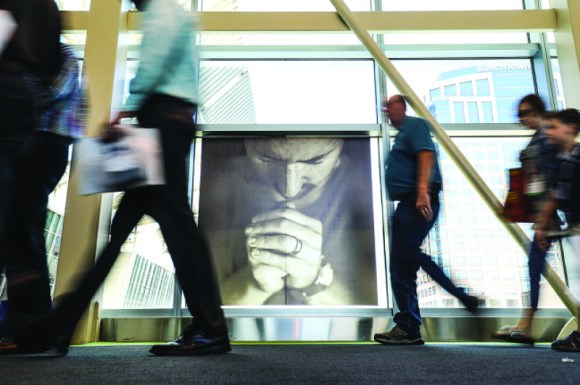
Prayer begets

If we took a selfie in Phoenix, this would be it. Busy days framed by prayer are represented in this photo from the Phoenix Convention Center during the June 13-14 SBC Annual Meeting and the week of meetings, preaching, and witnessing that preceded it.

Debate over a resolution condemning “alt-right racism” took the spotlight, but lesser reported actions at the 2017 Southern Baptist Convention will address another serious issue facing the denomination, an ongoing decline in baptisms and membership. And a matter some anticipated would make headlines failed to produce debate, complaints against leadership of the SBC’s Ethics & Religious Liberty Commission.

SBC President Steve Gaines announced plans for a year-long study on evangelism in the denomination, and the presentation of a plan for more effective soul-winning by SBC churches and pastors. Gaines’ effort comes after another year of baptism declines and a decade of shrinking SBC church membership.

“I was not prompted by any man to get this done,” Gaines said in Phoenix, “but the Lord laid this on my heart to emphasize prayer last year, and to emphasize evangelism this year.”

The Memphis-area pastor, who was re-elected to a second one-year term, named 19 pastors, professors, and seminary presidents to a task force, which will bring

2018 convention in Dallas. Southwestern Seminary President Paige Patterson, a proponent of traditional personal evangelism, will chair the panel. And Illinois’ Doug Munton, pastor of First Baptist Church of O’Fallon will also serve.

Gaines asked North American Mission Board President Kevin Ezell to present the motion creating the task force. Ezell outlined the troubling situation among SBC churches: The SBC has seen a steady decline in baptisms since 1980; 80% of SBC churches baptized 9 or fewer people in the most recent report of Annual Church Profiles, 50% reported two or fewer baptisms, and 25% baptized no one.

“I don’t think any pastor in the room would say they don’t have a passion for the lost, but I do think there is a practice problem,” Ezell said.

After the Phoenix meeting, Gaines urged continued prayer for renewal in our churches. “We must make prayer, evangelism and discipleship the priorities of our lives. We must jettison our selfish agendas and focus on Christ’s Great Commission,” Gaines said.

The Gaines

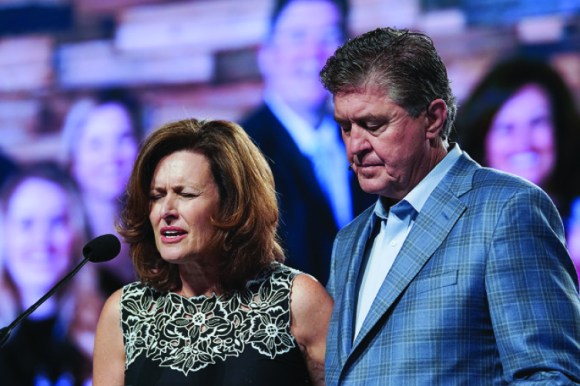
Donna Gaines prays fervently for her husband, SBC President Steve Gaines, just before he preaches during the opening session of the Annual Meeting. Gaines made prayer the focus of his first one-year term, and announced evangelism as the emphasis of his second term.

ERLC reports as usual
An anticipated debate over the ERLC did not materialize at the convention. Leaders had worked since January to heal strained relations between ERLC President Russell Moore and some pastors who objected to his comments about candidate Donald Trump last year, and also to his stance on a controversial religious liberty case involving construction of a mosque in New Jersey.

Moore would not comment on recent published reports that characterized the conflict as unresolved, positioning it as a generational tug-of-war between older Southern Baptists and younger leaders new to their positions. One report also said the ERLC is having difficulty accessing the Trump administration. Southern Baptists have been represented by Texas pastors Robert Jeffress and Jack Graham at recent White House functions involving religious freedoms.

Moore told the Illinois Baptist at a news conference that he saw the annual meeting as a “family reunion” of people who together advance the gospel.

The ERLC report was the last item on the convention agenda, when attendance in the hall is usually low and time for questions is limited. One motion to defund the ERLC was ruled out of order, as the SBC budget had been approved early in the opening session.

Moore restated the ERLC’s commitment to represent Southern Baptists on issues of marriage and family, sanctity of life, and religious liberty. “We are committed to be the Paul Revere, going ahead, speaking to churches, speaking to the officials, speaking to the public square… speaking to the watching world with a different word,” Moore said.
Moore interviewed Chicago pastor Nathan Carter about his church’s lawsuit against the city, which has blocked their purchase of a building in the University District because of parking rules.

‘Alt-right’ and other resolutions
Moore was at the table at a news conference on the first day of the convention, when the chair of the Resolutions Committee, former ERLC Vice President Barrett Duke explained why the panel did not bring the proposed resolution on racism and the alt-right supremacy movement to the floor for a vote. Moore was reportedly involved in the late-night writing session that produced a new resolution on the issue. And he addressed the proposal as a messenger from the floor.

“Southern Baptists were right to speak clearly and definitely that ‘alt-right’ white nationalism is not just a sociological movement,” Moore later said, “but a work of the devil.”

The resolution “on the anti-gospel of alt-right white supremacy” urged messengers to “earnestly pray, both for those who advocate racist ideologies and those who are thereby deceived, that they may see their error through the light of the Gospel, repent of these hatreds, and come to know the peace and love of Christ through redeemed fellowship in the Kingdom of God, which is established from every nation, tribe, people, and language.”

Another resolution addressed “the importance of moral leadership.” That resolution was a repeat of one passed during the Clinton administration’s Monica Lewinsky scandal. When asked whether the resolution was directed toward the Trump administration, Duke pointed out that neither the 1998 resolution or this one mentioned the president by name. We need moral leadership at every level, he said.

The resolution urged messengers to pray “that God will help us and all our fellow citizens to embrace the biblical moral values that will honor our creation in God’s image and bring God’s blessing on our nation.”

Ten resolutions in all were passed.

  • One on gambling specifically named it as a sin.
  • A statement reaffirmed the doctrine of penal substitutionary atonement—which says Jesus took upon Himself in His death the divine punishment due sinners—“as the burning core of the Gospel message and the only hope of a fallen race.”
  • And a resolution on campus ministry “urged our fellow Southern Baptists to devote considerable prayer,” among other resources, to “evangelistic and discipleship endeavors” on college and university campuses.

More Midwest voices
The Executive Committee brought a $192-million Cooperative Program allocation budget for next year. Messengers approved it. They also granted permission for the EC to sell its current building in downtown Nashville, should they receive a good offer. A building boom in the city has made the property very valuable, as was the case with the massive LifeWay publisher’s facilities which were sold last year in order to downsize. Proceeds after relocation would go to missions, EC President and CEO Frank Page said.

Another motion brought more Midwest representation to the Executive Committee. Four regions were given representation, even though they have too few church members to apply under the provisions of SBC Bylaw 30. The recommendation amended Bylaw 18 to list the Dakotas, Iowa, Minnesota-Wisconsin and Montana conventions as each being entitled to a single EC representative.

With this Annual Meeting, Illinois representative Wilma Booth completed two four-year terms on the EC. She will be succeeded by Adron Robinson, pastor of Hillcrest Baptist Church in Country Club Hills. And Sharon Carty, member of Emmanuel Baptist Church in Carlinville, will replace Charles Boling of Marion.

Messengers at the 2017 convention totaled 5,018.

The 2018 SBC will be held in Dallas.

-Eric Reed with additional reporting from Baptist Press