Archives For November 30, 2014

Nate_Adams_Dec15HEARTLAND | Nate Adams

Have you ever found yourself heading into the Christmas season feeling blue? I have. In fact, this was one of those years.

I couldn’t put my finger on exactly why I felt down, other than the fact that several things haven’t turned out the way I would have hoped this year. It appears some of the key measurements we set for our work at IBSA are not going to be met. In arenas outside IBSA that I care about, several decisions were made this year that were very different than what I thought best. Several people disappointed me. Even as I looked around for things I could call personal successes, well, I just couldn’t think of many.

The second factor that contributed to my blueness was just the sheer volume of work and challenges that seemed to still lay before me. After working so hard and seeing so little of the success I was looking for, it was hard to find the energy to dig in again.

In my blueness, I turned to music for some encouragement and reassurance. I found on my iPhone a playlist of 13 songs titled “Colorado Renewal 2013” that I had made two summers ago, during some personal retreat time. The first song, “Disappear,” by Bebo Norman, quickly gave expression to what I was feeling:

On a day like this I want to crawl beneath a rock
A million miles from the world
, the noise, the commotion – that never seems to stop.
And on a day like this
I want to run away from the routine
Run away from the daily grind
that can suck the life, right out of me.
I only know one place I can run to…

A place to run to is what I was looking for. And the song didn’t disappoint.

I want to hide in You, the way, the life, the truth so I can disappear
And love is all there is to see coming out of me
, and You become clear as I disappear.

For the next few minutes, I ran to Jesus, and disappeared there. I found sweet relief in the reality that Jesus’ completed work on the cross is all I need. I don’t have to earn or deserve anything more. Hidden in Him, everything returns to its proper perspective.

Then, just as the words of the first verse helped me express my discouragement, the words of the second verse helped me set a new direction, and a new motivation for the future.

I don’t want to care about earthly things
Be caught up in all the lies that trick my eyes
, they say it’s all about me
I’m so tired of it being about me.

As I looked back on the things that were making me blue at Christmas time, I realized they really were all about me, and what I could accomplish or control, what I could perhaps call success. And I realized that somehow I had indeed been deceived into thinking that my work, my successes, or even my ministry were the sources of my joy.

I recently watched a documentary about Bing Crosby that credited his classic “White Christmas” with being the song that first secularized Christmas. Until then, most Christmastime songs were sacred, Christ-centered. But after White Christmas, lots of writers and composers began creating sentimental Christmas songs with someone or something other than Christ as their focus. Of course one of those was Elvis Presley’s now famous lament, that it will be a “Blue Christmas without you.”

A Christmas season that depends on successes, or other people, or anything other than Jesus is bound to be blue. Maybe that’s one reason the shepherds fled their work and their despair and their longing and “came with haste” to the manger. That’s exactly where I want to run to and disappear this Christmas.

Nate Adams is executive director of the Illinois Baptist State Association.

Nick_RynersonCOMMENTARY | Nick Rynerson

It’s that time of year again. Christmas pageants, Advent sermons, beautifully lit homes, crowded malls, and—of course—television commercials showing you “the perfect gift for this holiday season.” Consumeristic binge-shopping and “once a year sales” have become as much a part of American Christmastime as trees, stockings, and the Nativity scene.

Modern Christians are quick to point out the gross consumerism that surrounds the celebration of Christ’s birth and we often viciously fight to curb and challenge Consumeristic Christmas™.

Perhaps rightfully so. As we all know, Christmas is more than just an excuse to spend money in excess, get together with family, and watch “It’s a Wonderful Life.” Christmas is a time to celebrate that God loved humanity enough to send His Son to free us from the unsolvable mess of sin we’d gotten into. Christmas marks the beginning of the end for humanity’s sin problem.

And, amazingly, we live in a culture that recognizes that.

Our culture may not recognize that they recognize it, but think about it for a second: probably almost everyone you know (if you live in the United States) changes up their life rhythms to spend prodigious amounts of money on other people, make an effort to get together with estranged relatives, and even go to church (sometimes)!

Christmas shoppingWhenever I think of how most non- Christian Americans celebrate the Christmas season, I’m deeply moved. The secular “holiday spirit” reminds me of Paul’s words to the Greek pagans in Acts 17:

“And he made from one man every nation of mankind to live on all the face of the earth, having determined allotted periods and the boundaries of their dwelling place, that they should seek God, and perhaps feel their way toward him and find him. Yet he is actually not far from each one of us, for, ‘In him we live and move and have our being’; as even some of your own poets have said, ‘For we are indeed his offspring’” (Acts 17:26-28 ESV).

If we set aside our criticisms to consider the Christmastime shopping habits of most people, we will glimpse something that echoes the woman in Mark 14:3-8 who anointed Jesus’ feet with expensive oil—people spending reckless amounts of money on gifts for their children, parents, friends, and relatives. At the mall, masses of people seek to communicate the deep and Christ-reflecting love they have for their families and neighbors in the best way they know how: through gift-giving.

While there are clearly sin issues at play in American consumerism, let’s be encouraged that—at least at Christmas—the generosity of Jesus flows through our malls and checkbooks. And when we talk with our non-Christian neighbors about Jesus this Christmas season, we, like Paul, can affirm God’s image, God’s love, and God’s common grace in them.

Nick Rynerson is a staff writer for Christ and Pop Culture and works for Crossway Publishing in Wheaton.

Leaders debate in wake of grand jury decisions

THE BRIEFING | Meredith Flynn

The Christian Post reports on a disagreement among some Southern Baptist leaders, following a grand jury’s decision not to indict Police Officer Darren Wilson in the death of Missouri teenager Michael Brown.

The_Briefing“Seems to me that racial reconciliation is a good thing and is a social issue, not a doctrinal or theological issue, and certainly not a “gospel demand,'” blogged Texas pastor Randy White. “If there is something Biblical that expresses racial reconciliation as a gospel demand, I’ve missed it.”

White’s Nov. 26 post at randywhiteministries.org was in response to Southern Seminary vice president Matthew Hall, who wrote about racial injustice after a Missouri grand jury decided not to indict former Ferguson police officer Darren Wilson in Brown’s death. Hall blogged the gospel demands racial reconciliation and justice, and gave five reasons why Christians ought to heed its instruction on the issues.


“…It’s high time that we start listening to our African-American brothers and sisters when they tell us that they’re experiencing a problem in this country,” Russell Moore said after a Staten Island grand jury did not indict Officer Daniel Pantaleo in the death of Eric Garner. In a Questions & Ethics podcast recorded after the verdict was announced Dec. 3, the Ethics and Religious Liberty Commission President denounced racial divisions in and among churches.


As a 13-year-old, Christian rapper Lecrae went free after harassing people with a pellet gun, he said in a Dec. 3 Facebook post. “One officer decided not to arrest me years ago but instead challenged me to get in my Bible.” The post was published on the same day as the Cleveland funeral of 12-year-old Tamir Rice, who was shot and killed by a police officer while carrying a pellet gun.


A Southern Baptist pastor in Florida was killed Dec. 4 by a gunman who also took the lives of two women. Baptist Press reported police arrested Andres Avalos in Bradenton two days after the murders of Pastor Tripp Battle, Amber Avalos (Andres Avalos’ wife), and Denise Potter. Battle was the pastor of Bayshore Baptist Church in Bradenton; his father-in-law, Keith Johnson, was formerly on staff at FBC Machesney Park and Vale Church (Bloomington) in Illinois.


Six in ten Americans say the government shouldn’t define or regulate marriage, according to this recent LifeWay Research study, and more than half say clergy should no longer be involved in the state’s licensing of marriage.


A group of religion leaders, including Pope Francis, have pledged to do everything they can to end human slavery by 2020.


Religion News Services wonders how Christians will respond to “Unbroken,” the Louis Zamperini biopic from director Angelina Jolie. The film reportedly doesn’t deal with Zamperini’s Christian faith, chronicled in Laura Hillenbrand’s 2010 book from its beginnings at a 1949 Billy Graham Crusade.


Why my family puts a shoebox under the Christmas tree

HEARTLAND | Serena Butler

UNCLE BENNY – The Butler family remembers the best reason to celebrate Christmas.

UNCLE BENNY – The Butler family remembers the best reason to celebrate Christmas.

Where do babies come from? It’s a question children have been asking through the ages and one that parents have found some creative ways of answering. My family has a unique explanation for a baby’s arrival to its new family.

When my dad, Charles, was about two years old, his mother was expecting a baby. The day came for the birth, and the doctor was summoned to the farmhouse in northern Florida. My grandfather took my dad and his older sister out into the fields to take a walk so that they would not be in the house during the delivery. A little while later, when they returned home, my newborn Uncle Benny was there. Because the family did not have a cradle for the baby, Uncle Benny was placed in a shoebox. So, if you were to ask little Charles Butler where babies come from, he would tell you that the doctor brings them in a shoebox.

Seventy-five years ago, Benjamin Harrison Butler was born and placed in a box. Two thousand years ago, another baby was born and placed in a box. Benny was a gift to his family. Jesus was a gift to the world.

This is the time of year when Christians remember the gift of the Christ-child. We hang lights, put up trees, and buy gifts for one another. We plan special worship services and send cards to family and friends. But we must remember that Christmas would not exist if it weren’t for the crucifixion and resurrection. The birth means nothing without the death. For this is the gospel, that Jesus died for our sins and rose from the dead, conquering the power of sin in our lives.

Grace, mercy, forgiveness, and new life are the true gifts given through Christ. But we celebrate the gift at its beginning, the birth.

2 Corinthians 5:17-18 says, “The old life is gone; a new life has begun! And all of this is a gift from God, who brought us back to himself through Christ. And God has given us this task of reconciling people to him.” When we accept the gift, our life is changed forever. In fact we are given a new life. And this new life is a gift from God.

We know that. We have heard it through numerous sermons and devotions. We know it through our own life experiences. But how often do we ignore the next part? Once we have received the gift of salvation, we then are given the responsibility of passing that gift on to others. The verse tells us that we have been “given the task of reconciling people to him.” That means sharing the gospel.

Christmas shopping season is upon us. We will visit malls and shop online. Some of us will spend hours making gifts to be given to loved ones. But the clothes we give will be outgrown or wear out. The toys will break or be cast aside. The electronics will become outdated.

Jesus is the one gift that will never fade away. It is truly the best gift anyone could receive. Paul describes it this way: “Thank God for this gift too wonderful for words!” (2 Corinthians 9:15)

A few years ago, my dad told the story of Uncle Benny’s birth to his Sunday school class. He also related it to the birth of Christ and how he was placed in a box. A few weeks later the class gave my dad a present. It was a baby doll in a shoebox to represent both Uncle Benny and the baby Jesus.

Now, if you were to visit the Butler home at Christmas and look under the tree, you would see a baby doll, dressed in blue, in a shoebox. He is named Uncle Benny, but he is a reminder to our family that the greatest gift of all is Jesus, a baby who was born and placed in a box. It is also a reminder that the baby should not stay with us, but we should be giving Jesus to others.

So, as you look for that perfect gift this Christmas, don’t overlook the gift you already possess. Jesus is the gift that is always the right size, won’t wear out or go out of style, and will be exactly what they were wishing for.

Serena Butler is Upper Midwest regional manager for Operation Christmas Child. She formerly served as IBSA’s director of missions awareness and Illinois WMU.

COMMENTARY | Meredith Flynn

“Great Awakening: Clear Agreement, Visible Union, Extraordinary Prayer.” The theme for the 2015 Southern Baptist Convention won’t fit easily on a T-shirt. But it’s a clear prescription for the kind of spiritual awakening Ronnie Floyd has been talking about since his election as SBC President.

SBC Annual Mtg logo

Theme art for the 2015 Southern Baptist Convention

The complex rallying cry also is a departure from the themes chosen over the past several years. While past presidents have certainly called Baptists to greater engagement in evangelism and missions, this is the first year in recent memory that a leader has set so direct a path to a common goal.

Floyd, pastor of Cross Church in northwest Arkansas, is uniquely situated to call Baptists to prayer. He’s written books on prayer, fasting and revival. He gathered leaders for regional and national meetings devoted to praying together. He is also leading the SBC at a time when churches are baptizing fewer people and facing more pushback from the culture.

When asked in a recent media conference call what he’s learned in his first few months as president, Floyd said he has found that Southern Baptists are optimistic about the future of the denomination.

“I have also found that while we have our challenges, people are very hopeful that we’re gonna find a way to make things happen together.”

Perhaps that’s why “clear agreement” and “visible union” are two prongs in Floyd’s theme: He’s hearing that Southern Baptists want to move forward as a denomination, despite decline or differing theology. “Southern Baptists need to be together,” he told media, referencing why he wants as many people as possible to be at the SBC Annual Meeting next June.

The Call to Columbus might be a difficult sell—it’s an out-of-the-way convention city for many Baptists, it’s an election “off-year,” and there’s no Disney World or White House anywhere nearby.

But Floyd’s call to “extraordinary prayer”—something he has trumpeted since his election—is intriguing. He drew the phrase from a Jonathan Edwards sermon whose title rivals that of Floyd’s new e-book in length. In “Pleading with Southern Baptists…,” the SBC President lays out the need for a great awakening in our culture and our churches (see sidebar at right), and suggests five action items.

His plan is reminiscent of the Isaiah 6 cycle people prayed through at the IBSA Annual Meeting in November, not because of its content, but because Floyd’s list puts the priority on prayer as the jumping-off point for any great move of God.

“It’s time to pray,” he said shortly after he was elected in Baltimore. “Quite honestly, it’s past time to pray.”

Baptists have heard the call, clearly outlined. Now, the question is whether they’ll heed it.

Meredith Flynn is managing editor of the Illinois Baptist newspaper.

THE BRIEFING | “It’s business as usual” at First Baptist Church of Ferguson.

“We had a very normal Sunday, a fairly normal size crowd for worship, without any disruptions,” said Ron Beckner, the church’s associate pastor.

Nearly a week after violence erupted in the wake of a grand jury’s decision not to indict Ferguson police officer Darren Wilson, the church continues to go about the business of Gospel ministry.

The_BriefingWhile there are protests ongoing, Beckner said they have been “largely peaceful” following the Thanksgiving holiday. “We’re taking things one-step at a time and are hopeful the violent reaction has faded.”

Pastor Stoney Shaw led the church in prayer for the community, its residents, and leaders Sunday morning. Beckner said Shaw reminded the church that this Christmas and throughout the year, “Jesus is the harbinger of peace.”

The church will continue with its regular Wednesday evening programming this week which includes AWANAs, youth group, and prayer meeting. “We want to be as normal as we can be,” Beckner said. “We want to function as normally as possible unless we can’t.

“We’re continuing to do what we’re planted here to do. We’ll change and adapt as needed to minister to our community.”

Reported by Lisa Sergent. Click here for more on how to pray for Ferguson.


A Ferguson-focused Facebook post by football player Benjamin Watson garnered nearly 825,000 “likes” and more than 450,000 shares in the week after the New Orleans Saint published his thoughts on the verdict. “…[U]ltimately the problem is not a SKIN problem, it is a SIN problem,” Watson wrote. “…BUT I’M ENCOURAGED because God has provided a solution for sin through the his son Jesus and with it, a transformed heart and mind.”


Long-time Baptist leader and pastor Jim Burton writes about how the church must deal with disability in this Baptist Press column. Burton’s own experience in “the blue zone” (noting the color of handicapped parking signs) began with a 2013 diagnosis of Lou Gehrig’s disease, or ALS.


58% of Protestant senior pastors support immigration reform “that includes a path to citizenship for those who are currently in the country illegally,” according to a pre-election survey by LifeWay Research. While 87% of responders said the U.S. government has a responsibility to halt illegal immigration, 79% said Christians should assist immigrants, even those who are in the U.S. illegally.


Bob, Larry, and all their veggie friends are now streaming on demand in a brand-new Netflix series. The first five episodes of “VeggieTales in the House” debuted Nov. 26. “It’s been clear that if we want the characters and the ministry to stay alive, then they need to keep moving as kids move to viewing media in different ways, VeggieTales creator Phil Vischer told Baptist Press.


HEARTLAND | Nate Adams

Recently Chicagoland church planter Dave Andreson was addressing a group of mostly college students on the subject of how to pray for your community. I was there primarily because our son Noah was hosting the meeting at his church, Calvary Baptist in Elgin.

Nate_Adams_blog_callout_Dec1Most of the students were from Judson University there in Elgin, where IBSA is developing a church planting partnership. Dave spoke pointedly to them. “If you’re not currently praying for your community, let me tell you why that probably is,” he said. “It’s because you haven’t really taken ownership of this community. You think of your community as the place that you’re from, or where your family lives. You figure you’re just here for a few years, going to school, so why bother? In the meantime, many of the people you will meet here desperately need to know Jesus Christ.”

I winced with conviction at the truth of Dave’s observation, and not just for college students. Sadly, I’ve known people who seem to have the mindset that their situation is temporary, and as a result they seem to be just biding their time spiritually.

“Oh we just came here for Bill’s job, but we’ll be going back home eventually,” they sometimes say. And yet when asked how long they’ve lived there, the answer is often twenty or thirty years.

Or, “When our kids are older and life slows down some, we may have more time to do missions or help with outreach.” Especially in today’s ever-changing and mobile society, we cannot wait until our situations are more “permanent” to take ownership of our communities. That day may never come.

Dave went on to speak of the passion that Jesus had for a city, and for a crowd, and for a man named Zacchaeus. He urged us to be like Jesus and see our city, and our crowds, and the God-created individuals around us with spiritual eyes. And he invited us to pray with him for Avondale, the Chicago neighborhood that he has now made his home, and where he is seeking to plant a new church. Avondale is a community of only two square miles, yet 40,000 people live there. It has no Baptist church, and little if any evangelical witness.

Dave challenged us all that night to take ownership of our communities, wherever we find ourselves, and to do it now. We can’t wait for more permanent or ideal circumstances. People need prayer, and relationship, and the Gospel message.

His challenge reminded me of a time that our family ate at a fast food restaurant, when our boys were still little. Though the employees were working hard, the dinner rush had overwhelmed them and more than half of the tables were a mess while the trashcans overflowed. So as we left, I asked our boys to help me clear the rest of the tables in the restaurant, in addition to our own. “But Dad, we don’t work here!” one of them cried. And yet because I asked them to, they helped me take responsibility for other people’s messes, there in our temporary community.

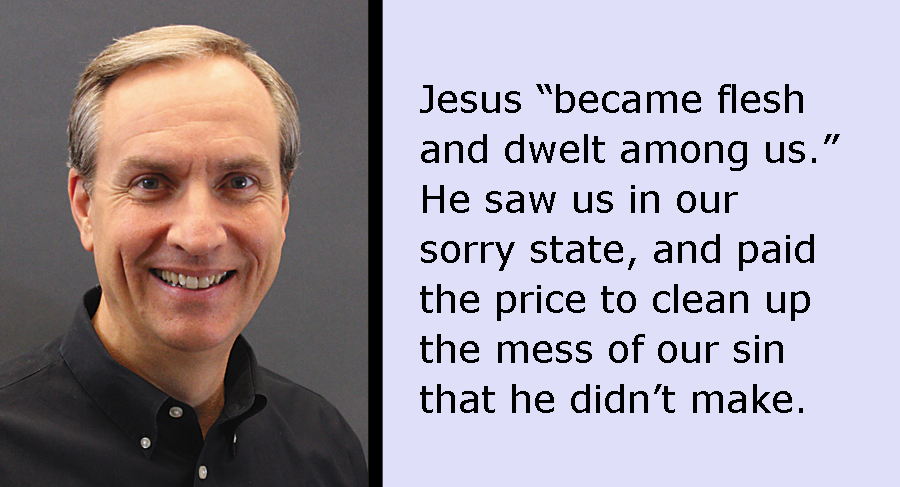
As we enter another Christmas season and begin reflecting on the birth of Christ, let us remember that Jesus willingly entered our world and made it His home. He “became flesh and dwelt among us.” He saw us in our sorry state, and paid the price to clean up the mess of our sin that he didn’t make.

So let’s enter in and spiritually invest in our own communities, even now. Let’s take ownership of where we live, even if it doesn’t feel permanent, or even if it’s in a difficult place like the Avondale neighborhood of Chicago. Our community, wherever it is, is our mission field. Home is here, and the time is now.

Nate Adams is executive director of the Illinois Baptist State Association.