


Our approach to teaching our children about Christian sexuality cannot be, ‘Just say no. Just don’t do it.’ That’s not a Christian sexual ethic. …We want them not to just have a right view about what to say no to, we want them to have a comprehensively Christ-centered, Christian view of sexuality.”
Archives For March 31, 2014
You’re not defined by your temptations. You’re not predestined by your temptations. You’re not necessarily sinning by your temptations.
“We have to show people what it is to take up their cross and follow God.”

NEWS | Meredith Flynn
Nashville, Tenn. | There are few things that make the Gospel more offensive and more out of sync with culture than what the Bible teaches about sex. But the church has to keep talking about it.
J.D. Greear, pastor of The Summit Church in Raleigh-Durham, N.C., told leaders gathered for the Ethics and Religious Liberty Commission’s summit on the Gospel and sexuality that the church can’t surrender the “high ground” in talking about sex, and also shouldn’t avoid hard topics like homosexuality. Greear also stressed that the root of sexual sin is idolatry, and the Gospel is powerful to deal with it.
“Our message cannot simply be, ‘Stop having sex.’ Our message has to be, ‘Behold, your God.'”
Encouraging leaders not to avoid hard topics, Greear said he had struggled two years ago with whether to speak publicly in favor of his state’s attempt to define marriage as between a man and a woman. He did and was met with harsh criticism, including one blogger who published the Greears’ home address.
For three weeks, Greear thought he and his leadership team might have made the wrong decision, he said. But now he has little doubt it was the right thing to do. Teaching his church to think “Christian-ly” about the issue was the goal; also, his church has seen several people come out of a homosexual lifestyle, accept Christ, and be baptized.
Greear’s message and the first day of the ERLC summit got a lot of attention on Twitter; by Monday evening, #erlcsummit was one of the social media site’s top trends. Posts from conference attendees were positive, but others watching from home or following the tweets expressed different views. The Twitter traffic seemed to increase when several leaders joined Greear on stage for a panel discussion on the Gospel and homosexuality.
There were light moments, like when Florida pastor Jimmy Scroggins told pastors to reject “redneck theology” when talking about homosexuality. No more “Adam and Steve” jokes, he said. But the conversation was serious when the panel talked about what pastors should do when gay people or couples want to join their church, or how to counsel a Christian who still feels attracted to members of his or her same sex.
“There are things that are broken because of the curse of sin that you becoming a believer doesn’t automatically fix,” Scroggins said. That’s why pastors have to preach the second coming of Christ, he said, and the transformation of all believers who are in Christ. “In some mysterious way that I can’t comprehend, He is going to put Humpty Dumpty back together again,” Scroggins said. Breaking into a grin, he added, “Can’t wait to see these tweets.”
Watch the ERLC Summit online at live.erlc.com.
 NEWS | Meredith Flynn
Nashville, Tenn. | The first Leadership Summit hosted by the Southern Baptist Ethics and Religious Liberty Commission kicked off this afternoon at the SBC building in Nashville. The meeting of 180 church leaders is focused on how the Gospel applies to human sexuality, especially in a culture that’s changing fast.
“So many of the questions that pastors grapple with today deal with situations that would not even have been possible a generation ago,” ERLC President Russell Moore said when the summit was announced a few months ago. “As technology advances and the culture changes, the questions that we have to grapple with are often increasingly complex.”
The meeting’s first speaker, Heath Lambert, tackled one of those digital age issues with a keynote address on pornography. Lambert, executive director of the Association of Certified Biblical Counselors and a professor at Southern Seminary, said porn is a “silent killer” in churches.
“I think that pornography represents the greatest moral crisis in the history of the church,” Lambert said. It is “something that evangelicals can do in a dark room behind a shut door after they’ve railed against homosexual marriage and talked about conservative theology.”
Redefining marriage is a threat to the church, he added, but “a greater threat to the church today is the Christian pastor, the Christian schoolteacher, the Christian Bible college and seminary student, who exalts sound theology, who points to the Bible, and then retreats to the basement computer to indulge in an hour or three of internet pornography.”
Using Proverbs 7 as a backdrop, Lambert likened pornography to the Scripture passage’s “forbidden woman.” The Bible gives strategies for dealing with sexual temptation, and the church should too, he said. But the first call is to cling to the Gospel.
“I’m pleading with the church to have practical strategies…but those behaviors won’t be enough if we are not teaching people to draw near to Jesus Christ,” Lambert said.
He closed his message with three charges to church leaders concerning pornography: First, pursue accountability. 75% of pastors are accountable to no one for their internet activity, Lambert said.
Second, address your people. “If your job is to preach the whole counsel of God, here it is,” Lambert said. “You’ve got to talk about it. If we do not share this, if we overlook it, it’s folly. It’s foolishness.”
And third, awaken the world to the problem. “Evangelicals have tenderly and tenaciously taken up many causes…I want to ask that together we would begin to take up this cause, that we would begin to say, ‘Enough is enough.'”
Marriage, purity, human trafficking, and pastoral care for sexual sin are among the topics the Leadership Summit will explore through large-group sessions, breakouts and panel discussions. Check back here for updates, and watch it at live.erlc.com.
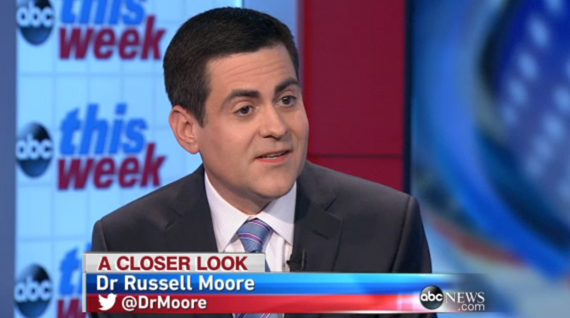
Russell Moore was joined on ABC’s “The Week” by fellow panelists Franklin Graham, Ralph Reed and Cokie Roberts. Photo from video on abcnews.go.com
NEWS | On Easter Sunday morning, ABC’s “This Week” featured a panel of guests discussing whether the influence of evangelicals is waning in the current culture. The group included Russell Moore, president of the Southern Baptist Ethics and Religious Liberty Commission, who said it is indeed a new day for Christians.
The percentage of people that are members of a church or synagogue has fallen from 70% in 1992 to 59% in 2013, said moderator Martha Raddatz, citing a Gallup statistic. She asked Moore if the numbers worry him, and what can be done about the decline.
“I’m not worried… because I think what we’re seeing is the collapse of a cultural, nominal form of Christianity,” Moore said. There was a time in America where in order to be a good person, to be seen as a good citizen, one had to nominally at least be a member of a church. Those days are over, and so we’re at a point now where Christianity is able to be authentic, and Christianity is able to be authentically strange.”
Moore pointed out that Christianity’s foundational beliefs are hard to grasp for the culture at large, but the disconnect isn’t unprecedented.
“Many people now when they hear about what Christians believe, what evangelical Christians believe, their response is to say, ‘That sounds freakish to me, that sounds odd and that sounds strange.’ Well, of course it does. We believe that a previously dead man is now the ruler of the universe and offers forgiveness of sins to anyone who will repent and believe.
“That’s the same sort of reaction that happened in the Greco-Roman empire when Christianity first emerged. So it offers an opportunity for the church to speak clearly, articulately, about what it is that we believe, to give a winsome and clear message about what the Gospel actually is.”
Raddatz asked Moore about his recent comment that “the illusion of a Moral Majority is no longer sustainable in this country.”
“Yes, it’s a different time,” Moore said on Sunday’s broadcast, “and that means that the way that we speak, we speak in a different way. We speak to people who don’t necessarily agree with us. There was a time in which we could assume that most Americans agreed with us on life, and on abortion, and on religious liberty and other issues. And we simply had to say, ‘We’re for the same things you’re for, join us.’
“It’s a different day. We have to speak to the rest of the culture and say, ‘Here’s why this is in your interest to value life, to value family, to value religious liberty.'”
The panel’s 10-minute conversation is available for viewing at the ABC News website.
 “Father, … I commit my spirit!”
Read Luke 23:46-49, John 19:31-42
Here are some signs that Jesus’ work really worked: The earth shakes, as God’s own creation trembles at the mighty act just finished on a barren hill outside the city. The massive temple curtain separating the place of God’s holy presence from sinful people is ripped from top to bottom, signifying the Creator’s invitation to humanity to enter into restoration. And on the cross, Jesus makes his own great declaration of faith in the Father’s plan: I trust You.
How could Jesus say this?
No prisoner in solitary confinement was ever more alone than our Christ on the cross. It had to be that way.
 Only Jesus could serve as the sacrifice for our sins. Only Jesus could be our spotless lamb. Only Jesus could be the human qualified to pay the penalty for sin. Because he was sinless. And in this he was unique in all of the universe. In this he was alone.
All he had to hold to was the Father’s promise of life on the other side of the grave. Soon he would rest, his salvation work complete. Soon all heaven would celebrate.
PRAY Lord, because of Your great love and completed work on the Cross, into Your hands I, too, commit my Spirit.
 COMMENTARY | Charles Lyons
I wish you could meet Richard.* When our church moved into the hulking former Masonic Temple, squatting on a Kedzie Boulevard corner, the guy I would come to know as Richard hung out with a crowd of 20 guys in front of our building each evening.
This was their hood. This was their corner. Now, many years later, Richard has confessed with his mouth and believed in his heart the Lord Jesus.
He’s in my Grow Group that meets every Thursday night. The week after Easter we were bemoaning that Richard had to work the previous Sunday. He’s a security guard at a hospital, which has served this dangerous Humboldt Park neighborhood since the early 1900s.
He was recounting the hectic happenings at his ER security post on Resurrection morning.
“Yeah, we had two rape victims come in, then we had two other girls who were hit and run…” His hands were waving. “Then we had a shooting victim brought in.”
Right about here I interjected, “This is all Easter morning?”
“That’s right,” he affirmed, voice rising.
“Then the Monsters* (local gang whose turf surrounds the hospital) started gathering outside the ER door trying to get in to finish off the guy they shot but failed to kill. We had to put a call into CPD (Chicago Police Department) for some help. On top of that, two overdoses came in.”
While all that was going on, about a mile and a half north, Armitage Baptist was lifting praises to the resurrected Christ. We were declaring the good news that Jesus’ death, burial, and resurrection is victory over sin and death. He’s in the life-transforming business. That very morning, almost a score of sinners
confessed Jesus as Lord in our services.
Cities are centers of death. The wages of sin is death. Cities … more sinners … more sin … more wages of sin … more death. I can’t help but think of the crime, the plagues, the fires, the wars that have wreaked havoc on cities throughout history.
Even natural disasters are more dramatic and more death-dealing when they hit cities. Think of the tornado in Joplin, Hurricane Katrina in New Orleans and Biloxi, and Hurricane Sandy in Long Island.
Think of Jerusalem – ravaged, destroyed, blood soaks every square foot of its rocky soil. Several hundred years before Christ, the Babylonians decimated the city. Several decades after Jesus, the Romans brought great horror to the sacred city.
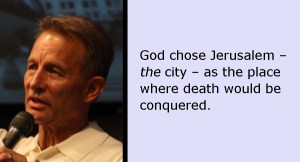
Jerusalem – The city. The city that is the center of the earth. The city central to God’s grand plan. On one dark Friday it is again the center of death. This death is the death of all deaths. Three days later death is conquered in a city, the city.
Could it be with all the devastation Satan has hurled at humanity in cities and through cities, that God chooses the city purposefully as the place where death will be conquered?
“O death, where is your sting, O grave where is your victory?” (1 Corinthians 15:55) The sting of death is sin and the power of sin is the law, but thanks
be to God who gives us the victory through our Lord, Jesus Christ.
Rosa,* new to our Grow Group, sat in stunned silence as Richard talked. Which, if you knew Rosa, was an awfully rare occasion. There had been a knock as our group assembled. The door was flung open. Richard entered the tiny living room seemingly filling it. Rosa told me later, “I recognized him right away! I don’t know if he recognized me, so I just introduced myself.
“Pastor, Pastor, he’s the guy who told my son that he was going to kill him!”
“When was this?” I asked.
“Over 15 years ago. Right out in front of church!”
It seems Rosa’s then-teenage son had some kind of run-in with Richard. Rosa had literally feared for her son’s life, taking precautions to avoid the big guy that ran the hood.
Not having seen him for years, she had the spiritually jolting, emotionally shocking experience of sitting that night studying the Word of God with the very man, now her brother in Christ, who had threatened the life of her son. And doesn’t God often take it up one more notch? Rosa’s son now works at the hospital because Richard helped him get the job!
Jesus is the death of death in the city.
Charles Lyons has pastored Armitage Baptist Church in Chicago since 1974. This column first appeared in the Baptist Bible Tribune.
“It is finished!”
Read John 19:30, Hebrews 1:1-3
When its payment is completed, a bill is customarily stamped “paid in full.” No more payment is expected. The cancelled paperwork is proof that the debt is no longer held against the debtor. In New Testament times, the word written across the final invoice was tetelestai. This Greek word means “it is finished.”
Tetelestai (pronounced “tuh-TELL-uh-sty”) appears only twice in Scripture, in John 19:28 and 19:30. In the first verse, “Scripture” is described as tetelestai. Often translated as fulfilled or completed, it is finished. Jesus did everything the prophets said he would do. He left no job undone, no stone unturned.
 Only two verses later in John’s account, Jesus himself declares his mission accomplished. After six hours on the cross, painfully pulling his body up to swallow every breath, it is almost impossible for Jesus to seize enough air to shout this news.
But he does. And everyone is stunned.
Tetelestai!
PRAY Lord, I am amazed by all you did to save me. Thank you for completing my redemption. Your work is finished, and I am paid for in full.
 COMMENTARY | Meredith Flynn
Watching actors portray Jesus on film is a little like Goldilocks trying out chairs at the three bears’ house. This Jesus is too small (“Jesus Christ Superstar”). This one is too passive (“Son of God”). Or just too weird (“Godspell”).
Even when Jesus resembles the one you met in Sunday school, like in the 1965 epic “The Greatest Story Ever Told,” you still find yourself looking for the inconsistencies that prove this Jesus isn’t as satisfying as the one in the Bible.
And when his suffering is gut-wrenchingly authentic (“The Passion of the Christ”), you want to see this Jesus during the rest of his life, and not just the last few hours.
Movies can’t capture him, and they’re not the best way to connect with him. But there’s still a reason to watch. Jesus on film may be undersized compared to the real-life version, but the other humans in the movies are caught in brilliant living color.
Judas, Nicodemus, Barabbas and the others are fully life-sized, and watching them interact with the film version of Jesus is downright convicting.
See the shades of jealousy you’ve never noticed in the “Greatest Story” Judas, and his belief that he was actually doing what was right for his people. Or listen to him wail in “Superstar,” narrating the whole story in what he believes is the voice of reason.
Watch Nicodemus in “Son of God” draw close and then pull away, again and again, as he’s torn between this new gospel and what he’s always known.
Simon of Cyrene comes to life in “The Passion,” starting off skeptical and reluctant to help Jesus carry his cross, but defending him at the end of their long march. In the same movie, Mary Magdalene can’t turn away from the gruesome crucifixion scene, her current reality mixing with memories of how Jesus rescued her from the Pharisees.
Even in “Godspell,” the loopy 1975 musical, we watch the disciples have their world turned upside down as Jesus teaches them things that are the opposite of the status quo.
The filmmakers created some of the dialogue to fill in places Scripture doesn’t describe in detail, so we don’t know exactly what was said or felt. But Judas’ jealousy and Mary’s neediness and Nicodemus’ doubts are relatable all the same because we’ve been in their shoes.
There’s a young church in San Diego called Barabbas Road. The founding pastor picked the name because all redeemed Christians have walked Barabbas’ path, he said. In fact, one of their early promotional videos featured different church members each proclaiming, “I am Barabbas.”
These Jesus movies elicit the same reaction: I am Barabbas. I am Nicodemus. You are Peter. You are Simon of Cyrene. Watching Jesus interact with vividly human people like us is the most moving thing about all these motion pictures.
And as a bonus feature, these abridged versions of Jesus will drive many viewers back to Scripture for the full story.
Meredith Flynn is managing editor of the Illinois Baptist.
“I thirst.”
Read John 19:28-29, Psalm 69:21,
Zechariah 12:10
Several times the Gospel writers say the events of the crucifixion happened to fulfill Scripture. Jesus sipped the sour wine. His bones were not broken, which would have sped up the dying process. His side was sliced open, and the water separated from the blood that spilled out showed he had died. Why was it necessary to fulfill the Scriptures?
Doubters might say that Jesus, sweet but deluded, had sacrificed himself unnecessarily. They might say there was no divine plan from before creation to redeem humanity from sin and death. They might say it was all miserable happenstance, a bad turn of events.
 But as the pivotal point in all history, the crucifixion was no accident. And to prove it, the Author of the plan had it written down hundreds, even more than 1,000 years before it happened. Bible scholars point to over 300 Old Testament prophecies of the birth, life, death, and resurrection of the Messiah.
And for it all to be proven true for those of us who stand on the A.D. side of time, Scripture was fulfilled. Down to the last sop of vinegar. Down to the last spear point.
PRAY Lord, thank you for the details of the crucifixion proving Jesus’ humanity, the reality of his death, and your divine plan over it all.


 iB2 News