Archives For June 30, 2013

pull quote_MOORECOMMENTARY | Russell Moore, from Baptist Press

With the Supreme Court’s gay marriage decisions all over the news, some Christian parents wonder how they ought to explain all of this to their small children. I’ve faced the same question as my children have asked, “What is the Supreme Court doing that’s keeping you so busy?” So how does one teach the controversy, without exposing one’s children to more than they can handle?

First of all, you should, I think, talk to your children about this. No matter how you shelter your family, keeping your children from knowing about the contested questions about marriage would take a “Truman Show”-level choreography of their lives. That’s not realistic, nor is it particularly Christian.

The Bible isn’t nearly as antiseptic as Christians sometimes pretend to be, and it certainly doesn’t shrink back from addressing all the complexities of human life. If we are discipling our children, let’s apply the Scriptures to all of life. If we refuse to talk to our children about some issue that is clearly before them, our children will assume we are unequipped to speak to it, and they’ll eventually search out a worldview that will.

This doesn’t mean that we rattle our children with information they aren’t developmentally ready to process. We already know how to navigate that; we talk, for instance, about marriage itself, and we give age-appropriate answers to the “Where do babies come from?” query. The same is true here. There is no need to inform small children about all the sexual possibilities in graphic detail in order to get across that Jesus calls us to live as husbands and wives with fidelity and permanence and complementarity.

Some parents believe that teaching their children the controversies about same-sex marriage will promote homosexuality. Christians and non-Christians can agree that sexual orientation doesn’t work that way. Moreover, the exact opposite is true. If you don’t teach your children about a Christian way of viewing the challenges to a Christian sexual ethic, the ambient culture will fill in your silence with answers of its own.

You can tell your children that people in American culture disagree about what marriage is. You can explain to them what the Bible teaches, from Genesis to Jesus to the apostles, about a man and a woman becoming one flesh. You can explain that as Christians we believe this marital relationship is different than other relationships we have. You can then tell them that some people have relationships they want to be seen as marriages, and that the Supreme Court is addressing that.

You can then explain that you love your neighbors who disagree with you on this. You agree that they ought to be free from mistreatment or harassment. But the church believes government can’t define or redefine marriage, but can only recognize what God created and placed in creation. Explain why you think mothers and fathers are different, and why those differences are good. Find examples in your own family of how those differences work together for the common good of the household, and point to examples in Scripture of the same.

Don’t ridicule or express hostility toward those who disagree. You might have gay or lesbian family members; be sure to express your love for them to your children, even as you say that you disagree about God’s design for marriage. You probably have already had to do that with family members or friends who are divorced or cohabiting or some other situation that falls short of a Christian sexual ethic. If your children see outrage in you, rather than a measured and Christlike biblical conviction, they eventually will classify your convictions here in the same category as your clueless opinions about “kids these days and their loud music.”

The issues at stake are more important than that. Marriage isn’t ultimately about living arrangements or political structures, but about the Gospel. When your children ask about the Supreme Court, be loving, winsome, honest, convictional and kind.

Russell Moore is president of the Southern Baptist Ethics and Religious Liberty Commission. This column first appeared on russellmoore.com.

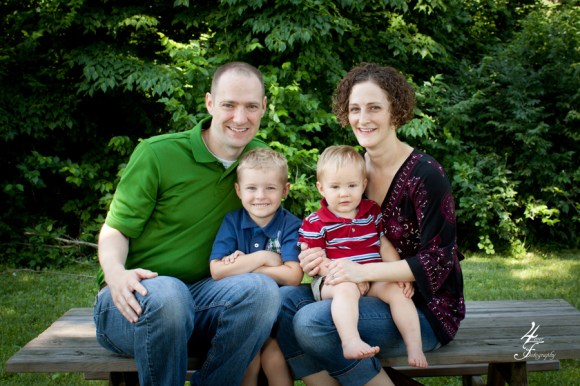
While Tom Goble is on a six-month deployment with the U.S. Air Force, his wife, Jackie, and sons, Jacob and Evan, are buoyed by the support of Towerview Baptist Church in Shiloh.

While Tom Goble is on a six-month deployment with the U.S. Air Force, his wife, Jackie, and sons, Jacob and Evan, are buoyed by the support of Towerview Baptist Church in Shiloh.

THE BRIEFING | Meredith Flynn

Shiloh | By the time Jackie Goble’s husband, Tom, returns from a deployment in Africa, the couple’s one-year-old son will probably be able to string a few words together and have a little conversation with his dad.

Evan had already started walking and saying “Dad” when Tom, a captain in the U.S. Air Force, left in June. That first week, Jackie says Evan would toddle into their bedroom calling for his dad. But it will be almost six months until they’re reunited, and it’s up to Jackie to hold down the fort for Evan and his older brother Jacob until then.

“Dad’s gone and we’re trying to rely on God, and point to God,” she says, recounting how she encourages her boys, and herself. “God’s taking care of us, God’s taking care of Dad. When we’re sad and we miss him, we just need to turn to God and pray and ask for protection for both us and Daddy.”

It’s a heavy load, one shared by many military families in Illinois and around the country. The Gobles have found support, though, at Towerview Baptist Church, a church uniquely located to serve their family and many others going through a deployment or navigating the specific challenges of being a military family. Read more in the newest edition of the Illinois Baptist, online here.

Other news:

Disaster Relief volunteers serve during memorial service for Arizona firefighters
The spring and summer months have been busy for Southern Baptist Disaster Relief volunteers working across the country, from storm cleanup in Illinois, Oklahoma and Texas, to wildfire recovery in Colorado, and now caring for people in Prescott, Arizona, after the deaths of 19 firefighters last week. Disaster Relief chaplains in the state were called out to minister in Prescott last week, and a new message on the Arizona Disaster Relief website asks for trained volunteers to help serve during a memorial service today. Read more Disaster Relief updates at NAMB.net/DR.


Believers in Egypt look for opportunities to share hope
Christian workers in Egypt say political unrest in the country is an opportunity to share the hope of Jesus, reports the International Mission Board. “It’s not just riots and chaos, this is opportunity,” says one worker. “For the first time in hundreds of years people are questioning everything. This is the greatest opportunity we have had in a long time in a city that is promised to the Lord.” Read the full story here.

Survey: On Twitter, Christians are happier
A new study from the University of Illinois compares the Tweets of people who follow five religious leaders (Pope Benedict XVI, Joel Osteen, Rick Warren, Dinesh D’Souza and Joyce Meyer), with the messages posted by Twitter users who follow five atheist leaders. The results, CNN reports, indicate Christians use more positive words and express more happiness through the social media tool. Read more on CNN’s Belief blog.

pull quote_ADAMS_julyHEARTLAND | Nate Adams

One of the ways my wife, Beth, and I celebrated our anniversary this year was to watch the video of our wedding ceremony and reception. It’s been a few years since we’ve done that, and I found myself a little surprised by some of the things I saw and heard, and how they made me feel.

I was ready to see a bride and groom that looked very young, but I was taken back a little at the site of our parents. For example my dad, on my wedding day, was exactly the age I am now after 28 years of marriage.

Having recently performed my own son’s wedding ceremony, there was something about seeing my dad perform my wedding ceremony when he was my age that was a little unnerving. Has a generation passed already? Will the next generation pass that quickly?

During that nostalgic viewing, however, I found great encouragement in the music we chose for our wedding ceremony. Some of it was just fun, such as the piano recessional that was the Charlie Brown theme song from the Peanuts cartoon series. Some of it was serious and prayerful, such as the hymn that truly expressed the desire of our hearts, “Savior Like a Shepherd Lead Us.”

But there were two more contemporary duets that spoke freshly to me as we watched ourselves getting married a generation later, and wondered at how quickly time passes. Just after our vows to one another, we heard this musical encouragement for lasting fidelity from the Farrell and Farrell song, “After All Those Years.”

“After all those years, when our children have said goodbye, after all those years I’ll love you even more.”*

I first heard Farrell and Farrell sing that song at an IBSA-sponsored Youth Encounter in Springfield, Illinois. Its message stuck with me, as I knew even then that I wanted to marry someone who I would adore, even after the kids were grown and gone. We’re almost there now. And I do.

But there was another duet, “The Wedding Day” by Harvest, that also reassured me, and helped me reset my perspective on weddings, and generations, and how quickly time passes. It pointed to the Wedding Day that is much more important than any here on earth.

“We will fly away, when He hears His Father say, ‘Jesus, go and get your bride. Today’s your wedding day.’”**

I think I understand more fully now why music is so important in our worship. We the Church are indeed the bride of Christ, waiting with longing for our Bridegroom to come and make our relationship complete. On one hand, it seems we’ve been waiting a long time. But when we live by faith with the one we’ve chosen to adore, the years and the generations fly by quickly. And that’s okay.

The music of a Christian marriage can give us a wonderful picture and promise of love and fidelity that lasts, both in a marriage and in a relationship with God. Many of us are fortunate to have been blessed by that kind of marriage for years, even generations.  And all of us in the Bride of Christ, His church, are blessed by it from now through eternity.

Nate Adams is executive director of the Illinois Baptist State Association.

* “After All Those Years,” by Tim Sheppard, ©1982, Tim Sheppard Music Company
** “The Wedding Day,” by Brent Lamb, ©1981, Straightway Music

pull quote_FLYNNCOMMENTARY | Meredith Flynn

There were many empty seats in Houston’s convention center right before the official beginning of the Southern Baptist Convention’s annual business meeting last month.

Granted, it was early – SBC President Fred Luter banged the opening gavel at 8:10 a.m. And it was a poorly attended meeting, with the lowest number of registered messengers in a Bible belt city since 1944.

But seven or eight rows from the front of the convention hall were two familiar Illinois faces: Jack and Wilma Booth.

The couple, members of Calvary Baptist in Elgin, were two of 95 reported Illinois messengers at this year’s convention. Wilma is currently on the SBC Executive Committee, and Jack is a member of IBSA’s Board of Directors. In Houston, they were a reminder that “being there” is valuable, even in a year without contested elections or decisions.

Not that there weren’t some crowded meeting rooms in Houston. A North American Mission Board luncheon focused on church planting hosted a reported 3,500 people. And younger leaders crowded into after-hours sessions hosted by 9Marks, a para-church organization based in Washington, D.C.

In fact, the Houston meeting may well be remembered as “the denim convention,” for the tendency of younger convention-goers to dress casually…and to be there. More than any year in recent memory, the SBC annual meeting seemed to actually skew younger.

The next generation of Baptist leaders is something to be excited about. They appreciate the previous generation that fought to return the SBC to its doctrinal roots. They’re concerned about delivering biblical truth in love. They understand new churches are an evangelistic force to be reckoned with. They crave face-to-face, genuine, redemptive relationships.

But they could also learn something from Jack and Wilma Booth, because “being there” will be more and more important as Southern Baptists carve out their identity in a changing world. And not just at youth-oriented meetings, but in the convention hall too, even at 8 a.m.

Southern Seminary President Al Mohler said as much at a 9Marks gathering in Houston, when he talked about how some cities draw a bigger convention crowd because families have the opportunity to vacation in the area. “I’m not saying that’s even bad stewardship…What’s bad stewardship denominationally, is to not show up when it appears less interesting to you.”

As the denomination looks toward its 2014 meeting in Baltimore, the influence of younger leaders will be interesting to watch. They’ll help elect a new president, and take on leadership roles themselves. But to do those things, they’ll need to be there.

Phil_MigliorattiCOMMENTARY | Phil Miglioratti

We’ve entered the dog-days of summer, this often oppressive and sweltering time of year that coincides with traditional summer slumps in church attendance as families scatter for summer vacations and other summertime activities.

But our need for prayer is never greater. Here are five suggestions to make your dog days of summer sparkle with spiritual freshness:

1. Family table time. Ask each church family to use at least one family meal each week to pray for their neighbors, whether those who live nearby, people they work with or fellow students. Keep a log of the names and needs of those the Lord leads toward in prayer. During a Sunday morning service in August, ask families to come prepared to share their prayers and God’s responses.

2. Schedule a church picnic. Before the festivities begin, ask every family to form a circle and to pray (facing inward) for the church, its spiritual health, its ministry vision and its evangelistic effectiveness. Reverse positions to face outward and pray for the community, its needs, its leaders and the church’s influence on it.

3. Weeknight prayer meeting. Take the midweek prayer service outside. Those who cannot handle the walk or the heat may stay inside and pray using this as a template. Ask everyone to pray with their eyes open, looking at and praying for:

  • God’s good creation
  • The church facilities
  • Residential areas, schools, recreational, medical or business districts to the north, to the east, to the south and to the west

4. Secret saint. Ask everyone in the congregation to become a secret intercessor. Prepare cards with the names of your church family for distribution on a Sunday morning – perhaps a reverse offering where everyone picks a name as a basket is passed. Ask the church family, including youth and older children, to pray each day for a week for the person whose name they drew. The following Sunday simply ask for testimonies of what it was like to pray once a day for their person or if anyone sensed a special blessing from the Lord because someone was praying for them.

5. Pastoral prayer. Recruit volunteers to pray aloud for the pastor each Sunday during the summer. Encourage them to pray from their deepest passion.

So, rather than succumb to the slow-down, casual atmosphere of summer, put those dog-days to good use. Prayer – encourage every member and family to invite the Holy Spirit to alert them every day to special summertime opportunities to pray for people they may only see in July or August. Care – show the love of Christ to them through practical and appreciated acts of service or mercy. Share – invite them to investigate the often misunderstood message of the Gospel. Let’s love our communities to Christ!

Phil Miglioratti is IBSA’s Prayer Ministries consultant. This column is from Baptist Press. Read more from Phil in the current issue of Resource online here.

Marriage_mapTHE BRIEFING | Illinois Baptist staff

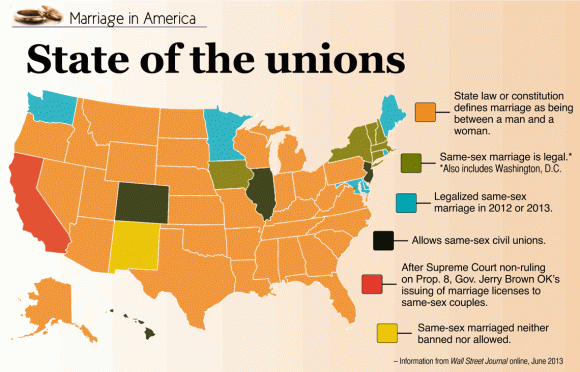
While bells were ringing at the National Cathedral in Washington, D.C., celebrating the U.S. Supreme Court decisions advancing same sex marriage, Christians elsewhere were lamenting the actions. And in Illinois, people on both sides of the issue were considering the impact of the high court’s rulings on the push to legalize same-sex marriage in our state.

The Court ruled against the federal Defense of Marriage Act, effectively giving married same-sex couples financial benefits previously reserved for heterosexual couples. And the justices’ non-action on California’s Proposition 8 allows a lower court’s ruling against it to stand, meaning same-sex marriages could begin in the state very soon. Same-sex marriage is now legal in 13 states and the District of Columbia.

The rulings do not change the law in Illinois. But favorable response from the Court does signal renewed momentum in efforts to pass SB10, the state’s gay marriage bill, proponents say.

And those defending traditional marriage are taking the court’s actions as a call to redouble their efforts to stop same-sex marriage in Illinois.

“The ruling doesn’t change what’s required of us,” said Ron Knox, pastor of FBC Royalton, Ill. “We must stand for the truth and proclaim the truth. That’s what we’re called to do.”

A shift in momentum?

The Court’s rulings energized supporters of same-sex marriage in Illinois, who are still waiting for SB10 to be called for a vote in the State House.

“Today the Supreme Court took a historic step by providing equal access to more than 1,100 federal rights and benefits for same-sex couples,” Gov. Pat Quinn said in a statement immediately after the court’s announcement. “Members of the Illinois House now have more than 1,100 new reasons to make marriage equality the law in Illinois.”

Sen. Heather Steans (D-Chicago), the chief sponsor of SB10 in the Illinois Senate, also urged the Illinois House to pass SB10. “The time is right for Illinois to join the 13 other states (counting California) with equal marriage. When the Religious Freedom and Marriage Fairness Act becomes law, the legal rights and responsibilities associated with marriage under both state and federal law will apply to committed, same-sex Illinois couples. … Now it’s time for Illinois to take a stand for fairness.”

But even with the momentum, some opponents of same-sex marriage don’t believe the House will take up again as early as they could, during a special session called by Quinn to handle the state’s pension crisis. It is more likely the House would revisit the bill during the fall veto session, which begins Oct. 22. And because the bill wasn’t passed during the regular spring session, it would need a 3/5 majority, or 71 votes, to make it to Quinn’s desk this fall.

The African-American Clergy Coalition based in Chicago, a major force in slowing SB10’s momentum, showed no signs of giving up after the Supreme Court’s ruling. “The people of Illinois…still have the right to determine if gay marriage should become law…” the group said in a statement.

Marriage defenders continue to put their trust in God regarding SB10. “The victory we had in the spring was because churches prayed for God’s mercy and stood up and spoke out,” said David Smith, executive director of the Illinois Family Institute. “We need to continue to be diligent in praying for and speaking to our elected officials.”

Some have expressed discouragement after the ruling. Smith understands, “It’s easy to get discouraged by the Supreme Court’s ruling. We need to double our resolve and stand on faith. Churches need to teach why God designed the institution of marriage. It’s vitally important we stand by it.

David Howard, Capitol City Association director of missions, also remains hopeful. “There’s no question Jesus came to seek and save that which was lost and we need to that as well. We need to be salt to continue to preserve what is good, and light to illuminate what is bad. The light will overcome the darkness. Ultimately we will win.”

Reported by Lisa Sergent. Read more in the July 8 issue of the Illinois Baptist, online this Friday at ibonline.ibsa.org.

Other news:

Gay marriage support makes headlines
Leading up to the Supreme Court’s anticipated rulings on marriage, Pew Research found the majority of media coverage focused on support for same-sex marriage. Between March 18 and May 12, 47% of news stories focused on pro-same-sex marriage views, while 9% emphasized the opposite view. Pew found 44% of news stories were mixed or neutral. Read more at Pew’s website.

Producers plan The Bible, part 2
The team behind this spring’s “The Bible” miniseries have signed on to produce a sequel that will focus on what happened after Christ’s death. Spouses Mark Burnett and Roma Downey will produce the series, which has the working title “AD: Beyond the Bible,” for NBC. The network’s chairman of entertainment, Bob Greenblatt, said in a statement that after following the development of the original miniseries, he “knew that the story was far from over after Christ’s crucifixion. In fact, what happened in the aftermath – which is essentially the beginning of Christianity – is utterly fascinating.” Read the full Associated Press story at Yahoo.com.

Ministers bring peace to trial
A ministerial alliance in Sanford, Fla., is tackling the challenge of keeping peace in their community in the midst of a controversial court case, CNN reports. “Sanford Pastors Connecting” rotates religious leaders in and out of the courtroom during the trial of George Zimmerman, charged with the murder of teenager Trayvon Martin.  The pastors have a “ministry of presence” in the courtroom, and are charged with reporting developments to the crowds outside and to their congregations.

“Regardless of what the verdict is, we can avoid the violence,” Rev. Robert K. Gregory Jr., of the Good News Jail & Prison Ministry in Sanford, told CNN. “If we work together, trust can be built.” Read more at CNN’s Belief blog. 

Wallenda prays during long walk
Viewers tuning in to watch Nik Wallenda’s death-defying tightrope walk across a gorge near the Grand Canyon likely heard him praying aloud throughout much of the stunt. Before the walk, Wallenda told The Christian Post he often prays while on the wire. “I find that peaceful and relaxing and He’s the only one up there listening to me.” Read more at The Christian Post.

tableHEARTLAND | Erich Bridges, from Baptist Press

We hauled the old kitchen table out to the curb the other day.

My wife found another table she liked at a yard sale. The old one was battered and beat up, so it had to go. We called a charity group to pick it up. I was in a hurry to go somewhere. My wife had errands to run, too. So we left it there. No moment of silence. No fond farewell. When we came home that afternoon, it was gone.

I felt a pang of sadness when I thought about it later. That old table deserved a better send-off than we gave it.

It wasn’t an antique or a fine work of craftsmanship, just a pine table from a low-end furniture store. But it was the center of our home for nearly 30 years. It’s where we got to know each other, where we talked, argued and made up. The first time our infant son laughed out loud, he was watching an empty pop bottle roll across the tabletop (he thought that was hilarious for some reason). The kids spent countless hours wriggling around underneath it as toddlers — and countless hours doing school projects atop it. My parents, both gone now, rocked their grandchildren to sleep beside it.

How many meals did we eat together around that table? How many prayers did we pray?

“Things don’t matter; people do,” was the motto of Martha Myers, the late, great missionary physician who spent her life — and ultimately gave it — serving the people of Yemen. For her, things had significance only if they could be used to help the needy. She had little interest in personal possessions for their own sake.

Martha was right. Things don’t matter. But things do have meaning, if we use them for people. That’s the difference between selfishly accumulating stuff and blessing others with it.

A missionary in Africa broke one of his sandals recently. What to do? “I did what I have always done,” he wrote. “I went to what I considered a nice store, sought out a pair of sandals that I thought would be serviceable and purchased them for $24. An astronomical price for the Africans, I am sure. But I am an American. When things break we don’t fix them; we throw them away. My new sandals broke two days later. I asked a local friend what he would do.

“‘Fix them,’ he replied. Apparently there are men all over town who repair shoes for a living. He took my old sandals home. The next morning he brought them back, having sewn the sole of my favorite sandal to the upper part. Amazing! They still work. They feel great. Cost: $1. I had them fix my new sandals as well for the same price.”

The missionary also brought a new soccer ball with him from America, but it wouldn’t hold air.

“I went and bought another ball. The Africans with whom I was playing asked if they could have my broken ball. ‘Why?’ I asked.

“‘Because we can sell it,’ they replied. They were able to get $4 for it. Apparently one of the boys from the area took some glue and inserted it into the hole and plugged the leak. Who knows how long it will stay inflated, but some kid and I are each $2 richer!

“What have I learned? God is teaching me how to be a better steward of what He has given me. Can what I am about to throw away be repaired or used again in some other way? In America, when something breaks, you replace it. In Africa, we are learning to see things differently — and even find the value in something that looks ‘broken.'”

I wish I had done that with our good old kitchen table.

Erich Bridges is an International Mission Board global correspondent.