


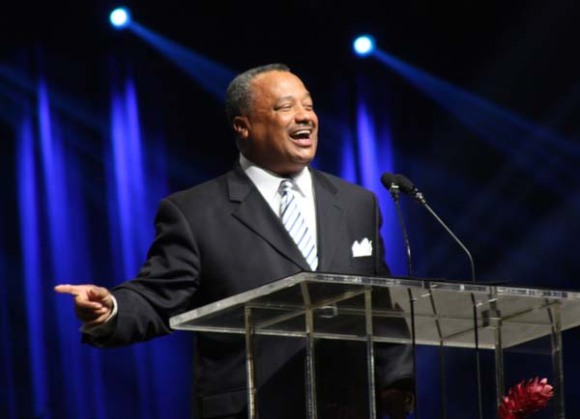
Pastor Fred Luter balances serious subjects with joyful repartee while preaching at the Pastors’ Conference on the eve of his election as SBC President.
Posted by Eric Reed
A newspaper profile of Fred Luter pointed out the ways he will be a new face for Southern Baptists. Beyond race, Luter will bring a smile as the chief representative of the denomination, something that is lacking in our history of leadership by serious, white middle-age pastors, the report said.
Not that Luter isn’t serious. He is very serious about the traditional values of Southern Baptists, both theologically and culturally. His sermon that closed the Pastors Conference on the eve of his election as theconvention’s first African American president was a fiery litany of the ills of times—broken homes, crime, racism, abortion, homosexual lifestyles—and the hope, the only hope we have in the gospel of Jesus Christ. But this energetic dance of oratory was punctuated by self-effacing confessions of personal sin and redemption, and joyous grins attesting the effects of Christ in his life.
Fred Luter is serious about the joy of his salvation.
“I love to laugh,” he told the reporter. “I love to have a good time.” And those who hear Pastor Luter preach know it’s true. “If anybody has joy, if anybody has peace and happiness, it should be us,” he said.
If the perception persists that “Baptists don’t have any fun, that we don’t laugh—we don’t have any joy, I would love to change that perception,” Luter said.
Luter is equally serious about making the fuller ethnic representation a fact of life in all areas of Southern Baptist life.
“If we stop appointing African Americans or Asians or Hispanics to leadership roles in this convention after my term is over, we failed. We absolutely failed,” Luter said at a news conference after his historic election.
Luter summarized his election as “a genuine, authentic move by this convention that says our doors are open, and the only way they can see that is not just putting up an African American president, but seeing other ethnic groups inother areas of this convention. Time will tell and I’ll be a cheerleader promoting that.”
Luter and others described his election, at a national convention held in his own hometown of New Orleans, as providential. After a lengthy season of prayer, Luter and his wife agreed to put his name forward as a candidate in January. No other candidates emerged, and Luter was elected unopposed on the first day of the annual meeting.
Messengers stood and applauded for several moments as the convention’s vote was cast for the lone candidate, cheering and whooping and waving their ballots in the air. Some wept at the election of the African American pastor, seen by many as a fitting sign of repentance of the denomination’s birth in a time of slavery.
“There will be some pitfalls,” Luter said of his service as SBC president, “but I hope I will learn from them and study more on things I anticipate being asked.” Already Luter has faced the national media, answering questions about the role of race in the mostly white denomination. Luter said he hopes to be known as a man of God who “loves being part of this convention.”
And he smiles when he says it.






 iB2 News